
🎯 Recommended Products for Students & Parents
Handpicked products specially selected for our visitors.

School Backpack Combo
✔ 29 L Spacious Backpack
✔ Includes Tiffin & Pouch
✔ Perfect for School & Coaching

Niacinamide Bright & Clear Skin Combo
✔ Brightens Skin
✔ Reduces Acne Marks
✔ Suitable for Daily Skincare
Disclosure: Some links on this page are affiliate links. We may earn a small commission if you purchase through them, at no additional cost to you.
Have you ever noticed an old iron gate turning reddish-brown or a silver coin losing its shine over time? These common changes happen because metals react with their surroundings through chemical processes known as corrosion and rusting.
Although these terms are often used interchangeably, they do not mean the same thing. Understanding the corrosion vs rusting difference is essential for school science, competitive exams, and everyday life.
In this article, you’ll learn:
Table of Contents
What is Corrosion?
Corrosion is the gradual deterioration of a metal caused by chemical reactions with its environment. When metals come into contact with oxygen, moisture, acids, salts, or other chemicals, they slowly react to form more stable compounds such as oxides, sulfides, or carbonates.
Corrosion can occur in many different metals, including:
- Iron
- Copper
- Aluminium
- Silver
- Zinc
Since different metals react differently, corrosion can appear in several forms depending on the metal and the surrounding environment.
The Chemistry Behind Corrosion
Corrosion is an oxidation reaction, which means the metal loses electrons while reacting with substances in its surroundings.
Some common examples include:
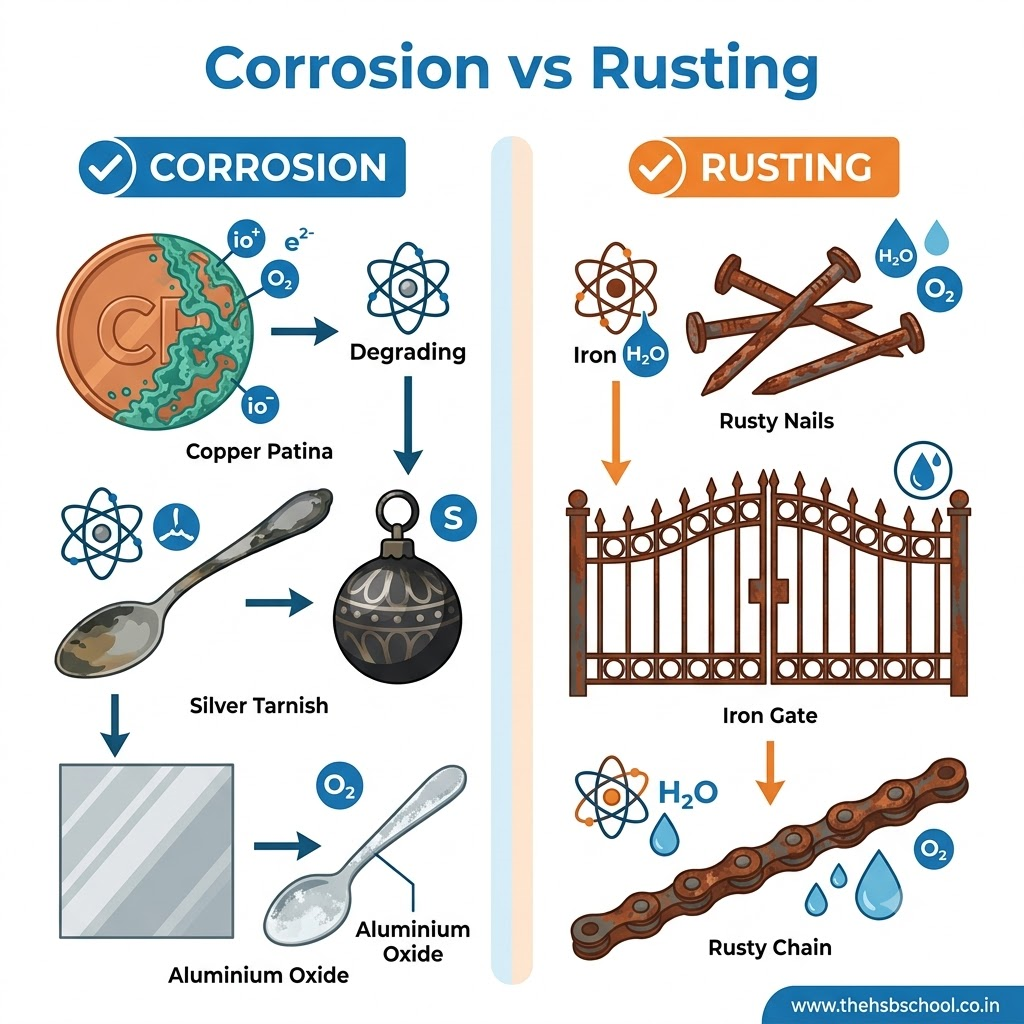
- Silver reacts with sulfur compounds in the air to form silver sulfide, causing the surface to turn black.
- Aluminium reacts with oxygen to form a thin layer of aluminium oxide (Al₂O₃) that protects the metal underneath.
- Copper reacts with oxygen, moisture, and carbon dioxide to develop a green protective coating called patina.
What is Rusting?
Rusting is a specific type of corrosion that occurs only in iron and steel.
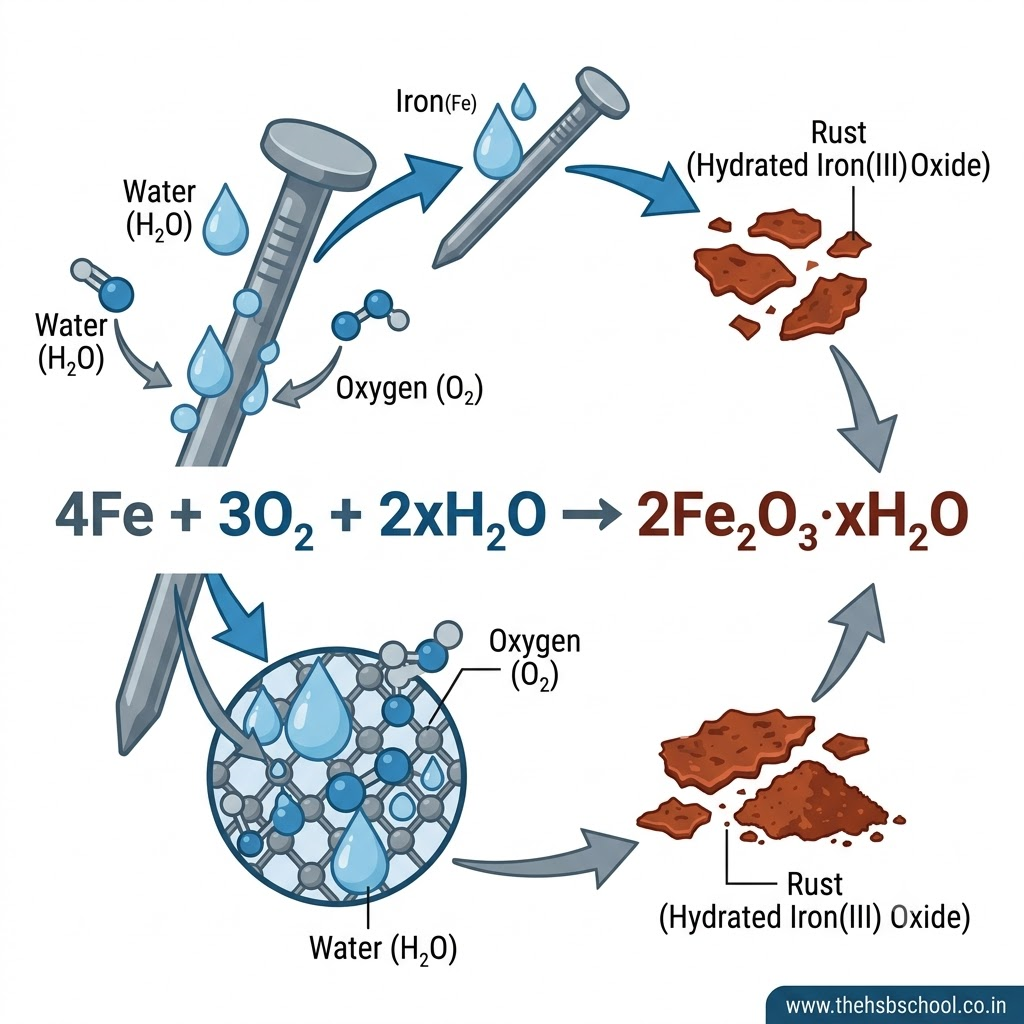
When iron is exposed to both oxygen and water (or moisture), it undergoes a chemical reaction that produces rust, a reddish-brown flaky substance.
Unlike many other corrosion products, rust does not protect the metal. Instead, it keeps exposing fresh iron to air and moisture, allowing the damage to continue.
The Chemistry of Rusting
Rust is chemically known as hydrated iron(III) oxide.
The simplified chemical equation for rust formation is:
4Fe + 3O₂ + xH₂O = Fe₂O₃·xH₂O
Understanding the Equation
- Fe = Iron
- O₂ = Oxygen from the atmosphere
- H₂O = Water or moisture
- Fe₂O₃·xH₂O = Hydrated iron(III) oxide (Rust)
The variable x indicates that rust contains different amounts of water depending on environmental conditions.
Real-Life Examples of Corrosion and Rusting
1. Copper Patina (Corrosion)
One of the best-known examples of corrosion is the green color of the Statue of Liberty.
Copper reacts with oxygen, carbon dioxide, and moisture to produce basic copper carbonate, commonly called patina.
Interestingly, this green coating protects the copper beneath it from further corrosion.
2. Rusty Bicycle Chain (Rusting)
A bicycle chain left outdoors often develops rust.
Unlike patina, rust is porous and flaky. It absorbs moisture and allows oxygen to reach deeper layers of iron, causing continuous corrosion until the metal becomes weak and brittle.
Corrosion vs Rusting difference: Comparison Table
| Feature | Corrosion | Rusting |
|---|---|---|
| Definition | General deterioration of metals due to chemical reactions | A specific type of corrosion affecting iron and steel |
| Metals Affected | Most metals | Only iron and steel |
| Main Cause | Oxygen, moisture, acids, salts, or chemicals | Oxygen and moisture |
| Product Formed | Oxides, sulfides, carbonates, etc. | Hydrated iron(III) oxide (Rust) |
| Appearance | Green, black, white, grey, or dull | Reddish-brown |
| Protective Layer | Sometimes protective (e.g., aluminium oxide, patina) | Not protective |
| Scope | Broad process | Specific form of corrosion |
Key Corrosion vs Rusting Difference
The easiest way to remember the corrosion vs rusting difference is:
- Corrosion is the general process in which metals deteriorate due to chemical reactions.
- Rusting is only the corrosion of iron and steel.
In simple words:
Every rusting process is corrosion, but not every corrosion process is rusting.
Why is Rusting So Dangerous?
Rust weakens iron and steel, making structures unsafe over time.
Some common problems caused by rust include:
- Weak bridges and buildings
- Damaged vehicles
- Leaking water pipelines
- Corroded ship hulls
- Broken industrial machinery
- Reduced lifespan of tools and equipment
Every year, corrosion causes billions of rupees in repair and maintenance costs worldwide.
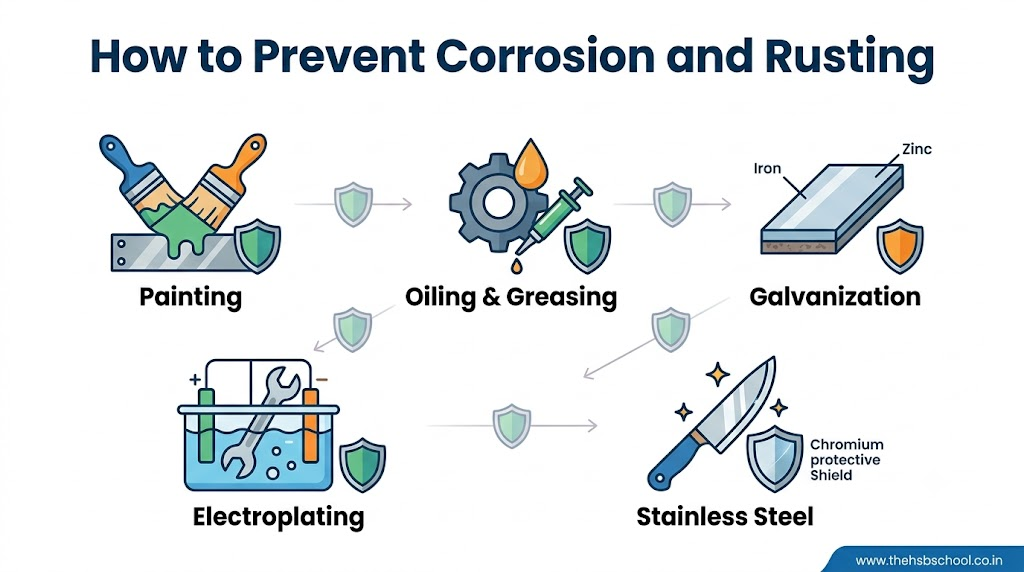
How to Prevent Corrosion and Rusting
Several techniques are used to protect metals from damage.
1. Painting
A coat of paint prevents oxygen and moisture from reaching the metal surface.
2. Oiling and Greasing
Machinery and moving parts are coated with oil or grease to repel water.
3. Galvanization
Iron is coated with zinc. Since zinc corrodes more readily than iron, it protects the underlying metal.
4. Electroplating
A thin layer of chromium, nickel, or another corrosion-resistant metal is deposited onto the surface.
5. Alloying
Mixing metals creates stronger, corrosion-resistant materials.
For example, stainless steel contains chromium, which forms a protective oxide layer and prevents rust.
Easy Memory Trick
Remember this simple sentence:
All rusting is corrosion, but not all corrosion is rusting.
Think of Corrosion as a large family of chemical reactions, while Rusting is just one member of that family.
Frequently Asked Questions (FAQs)
Is rusting a type of corrosion?
Yes. Rusting is a specific type of corrosion that occurs only in iron and steel.
Can aluminium rust?
No. Aluminium does not rust because rust forms only on iron.
However, aluminium does corrode by forming a thin protective layer of aluminium oxide that prevents further damage.
Why does rust form faster near the sea?
Coastal air contains moisture and dissolved salt. Saltwater acts as an electrolyte, speeding up the electrochemical reactions responsible for rusting.
Is rusting a physical or chemical change?
Rusting is a chemical change because a completely new substance—hydrated iron(III) oxide—is formed. The process cannot be easily reversed.
Why doesn’t copper rust?
Copper does not rust because rust forms only on iron. Instead, copper undergoes corrosion and develops a green protective coating called patina.
Quick Revision
- Corrosion is the gradual deterioration of metals through chemical reactions.
- Rusting is a specific type of corrosion that affects only iron and steel.
- Rust is hydrated iron(III) oxide.
- Copper, aluminium, silver, and zinc corrode but do not rust.
- Rust weakens metals, while some corrosion products (like aluminium oxide and patina) protect the metal.
- Painting, galvanization, electroplating, oiling, and alloying help prevent corrosion.
Conclusion
Although corrosion and rusting are closely related, they are not identical. Corrosion is the broad process through which metals deteriorate due to chemical reactions, while rusting refers specifically to the corrosion of iron and steel.
Knowing the corrosion vs rusting differenceis important not only for science examinations but also for understanding how engineers protect bridges, vehicles, buildings, and machinery from damage.
The easiest way to remember the concept is:
Every rusting process is corrosion, but every corrosion process is not rusting.