
🎯 Recommended Products for Students & Parents
Handpicked products specially selected for our visitors.

School Backpack Combo
✔ 29 L Spacious Backpack
✔ Includes Tiffin & Pouch
✔ Perfect for School & Coaching

Niacinamide Bright & Clear Skin Combo
✔ Brightens Skin
✔ Reduces Acne Marks
✔ Suitable for Daily Skincare
Disclosure: Some links on this page are affiliate links. We may earn a small commission if you purchase through them, at no additional cost to you.
If you searched for parts of speech rules with examples PDF, you’re probably trying to do one of three things: pass an English grammar exam, teach grammar to students, or finally understand why “run” is sometimes a noun and sometimes a verb. This guide covers all eight parts of speech, gives you the exact rules that govern each one, walks through dozens of real examples, and ends with a printable summary table plus a short quiz you can use to test yourself right now.
Unlike a plain textbook page, this guide is built to be interactive — you’ll find quick-check questions after every section, a downloadable-style reference table, and real sentence breakdowns so the rules actually stick instead of just sitting on a page.
Parts of Speech Rules with Examples PDF
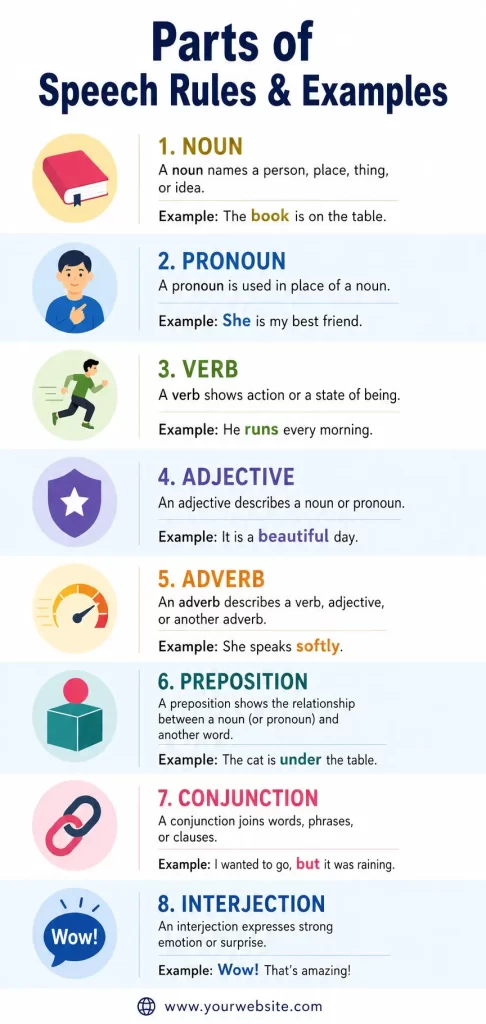
Parts of Speech Rules with Examples PDF
Table of Contents
What Are Parts of Speech?
Parts of Speech Rules with Examples PDF: Parts of speech are the categories every English word falls into, based on the job that word does inside a sentence. Grammarians count eight of them: noun, pronoun, verb, adjective, adverb, preposition, conjunction, and interjection. The same word can belong to different parts of speech depending on how it’s used — “light,” for example, can be a noun (turn on the light), a verb (light the candle), or an adjective (a light bag).
Learning the parts of speech rules with clear examples is the foundation of every other grammar skill: sentence structure, punctuation, tenses, and even spelling decisions depend on knowing what role a word is playing.
Parts of Speech Rules with Examples PDF:
The 8 Parts of Speech: Rules and Examples
1. Noun — Naming Words
Rule: A noun names a person, place, thing, idea, or quality. Nouns can be singular or plural, and they usually change form to show number and possession.
Types of nouns with examples:
| Type | Rule | Examples |
|---|---|---|
| Common noun | General name, not capitalized | dog, city, teacher |
| Proper noun | Specific name, always capitalized | Rahul, Mumbai, Google |
| Concrete noun | Something you can sense physically | table, rain, music |
| Abstract noun | An idea or quality, not physical | honesty, freedom, happiness |
| Countable noun | Can be counted, has a plural form | book/books, apple/apples |
| Uncountable noun | Cannot be counted, no plural form | water, information, advice |
| Collective noun | Names a group as one unit | team, family, herd |
Example sentence: The teacher gave the students a difficult assignment. (teacher, students, assignment — all nouns)
Quick check: Is “kindness” a concrete or abstract noun? (Answer: abstract — you can’t touch it.)
2. Pronoun — Replacement Words
Rule: A pronoun stands in for a noun so you don’t have to repeat it. The noun it replaces is called its antecedent, and the pronoun must agree with that antecedent in number and gender.
Types with examples:
- Personal pronouns: I, you, he, she, it, we, they
- Possessive pronouns: mine, yours, his, hers, ours, theirs
- Reflexive pronouns: myself, yourself, himself, themselves
- Demonstrative pronouns: this, that, these, those
- Relative pronouns: who, whom, whose, which, that
- Indefinite pronouns: someone, anyone, everybody, nothing
Example sentence: Priya forgot her umbrella, so she got wet. (“her” and “she” both refer back to Priya)
Common mistake: Mixing up “who” (subject) and “whom” (object). Who called you? / To whom did you give it?
3. Verb — Action and Being Words
Rule: A verb shows action or a state of being, and it must agree with its subject in number. Verbs also change form to show tense — past, present, or future.
Types with examples:
- Action verbs: run, write, think, build
- Linking verbs: am, is, are, was, seem, become
- Helping (auxiliary) verbs: have, do, will, can, should
Example sentence: She has been working on this project since morning. (“has been working” is a verb phrase showing present perfect continuous tense)
Rule to remember: Singular subjects take singular verbs, and plural subjects take plural verbs. He runs (singular). They run (plural).
4. Adjective — Describing Words
Rule: An adjective describes or modifies a noun or pronoun. It usually answers the question which one, what kind, or how many.
Types with examples:
- Descriptive: happy, tall, blue
- Quantitative: some, many, few
- Demonstrative: this, that, these, those
- Possessive: my, your, his, our
- Comparative: taller, smarter, faster
- Superlative: tallest, smartest, fastest
Example sentence: The bright red car raced past three slow trucks. (bright, red, three, slow — all adjectives)
Quick check: In “the tallest building,” is “tallest” comparative or superlative? (Answer: superlative — it compares more than two things.)
5. Adverb — Words That Modify Verbs, Adjectives, or Other Adverbs
Rule: An adverb describes a verb, adjective, or another adverb, but never a noun. It usually answers how, when, where, how often, or to what degree. Many (not all) adverbs end in -ly.
Types with examples:
- Manner: quickly, carefully, softly
- Time: now, soon, yesterday
- Place: here, there, outside
- Frequency: always, often, rarely
- Degree: very, almost, quite
Example sentence: She spoke very softly during the meeting. (“very” modifies “softly,” and “softly” modifies “spoke”)
6. Preposition — Words That Show Relationships
Rule: A preposition connects a noun or pronoun to another word in the sentence, usually showing location, time, or direction. A preposition is always followed by a noun, pronoun, or noun phrase, forming a prepositional phrase.
Common examples: in, on, at, under, between, before, after, with, without, during
Example sentence: The keys are under the mat, near the front door. (“under the mat” and “near the front door” are prepositional phrases)
Rule to remember: Never end a formal sentence with a preposition if you can restructure it — though in everyday spoken English, this rule is often relaxed.
7. Conjunction — Joining Words
Rule: A conjunction connects words, phrases, or clauses and shows the relationship between them.
Types with examples:
- Coordinating conjunctions (FANBOYS): for, and, nor, but, or, yet, so
- Subordinating conjunctions: because, although, since, unless, while
- Correlative conjunctions: either…or, neither…nor, not only…but also
Example sentence: I wanted to go for a walk, but it started raining, so I stayed home.
8. Interjection — Words That Show Emotion
Rule: An interjection expresses sudden feeling or emotion and is usually followed by an exclamation mark. It has no grammatical connection to the rest of the sentence.
Examples: Wow! Ouch! Alas! Hurray! Oh no!
Example sentence: Wow! That was an incredible performance.
Parts of Speech Rules with Examples PDF:
Parts of Speech Rules Summary Table
| Part of Speech | Job in a Sentence | Example Words | Example Sentence |
|---|---|---|---|
| Noun | Names a person, place, or thing | dog, Delhi, love | The dog barked loudly. |
| Pronoun | Replaces a noun | he, they, this | She left early. |
| Verb | Shows action or being | run, is, become | They play cricket. |
| Adjective | Describes a noun/pronoun | happy, blue, tall | A happy child laughed. |
| Adverb | Describes a verb/adjective/adverb | quickly, very | He ran quickly. |
| Preposition | Links noun to another word | in, on, under | The cat sat on the mat. |
| Conjunction | Joins words or clauses | and, but, because | I stayed because it rained. |
| Interjection | Expresses emotion | wow, ouch | Ouch! That hurt. |
Keep this table handy as your quick grammar cheat sheet whenever you’re revising for a test or checking your own writing.
One Word, Multiple Parts of Speech
Parts of Speech Rules with Examples PDF: A word’s part of speech depends entirely on its function in a sentence, not on the word itself. This trips up a lot of learners, so here are a few examples:
- Book: I bought a book (noun) vs. Please book the tickets (verb)
- Fast: He is a fast runner (adjective) vs. She ran fast (adverb)
- Well: The well is deep (noun) vs. She sings well (adverb) vs. I feel well (adjective)
This is exactly why memorizing word lists isn’t enough — you have to look at how the word is being used in context, which is the core rule behind identifying any part of speech correctly.
Practice Exercise: Identify the Part of Speech
Parts of Speech Rules with Examples PDF: Try labeling the underlined words yourself before checking the answers below.
- She quickly finished her homework before dinner.
- The committee will announce its decision tomorrow.
- Wow, that sunset is beautiful!
- He walked toward the old library.
- I like tea, but my brother prefers coffee.
Answers: 1. Adverb 2. Noun 3. Interjection 4. Preposition 5. Conjunction
Common Mistakes with Parts of Speech
- Confusing adjectives and adverbs: “She did good” should be “She did well” (well is the adverb describing “did”).
- Misusing “who” and “whom”: Use “who” for subjects, “whom” for objects.
- Treating gerunds as verbs only: Words ending in -ing (swimming, reading) can act as nouns, called gerunds. Swimming is fun — here “swimming” is a noun, not a verb.
- Forgetting subject-verb agreement: “The list of items are on the table” is wrong; it should be “is,” because the subject is “list,” not “items.”
Frequently Asked Questions
How many parts of speech are there in English? There are eight main parts of speech: noun, pronoun, verb, adjective, adverb, preposition, conjunction, and interjection. Some modern grammar books add a ninth category, the article/determiner, as a separate class.
#Parts of Speech Rules with Examples PDF
What is the easiest way to remember all parts of speech rules with examples? Group them by function — naming words (noun, pronoun), describing words (adjective, adverb), action words (verb), and connecting/expressing words (preposition, conjunction, interjection). Practicing with real sentences, like the ones in this guide, works better than memorizing definitions alone.
Can a single word belong to more than one part of speech? Yes. The part of speech depends on how a word functions in a specific sentence, not on the word in isolation. “Light,” “book,” and “well” are common examples that shift categories depending on context.
Where can I get a free parts of speech rules with examples PDF for offline study? You can copy the summary table and rules from this guide into a document and save or print it for offline revision — that gives you a personal, ready-to-use PDF version of everything covered here.
#Parts of Speech Rules with Examples PDF
Final Recap
Parts of Speech Rules with Examples PDF: Mastering the parts of speech rules with examples is the single most useful grammar skill you can build, because every sentence you write or speak depends on it. Go back through the summary table, redo the practice exercise after a day or two, and try spotting each part of speech in something you read today — a news article, a text message, or even this guide. That kind of active practice is what turns grammar rules into instinct.
Parts of Speech Rules with Examples PDF:
#Parts of Speech Rules with Examples PDF