
🎯 Recommended Products for Students & Parents
Handpicked products specially selected for our visitors.

School Backpack Combo
✔ 29 L Spacious Backpack
✔ Includes Tiffin & Pouch
✔ Perfect for School & Coaching

Niacinamide Bright & Clear Skin Combo
✔ Brightens Skin
✔ Reduces Acne Marks
✔ Suitable for Daily Skincare
Disclosure: Some links on this page are affiliate links. We may earn a small commission if you purchase through them, at no additional cost to you.
Have you ever heard someone say, “The car is moving at 60 km/h”?
That tells us the speed of the car.
But if someone says, “The car is moving at 60 km/h towards Mumbai”, that tells us its velocity.
Many students get confused between speed and velocity because both are related to motion. However, these two physics terms are not exactly the same.
In this article, you will learn:
This guide is written in simple English for school students, NEET aspirants, and beginners.
What is the Difference Between Speed and Velocity?
The main difference between speed and velocity is:
- Speed tells us how fast an object moves.
- Velocity tells us how fast an object moves in a particular direction.
Speed does not include direction, but velocity always includes direction.
Understanding the Basics of Motion
Before learning speed vs velocity, let us understand four important terms in physics.
Distance and Displacement
What is Distance?
Distance is the total path covered by an object during motion.
Example:
If you walk:
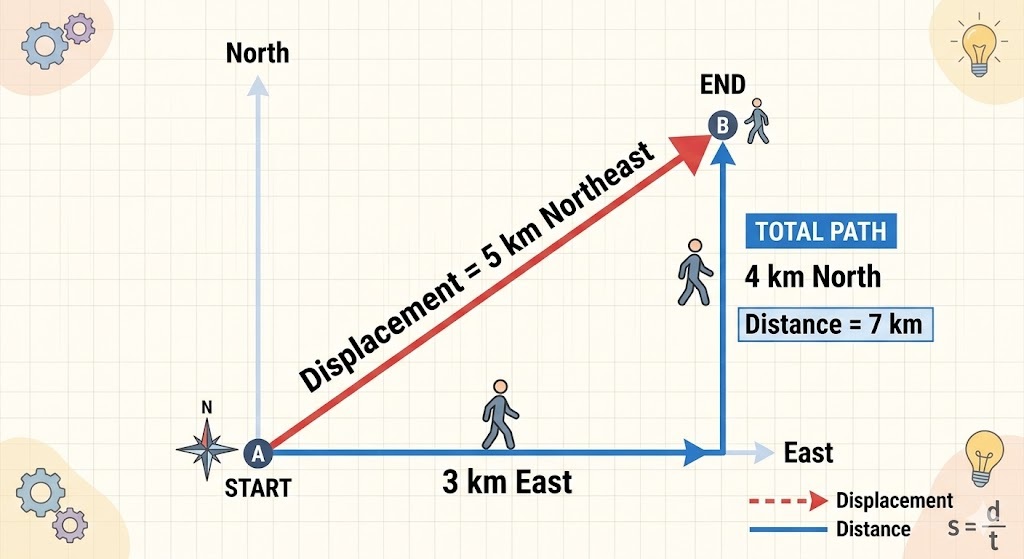
- 3 km East
- then 4 km North
Your total distance traveled is:3+4=7 km
Distance is always positive.
What is Displacement?
Displacement is the shortest straight-line distance between the starting point and ending point along with direction.
In the same example:
- Your displacement becomes 5 km Northeast.
So:
- Distance = 7 km
- Displacement = 5 km Northeast
Scalar and Vector Quantities
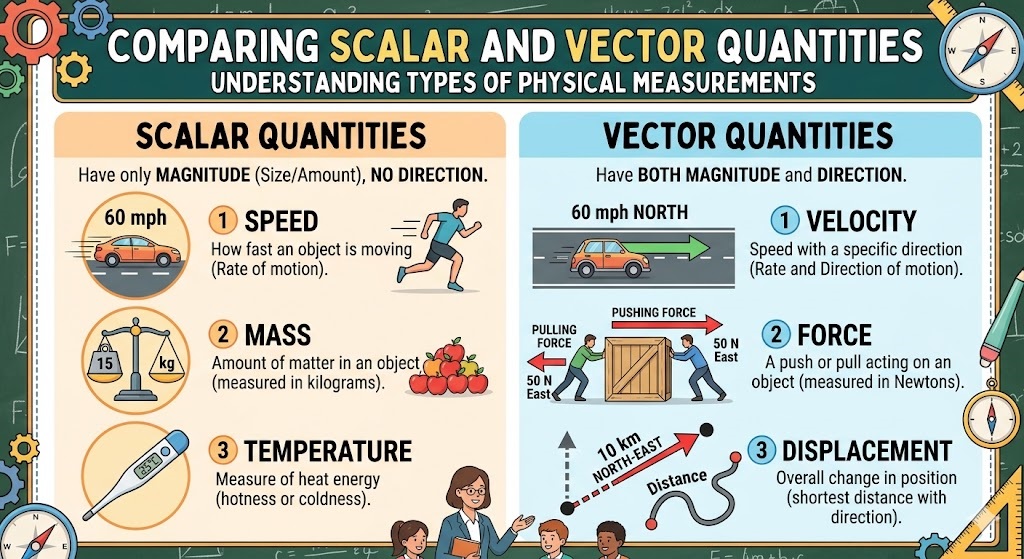
Scalar Quantity
A scalar quantity has only magnitude.
Examples:
- Speed
- Mass
- Temperature
- Time
Vector Quantity
A vector quantity has both magnitude and direction.
Examples:
- Velocity
- Force
- Displacement
- Acceleration
What is Speed in Physics?
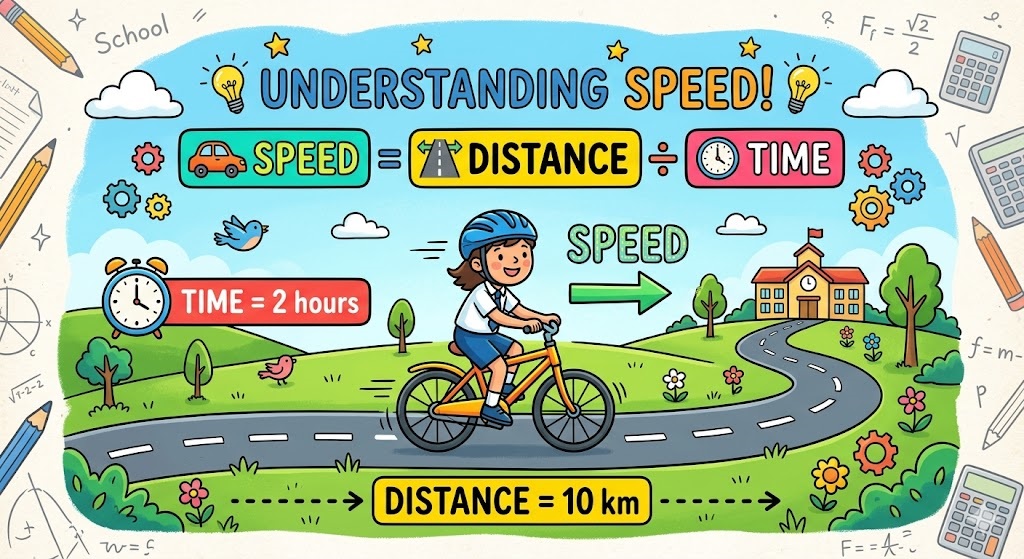
Speed tells us how fast an object is moving.
It only describes the rate of motion and does not include direction.
Therefore, speed is a scalar quantity.
Formula of Speed
Speed=TimeDistance
Example of Speed
If a bike travels 100 km in 2 hours:Speed=2100=50 km/h
So, the speed of the bike is 50 km/h.
What is Velocity in Physics?
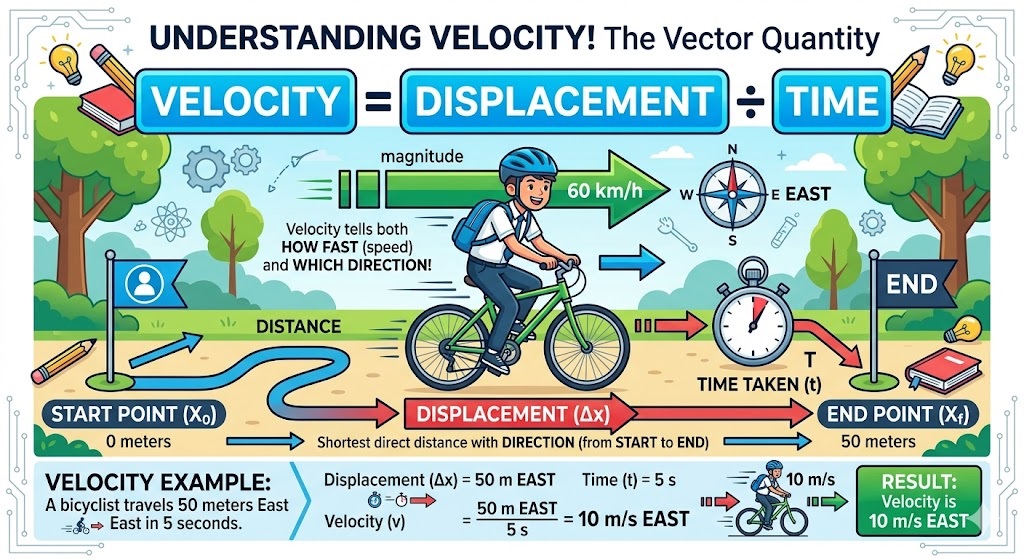
Velocity is the speed of an object in a specific direction.
Velocity includes:
- Magnitude
- Direction
Therefore, velocity is a vector quantity.
Formula of Velocity
Example of Velocity
If a person walks:
- 50 meters East
- in 10 seconds
Then:Velocity=1050=5 m/s East
So, the velocity is 5 m/s East.
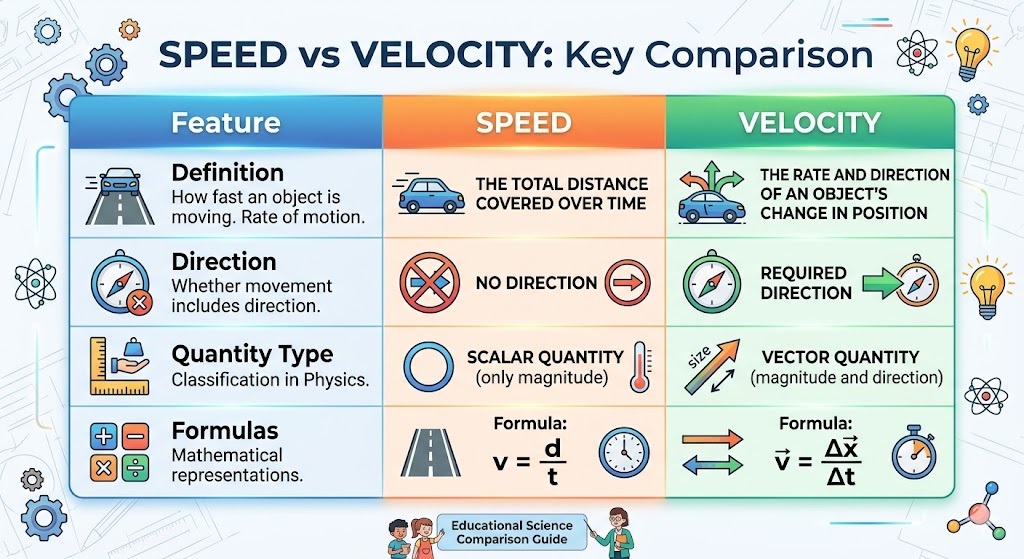
Difference Between Speed and Velocity (Table)
| Feature | Speed | Velocity |
|---|---|---|
| Definition | How fast an object moves | How fast an object moves in a specific direction |
| Quantity Type | Scalar quantity | Vector quantity |
| Direction | Not required | Required |
| Depends On | Distance | Displacement |
| Value | Always positive | Can be positive, negative, or zero |
Real-Life Examples of Speed and Velocity
Example of Speed
A ceiling fan rotates at 300 RPM.
Here, only the rate of rotation is given. No direction is mentioned.
So, this represents speed.
Example of Velocity
A train moves at 80 km/h towards North.
Here:
- 80 km/h = magnitude
- North = direction
So, this represents velocity.
Can Speed and Velocity Be Equal?
Yes.
When an object moves in a straight line without changing direction, the distance and displacement become equal.
In this case:
- Speed = Velocity
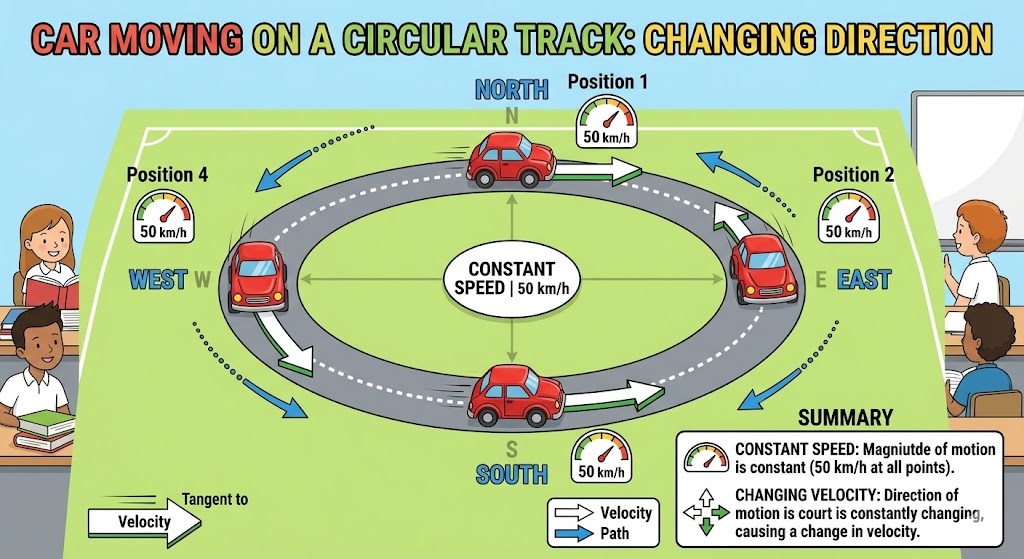
Can Velocity Change Even if Speed Remains Constant?
Yes.
In circular motion:
- Speed may remain constant
- Direction continuously changes
Since velocity depends on direction, velocity changes continuously.
Example:
A car moving around a circular track at constant speed.
SI Unit of Speed and Velocity
The SI unit of both speed and velocity is:meter per second (m/s)
Other common units:
- km/h
- cm/s
Frequently Asked Questions (FAQs)
Is speed a scalar quantity?
Yes, speed is a scalar quantity because it only has magnitude.
Why is velocity called a vector quantity?
Velocity has both magnitude and direction. Therefore, it is a vector quantity.
Can velocity be zero?
Yes. If displacement becomes zero, average velocity can become zero.
Which is greater: speed or velocity?
Speed is always greater than or equal to the magnitude of velocity.
Quick Revision
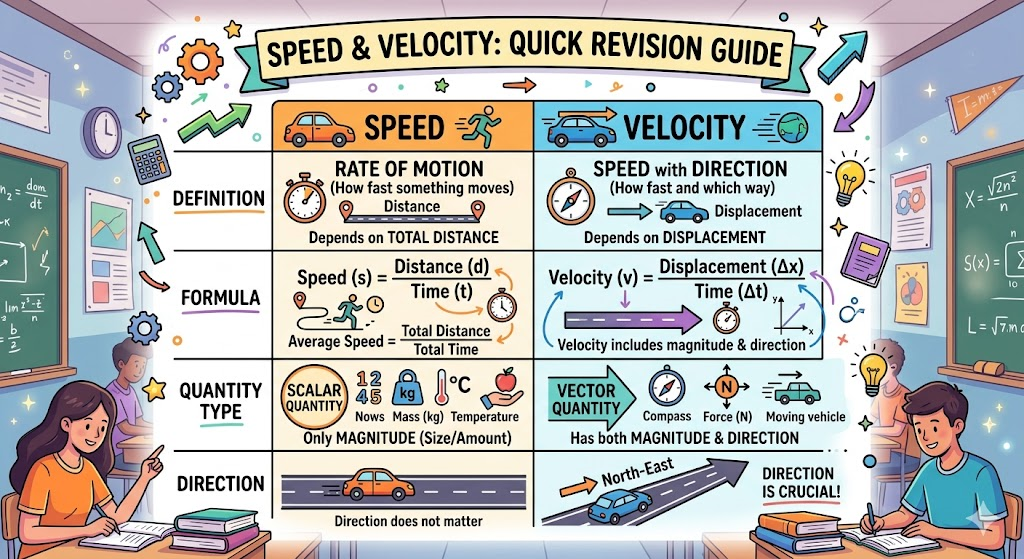
- Speed = Distance ÷ Time
- Velocity = Displacement ÷ Time
- Speed is scalar
- Velocity is vector
- Velocity always includes direction
Conclusion
The difference between speed and velocity is one of the most important concepts in physics.
- Speed only tells us how fast an object moves.
- Velocity tells us both speed and direction.
Understanding speed vs velocity helps students build a strong foundation for physics concepts used in school exams, NEET, and JEE preparation.
Do you want to read more about science. check this out: