
🎯 Recommended Products for Students & Parents
Handpicked products specially selected for our visitors.

School Backpack Combo
✔ 29 L Spacious Backpack
✔ Includes Tiffin & Pouch
✔ Perfect for School & Coaching

Niacinamide Bright & Clear Skin Combo
✔ Brightens Skin
✔ Reduces Acne Marks
✔ Suitable for Daily Skincare
Disclosure: Some links on this page are affiliate links. We may earn a small commission if you purchase through them, at no additional cost to you.
Physics becomes much easier when you understand the basic concepts clearly. One of the most important fundamentals in physics is understanding the difference between scalar and vector quantity.
Whenever we study motion, force, speed, displacement, energy, or acceleration, we deal with physical quantities. Scientists classify these quantities into two major types:
- Scalar Quantities
- Vector Quantities
Understanding these two concepts helps students build a strong foundation for topics like motion, mechanics, gravitation, and kinematics.
In this detailed guide, we will learn:
What is a Scalar Quantity?
A scalar quantity is a physical quantity that has only magnitude and no direction.
In simple words:
Scalar quantities tell us “how much” but not “in which direction.”
A scalar quantity only needs:
- a numerical value
- a unit
Direction is not required.
Scalar Quantity Definition
A physical quantity having magnitude only is called a scalar quantity.
Examples of Scalar Quantities
Some common scalar quantity examples are:
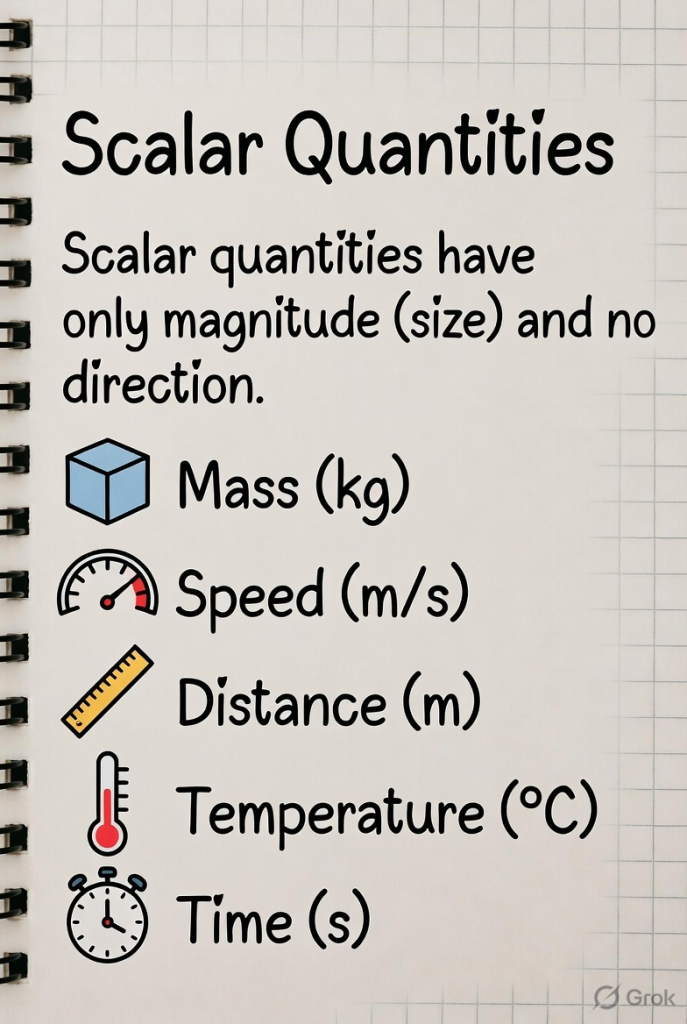
Example 1: Mass
If a bag has a mass of:
5 kg
This statement is complete because mass only needs magnitude.
Example 2: Speed
If a car moves at:
60 km/h
It only tells us how fast the car is moving, not its direction.
So, speed is a scalar quantity.
Example 3: Temperature
If today’s temperature is:
35°C
No direction is involved.
Therefore, temperature is also a scalar quantity.
What is a Vector Quantity?
A vector quantity is a physical quantity that has both:
- magnitude
- direction
In simple words:
Vector quantities tell us “how much” and also “in which direction.”
Without direction, a vector quantity becomes incomplete.
Vector Quantity Definition
A physical quantity having both magnitude and direction is called a vector quantity.
Examples of Vector Quantities
Common vector quantities include:
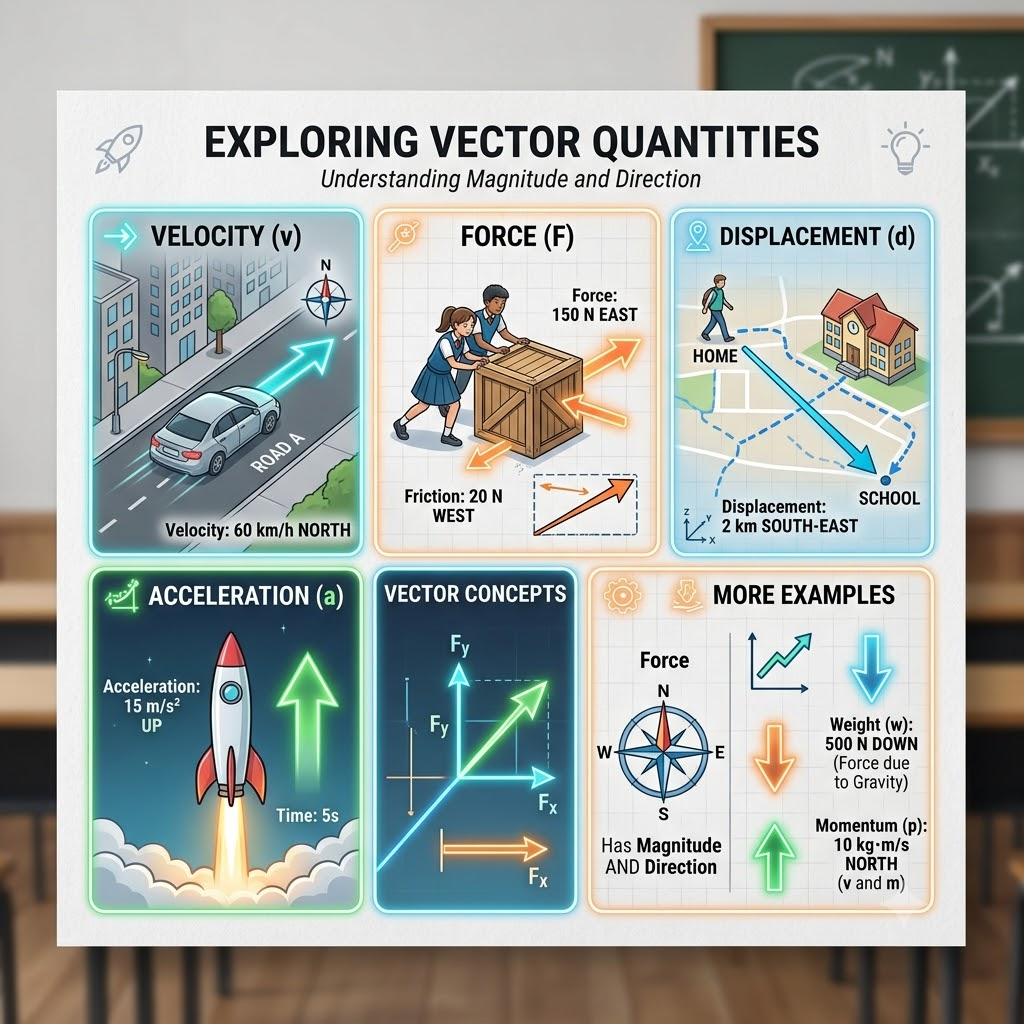
Example 1: Velocity
Suppose a car moves:
60 km/h towards North
This includes:
- magnitude = 60 km/h
- direction = North
Therefore, velocity is a vector quantity.
Example 2: Force
If you push a box with:
20 N towards East
The force has:
- size (20 N)
- direction (East)
So, force is a vector quantity.
Example 3: Displacement
If a person walks:
10 meters West
The statement includes both distance and direction.
Hence, displacement is a vector quantity.
Why Direction Matters in Vector Quantities
Direction completely changes vector quantities.
For example:
- A car moving 50 km/h East
- A car moving 50 km/h West
Both have the same speed, but different velocities because the directions are opposite.
That is why velocity is a vector quantity.
Difference Between Scalar and Vector Quantity
| Feature | Scalar Quantity | Vector Quantity |
|---|---|---|
| Definition | Has only magnitude | Has magnitude and direction |
| Direction | Not required | Required |
| Representation | Normal numbers | Arrow symbols |
| Components | Cannot be resolved | Can be resolved into components |
| Addition | Simple arithmetic | Vector addition rules |
| Examples | Speed, Mass, Time | Velocity, Force, Acceleration |
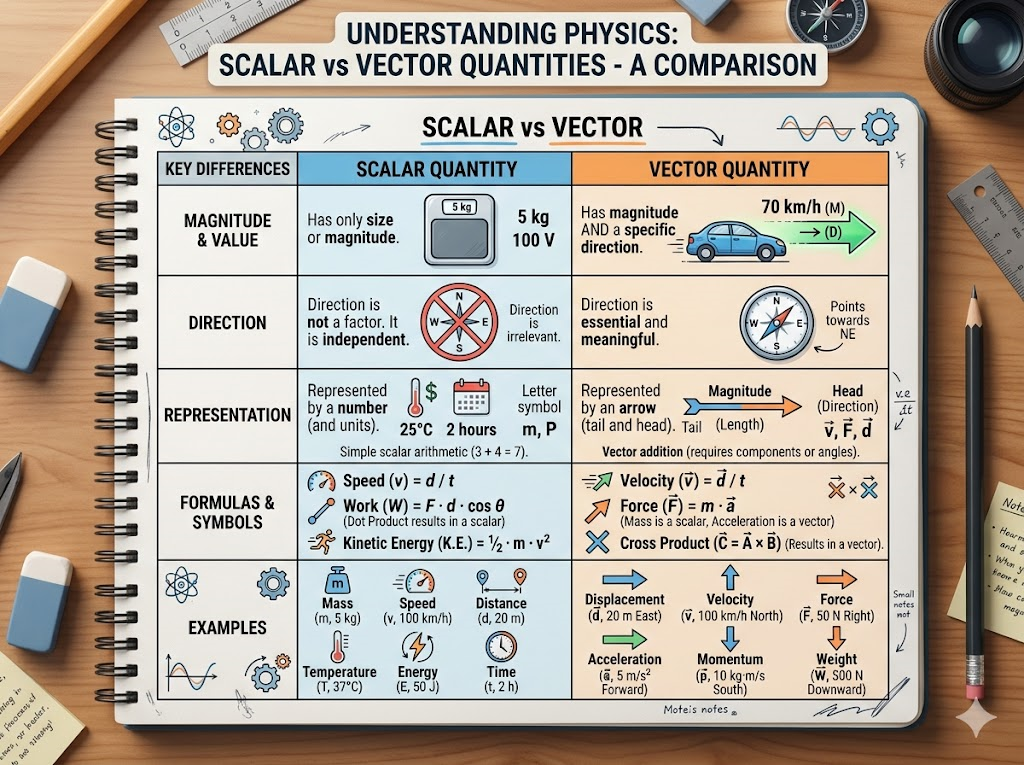
Scalar and Vector Quantity Examples Table
| Scalar Quantities | Vector Quantities |
|---|---|
| Distance | Displacement |
| Speed | Velocity |
| Mass | Weight |
| Time | Force |
| Temperature | Acceleration |
| Energy | Momentum |
Scalar vs Vector Quantities
Interactive Visualizer • Physics Education
🔵 Scalar Quantity
Has only magnitude. No direction needed.
🔴 Vector Quantity
Has both magnitude and direction.
Difference Between Scalar and Vector Quantities
| Scalar Quantity | Vector Quantity |
|---|---|
| Only Magnitude | Magnitude + Direction |
| Speed | Velocity |
| Distance | Displacement |
| Mass | Force |
| Temperature | Acceleration |
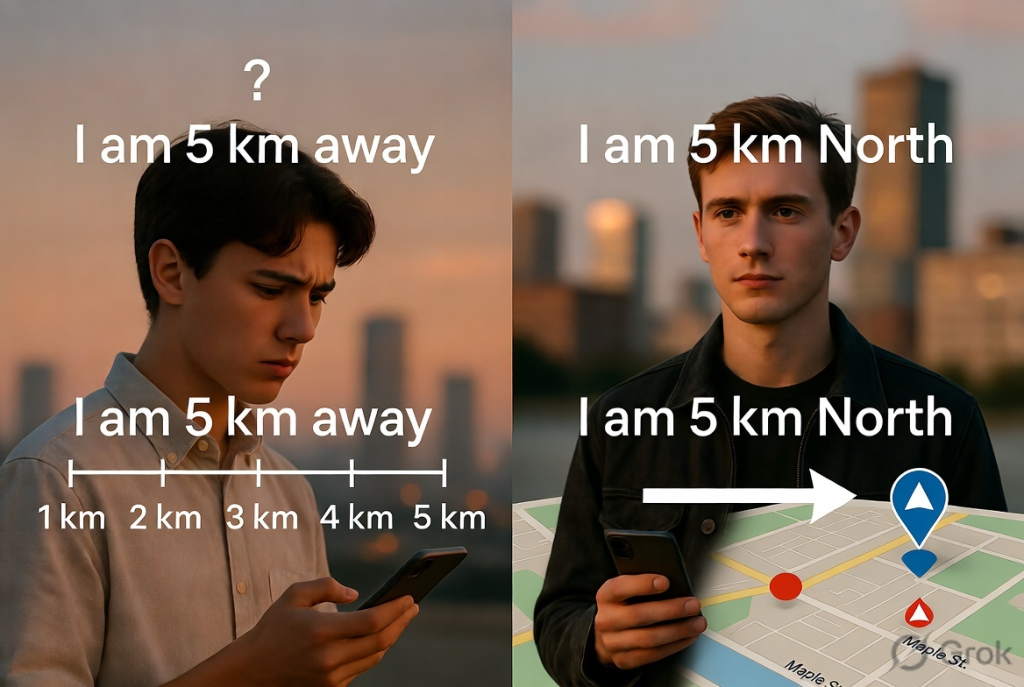
Real-Life Example of Scalar and Vector Quantities
Scalar Example
Imagine your friend says:
“I am 5 km away.”
You know the distance but not the direction.
This is a scalar quantity.
Vector Example
Now suppose your friend says:
“I am 5 km North of your house.”
Now you know:
- magnitude = 5 km
- direction = North
This becomes a vector quantity.
Representation of Vector Quantities
Vectors are usually represented using arrows.
For example:
- Force →
- Velocity →
A longer arrow represents greater magnitude.
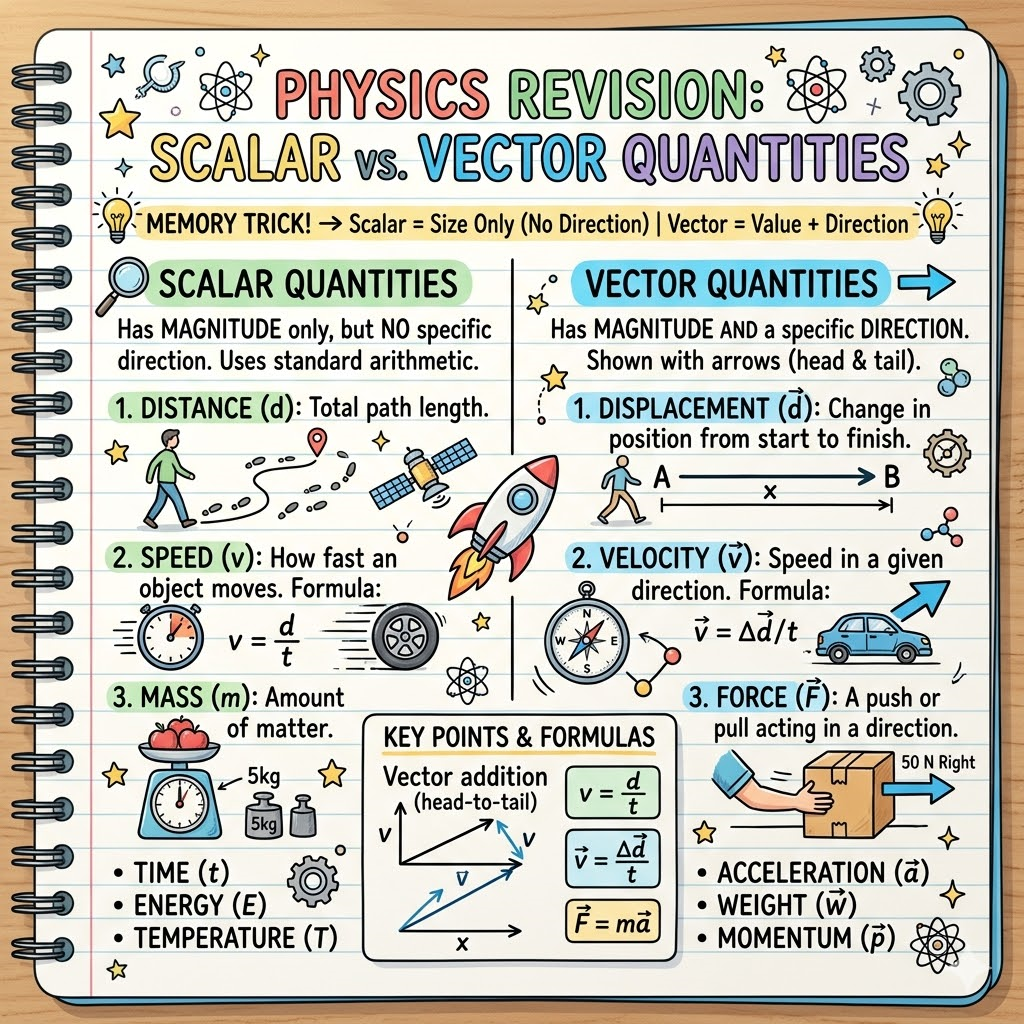
Easy Trick to Remember Scalar and Vector
Scalar = Size Only
Both start with the letter “S”.
Vector = Value + Direction
Vectors always need direction.
Applications of Scalar and Vector Quantities
Scalar and vector quantities are widely used in:
- Physics
- Engineering
- Navigation
- Robotics
- Space science
- Computer graphics
Vectors are especially important in studying motion and forces.
Frequently Asked Questions (FAQs)
Is speed a scalar or vector quantity?
Speed is a scalar quantity because it only has magnitude.
Is velocity a scalar or vector quantity?
Velocity is a vector quantity because it has both magnitude and direction.
Is mass scalar or vector?
Mass is a scalar quantity.
Why is force a vector quantity?
Force acts in a specific direction, so it is a vector quantity.
Is weight scalar or vector?
Weight is a vector quantity because gravity pulls objects downward in a specific direction.
Conclusion
The main difference between scalar and vector quantity is direction.
- Scalar quantities have only magnitude.
- Vector quantities have both magnitude and direction.
Understanding difference between scalar and vector quantity is extremely important for mastering physics concepts like motion, force, and mechanics.
Once you clearly understand these basics, solving physics problems becomes much easier and more logical.