
🎯 Recommended Products for Students & Parents
Handpicked products specially selected for our visitors.

School Backpack Combo
✔ 29 L Spacious Backpack
✔ Includes Tiffin & Pouch
✔ Perfect for School & Coaching

Niacinamide Bright & Clear Skin Combo
✔ Brightens Skin
✔ Reduces Acne Marks
✔ Suitable for Daily Skincare
Disclosure: Some links on this page are affiliate links. We may earn a small commission if you purchase through them, at no additional cost to you.
Introduction
Have you ever stepped outside on a bright sunny day and felt the warmth of the Sun on your skin? While sunlight makes life possible on Earth, it also carries harmful radiation that could seriously damage living organisms.
So why don’t we get exposed to these dangerous rays every day?
The answer lies in a remarkable natural shield called the ozone layer. This invisible layer acts like Earth’s giant sunscreen, protecting humans, animals, plants, and marine life from harmful ultraviolet radiation.
In this article, you’ll learn what What Is Ozone Layer and Its Importance, where it is located, how it works, and why protecting it is essential for life on Earth.
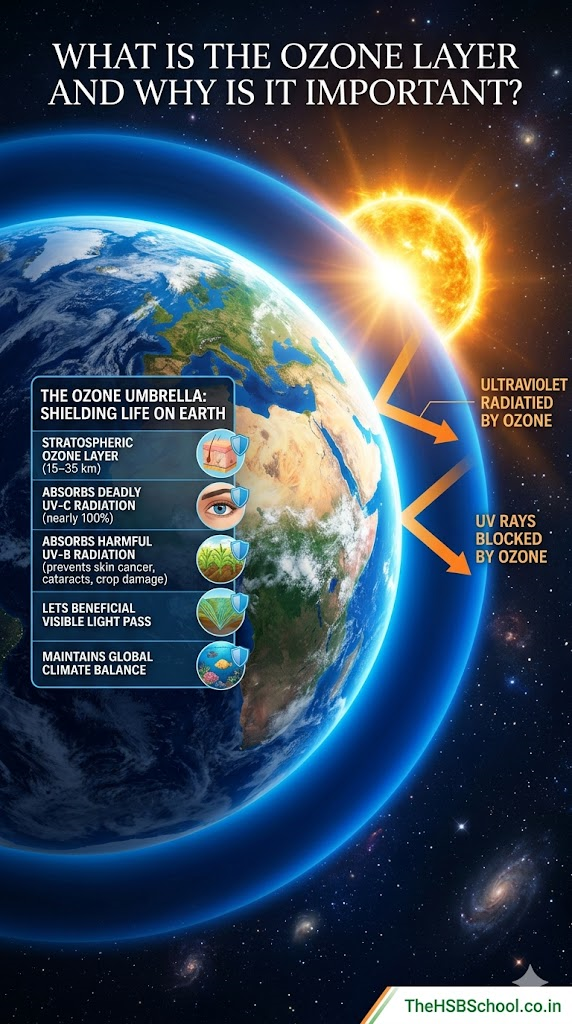
Table of Contents
What Is the Ozone Layer?
The ozone layer is a region of Earth’s atmosphere that contains a high concentration of ozone gas (O₃). It forms a protective shield around our planet by absorbing most of the Sun’s harmful ultraviolet (UV) radiation.
Without this natural barrier, life on Earth would face severe health and environmental challenges.
The ozone layer is often called Earth’s “protective umbrella” because it continuously shields us from dangerous solar radiation.
What Is Ozone (O₃)?
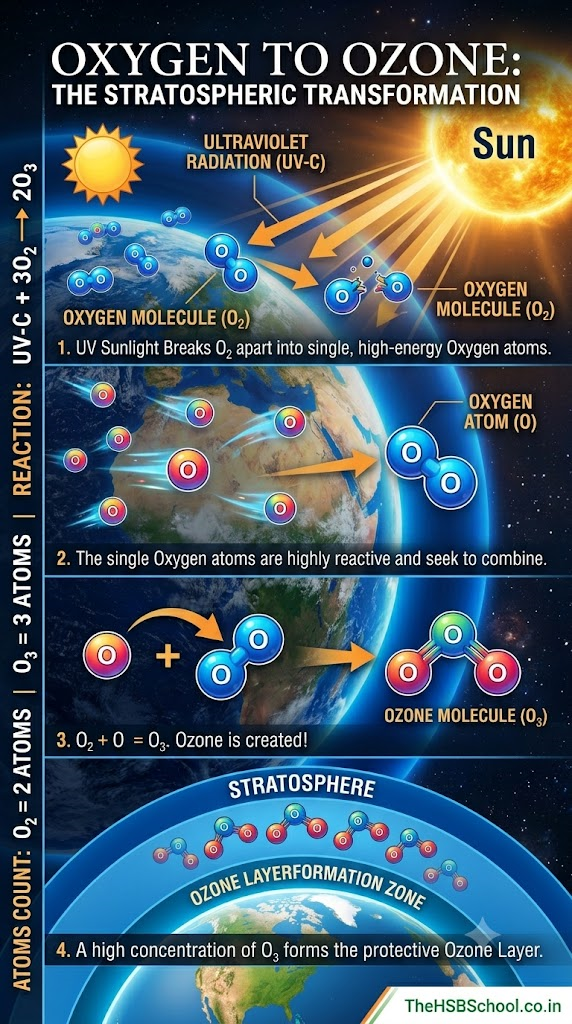
Ozone is a special form of oxygen.
- Normal oxygen = O₂ (two oxygen atoms)
- Ozone = O₃ (three oxygen atoms)
High-energy sunlight breaks apart oxygen molecules in the upper atmosphere. These oxygen atoms then combine with other oxygen molecules to form ozone.
Easy Example
Think of oxygen (O₂) as a team of two players.
When another oxygen atom joins them, they become ozone (O₃)—a powerful team of three that protects life on Earth.
Where Is the Ozone Layer Located?
Earth’s atmosphere is divided into several layers.
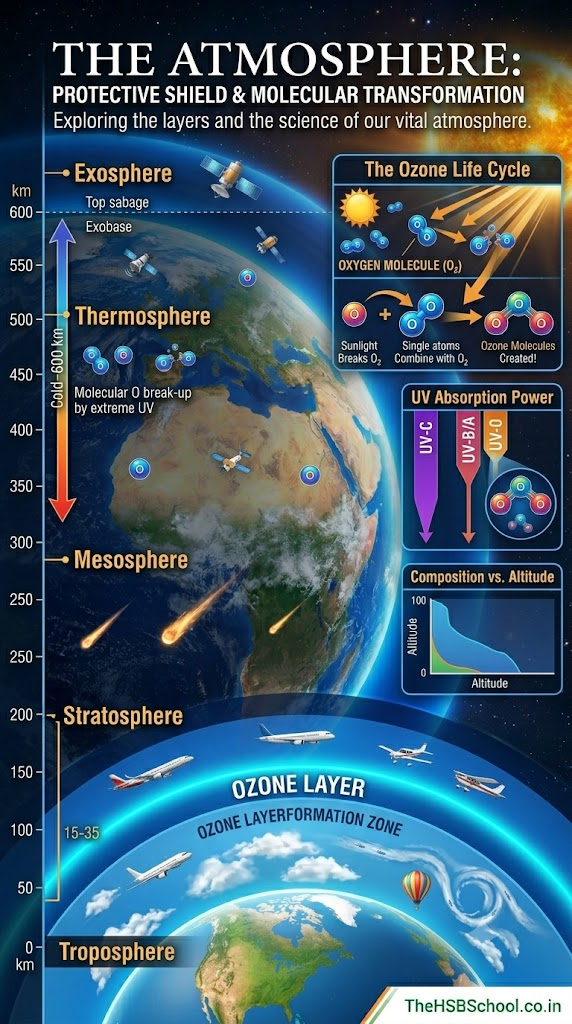
Layers of the Atmosphere
Troposphere (0–12 km)
The lowest layer where humans live and weather occurs.
Stratosphere (12–50 km)
The ozone layer is located here, mainly between 15 km and 35 km above Earth’s surface.
Mesosphere
The layer where many meteors burn up.
Thermosphere
Contains the auroras and many satellites.
Exosphere
The outermost atmospheric layer that gradually merges into space.
The ozone layer remains concentrated in the stratosphere because conditions there allow ozone molecules to form and survive.
Importance of the Ozone Layer
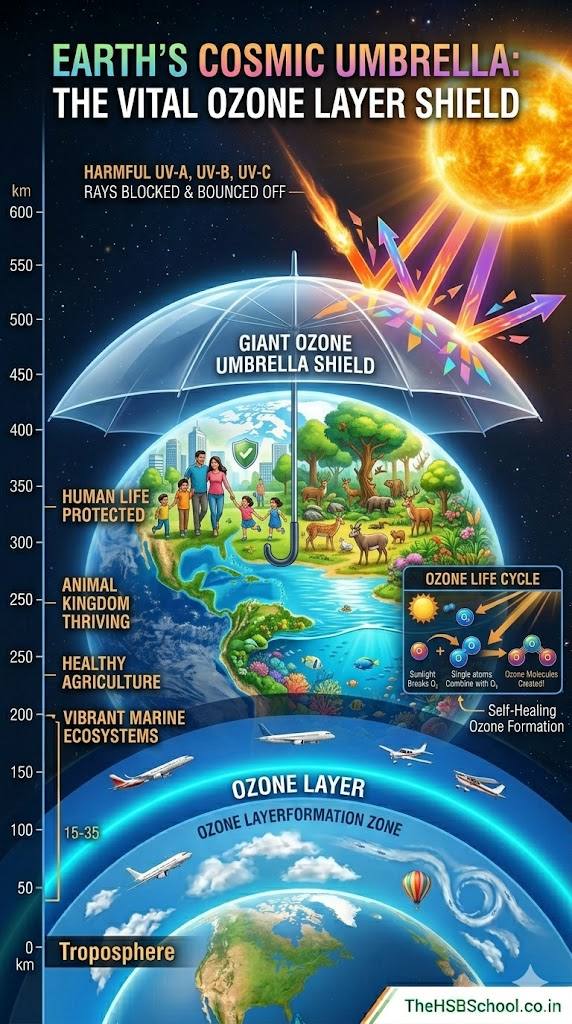
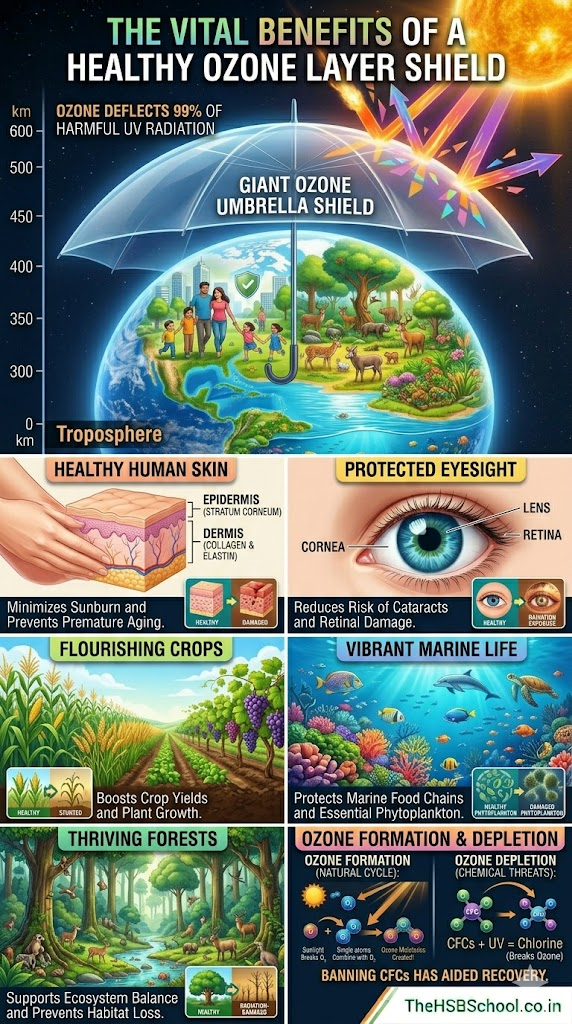
The importance of the ozone layer cannot be overstated. It plays a critical role in maintaining life on Earth.
1. Protects Earth from Harmful UV Rays
The Sun emits ultraviolet radiation, including:
The ozone layer absorbs nearly all UV-C rays and most UV-B rays before they reach Earth’s surface.
2. Prevents Skin Cancer and Sunburn
Excessive UV exposure can cause:
- Skin cancer
- Severe sunburn
- Premature aging
- DNA damage
The ozone layer significantly reduces these health risks.
3. Protects Human Eyes
Harmful UV radiation can damage eye tissues and increase the risk of:
- Cataracts
- Eye inflammation
- Vision problems
The ozone layer acts like a protective pair of sunglasses for the entire planet.
4. Protects Crops and Agriculture
Plants are sensitive to ultraviolet radiation.
Without adequate ozone protection:
- Crop yields would decrease
- Plant growth would slow down
- Food production would suffer
The ozone layer helps ensure stable agricultural productivity.
5. Protects Marine Ecosystems
Tiny marine organisms called phytoplankton form the foundation of ocean food chains.
Excessive UV radiation can damage these organisms, affecting:
- Fish populations
- Marine biodiversity
- Global oxygen production
The ozone layer helps preserve ocean ecosystems.
6. Maintains Ecological Balance
Every ecosystem depends on a stable environment.
By blocking harmful radiation, the ozone layer helps animals, plants, and microorganisms thrive and maintain ecological balance.
What Is Ozone Layer Depletion?
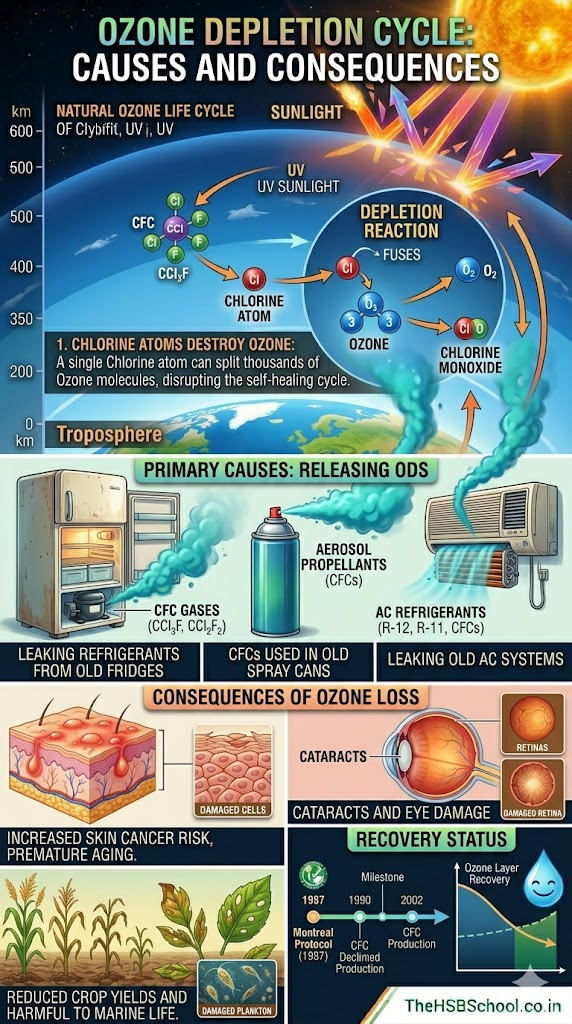
Ozone depletion refers to the thinning of the ozone layer caused by human-made chemicals.
Scientists first detected serious ozone depletion during the 1980s.
Major Causes of Ozone Depletion
Chlorofluorocarbons (CFCs)
These chemicals were commonly used in:
- Refrigerators
- Air conditioners
- Aerosol sprays
- Foam manufacturing
Halons
Halons were widely used in fire extinguishing systems.
When these chemicals reach the stratosphere, sunlight breaks them apart and releases chlorine or bromine atoms.
A single chlorine atom can destroy thousands of ozone molecules.
What Is the Ozone Hole?
The term ozone hole refers to a region where ozone concentration becomes extremely low.
The largest ozone hole appears over Antarctica during the Southern Hemisphere spring.
Despite its name, it is not a physical hole. Instead, it is a temporary area where ozone becomes significantly thinner than normal.

How the World Is Protecting the Ozone Layer
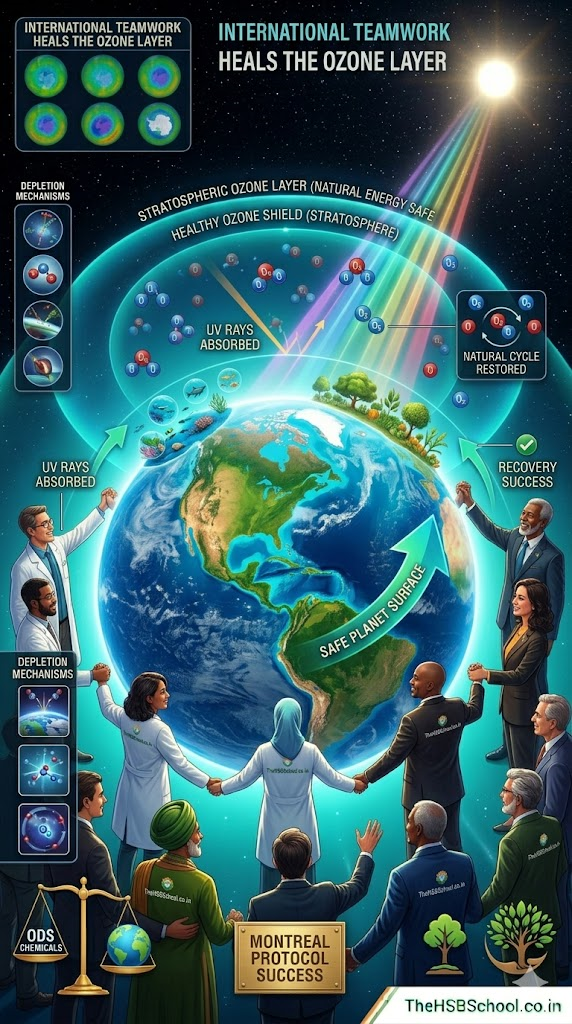
In 1987, countries around the world signed the Montreal Protocol, an international agreement designed to phase out ozone-depleting substances.
This agreement is considered one of the most successful environmental initiatives in human history.
As a result, scientists have observed encouraging signs that the ozone layer is gradually recovering.
How You Can Help Protect the Ozone Layer
Even small actions can make a difference.
Maintain Cooling Appliances
Ensure refrigerators and air conditioners are regularly serviced to prevent refrigerant leaks.
Use Environmentally Friendly Products
Choose products that do not contain ozone-depleting chemicals.
Spread Awareness
Teach friends, family, and classmates about the importance of the ozone layer.
Reduce Environmental Pollution
Conserving energy and reducing emissions contribute to a healthier environment.
Amazing Facts About the Ozone Layer
It Has a Distinct Smell
Ozone has a sharp, fresh smell that can sometimes be noticed after thunderstorms.
It Is Surprisingly Thin
If all atmospheric ozone were compressed to sea level, it would form a layer only a few millimeters thick.
The Ozone Hole Changes Size
The Antarctic ozone hole expands and contracts seasonally depending on weather and atmospheric conditions.
Ozone Protects Every Living Organism
From microscopic plankton to giant whales, every living thing benefits from ozone protection.
Conclusion
Understanding what the ozone layer is and its importance helps us appreciate one of Earth’s most valuable natural defense systems.
Located in the stratosphere, the ozone layer absorbs harmful ultraviolet radiation and protects humans, animals, plants, and ecosystems from serious damage.
Although ozone depletion once threatened this protective shield, international cooperation and environmental awareness have helped the ozone layer begin its recovery. By continuing to protect our environment, we can ensure that this cosmic umbrella remains strong for future generations.
Frequently Asked Questions
What is the ozone layer in simple words?
The ozone layer is a protective layer of ozone gas in the stratosphere that blocks harmful ultraviolet rays from the Sun.
Why is the ozone layer important?
It protects humans, animals, plants, and marine life from harmful UV radiation.
What does O₃ mean?
O₃ is the chemical formula for ozone, which consists of three oxygen atoms bonded together.
Is the ozone layer recovering?
Yes. Thanks to international efforts such as the Montreal Protocol, the ozone layer is gradually recovering.
Where is the ozone hole located?
The largest ozone hole forms over Antarctica during the Southern Hemisphere spring season.
Do you want to read more about science. check this out: