
🎯 Recommended Products for Students & Parents
Handpicked products specially selected for our visitors.

School Backpack Combo
✔ 29 L Spacious Backpack
✔ Includes Tiffin & Pouch
✔ Perfect for School & Coaching

Niacinamide Bright & Clear Skin Combo
✔ Brightens Skin
✔ Reduces Acne Marks
✔ Suitable for Daily Skincare
Disclosure: Some links on this page are affiliate links. We may earn a small commission if you purchase through them, at no additional cost to you.
Imagine trying to give someone a glass of water using a giant fire hose. Most of the water would be wasted, and very little would actually reach the person’s mouth. For many years, traditional irrigation methods worked in a similar way by flooding entire fields with water.
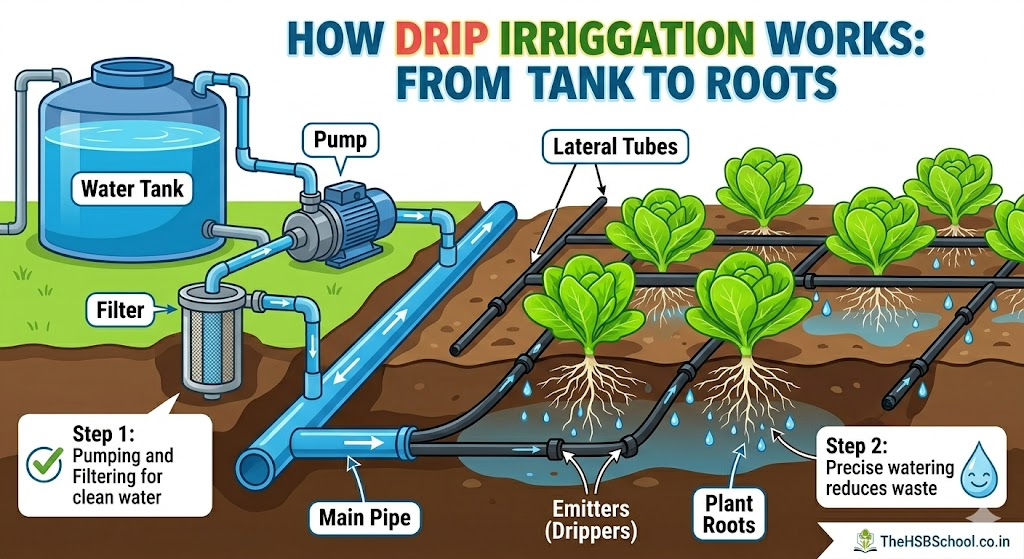
Today, with increasing water shortages and the need for sustainable farming, farmers are turning to drip irrigation, one of the most efficient irrigation methods available. It delivers water directly to plant roots, reducing waste and improving crop growth.
In this article, we will explore the advantages and disadvantages of drip irrigation, how it works, its applications, and important exam questions.
Table of Contents
What is Drip Irrigation?
Drip irrigation is a method of irrigation in which water is supplied slowly and directly to the root zone of plants through a network of pipes, tubes, valves, and emitters.
Instead of watering the entire field, drip irrigation delivers only the required amount of water to each plant. Because of its efficiency, it is also known as trickle irrigation.
Definition of Drip Irrigation
Drip irrigation is a modern irrigation method that supplies water drop by drop directly to plant roots through pipes and emitters, minimizing water wastage.
Components of a Drip Irrigation System
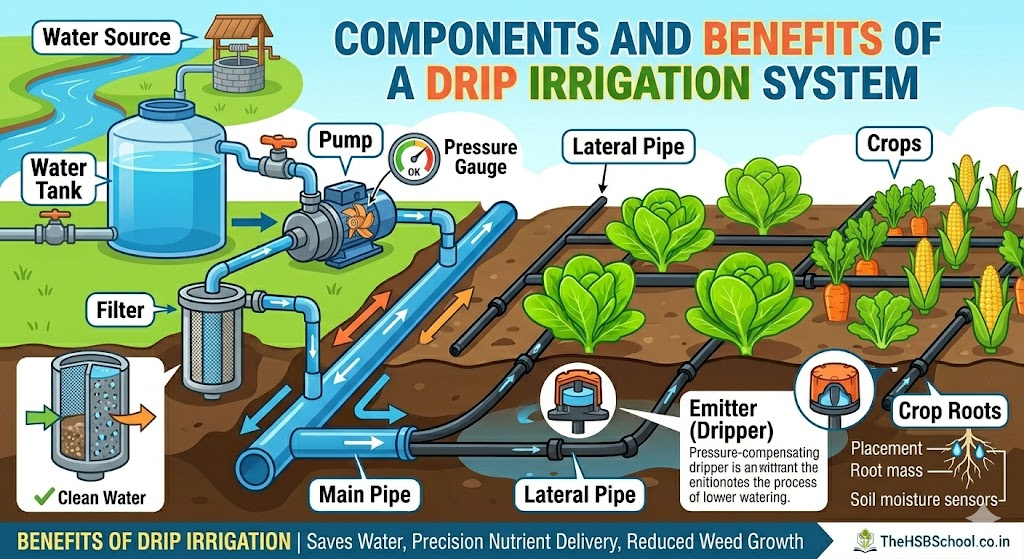
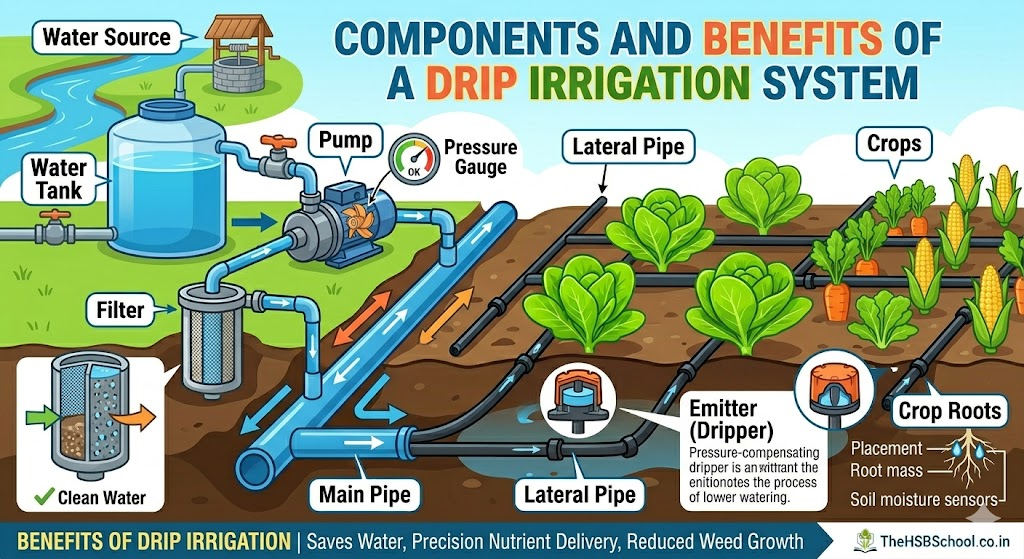
A drip irrigation system consists of several important components:
1. Water Source and Pump
The water source may be a well, pond, tank, or reservoir. A pump helps move water through the system.
2. Filters
Filters remove dirt, sand, and other particles that could block the emitters.
3. Main and Sub-Main Pipes
These pipes carry water from the source to different parts of the field.
4. Lateral Tubes
Smaller tubes distribute water to individual plants.
5. Emitters or Drippers
Emitters release water slowly near the plant roots.
Advantages of Drip Irrigation
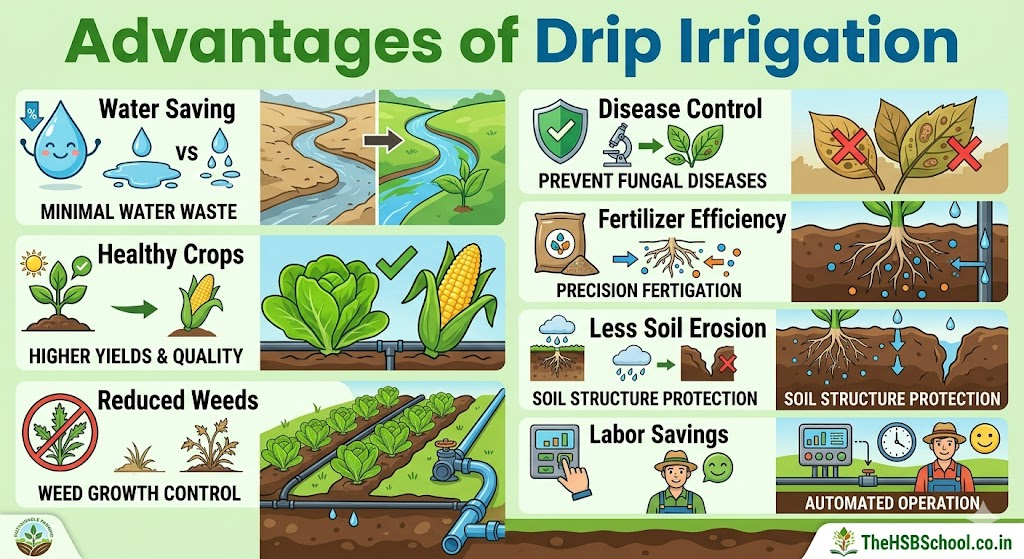
Drip irrigation offers many benefits to farmers and gardeners.
1. Saves Water
One of the biggest advantages of drip irrigation is water conservation. Water is delivered directly to plant roots, reducing losses due to evaporation and runoff.
2. Increases Crop Yield
Plants receive a regular supply of water, resulting in healthier growth and higher productivity.
3. Reduces Weed Growth
Since only the root area is watered, weeds receive less moisture and grow less frequently.
4. Prevents Soil Erosion
Unlike flood irrigation, drip irrigation does not wash away the fertile topsoil.
5. Saves Time and Labour
Automatic drip systems reduce the need for manual watering and labour.
6. Efficient Fertilizer Application
Fertilizers can be mixed with irrigation water and supplied directly to the roots. This process is called fertigation.
7. Suitable for Uneven Land
Drip irrigation works efficiently even on sloping and irregular land surfaces.
8. Reduces Plant Diseases
Because leaves remain dry, fungal infections and other diseases are less common.
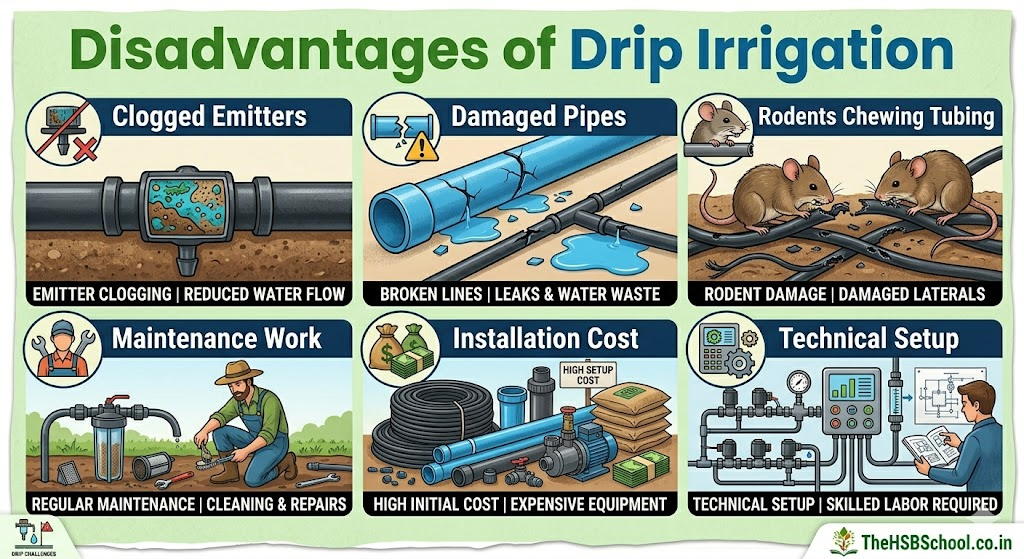
Disadvantages of Drip Irrigation
Although drip irrigation has many benefits, it also has some limitations.
1. High Initial Cost
Installing pumps, filters, pipes, and emitters requires a significant investment.
2. Emitters May Become Clogged
Tiny emitter openings can become blocked by dirt, algae, or mineral deposits.
3. Regular Maintenance is Required
Filters and emitters need periodic cleaning and inspection.
4. Damage by Animals or Machinery
Rodents, insects, or farm equipment may damage the pipes.
5. Requires Technical Knowledge
Farmers must understand system design, water pressure, and maintenance procedures.
6. Not Suitable for All Crops
Closely spaced crops such as rice and wheat may not be ideal for drip irrigation.
Advantages and Disadvantages of Drip Irrigation in Points
Advantages
- Saves water
- Increases crop yield
- Reduces weed growth
- Prevents soil erosion
- Saves labour and time
- Improves fertilizer efficiency
- Suitable for uneven land
- Reduces plant diseases
Disadvantages
- High installation cost
- Emitters can clog
- Requires maintenance
- Pipes may be damaged
- Needs technical knowledge
- Not suitable for all crops
Difference Between Drip Irrigation and Flood Irrigation
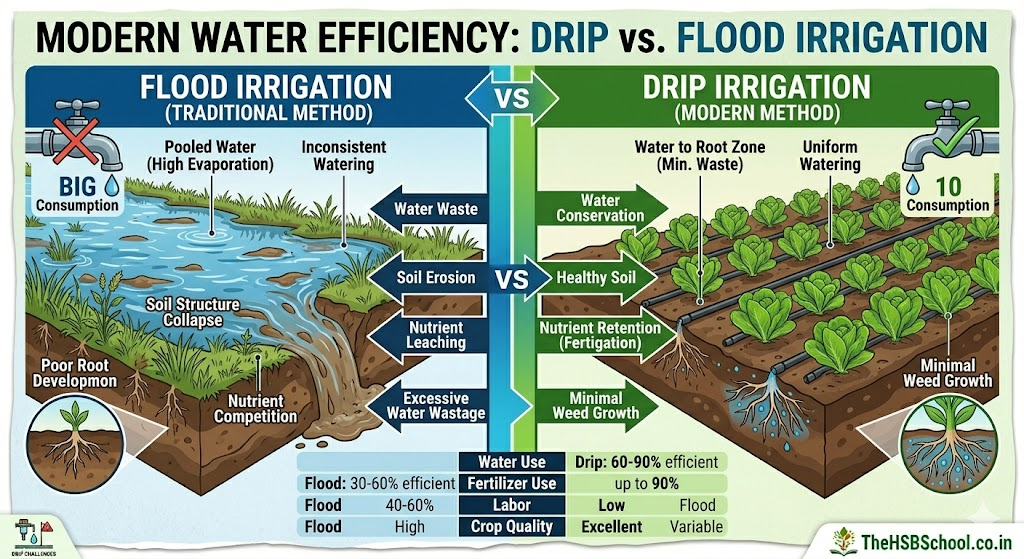
| Feature | Drip Irrigation | Flood Irrigation |
|---|---|---|
| Water Usage | Low | High |
| Water Efficiency | High | Low |
| Weed Growth | Less | More |
| Soil Erosion | Minimal | High |
| Labour Requirement | Low | High |
| Crop Yield | Higher | Lower |
| Initial Cost | High | Low |
Applications of Drip Irrigation
Drip irrigation is widely used in:
- Vegetable cultivation
- Fruit orchards
- Vineyards
- Flower farming
- Greenhouses
- Home gardens
- Plantation crops
Importance of Drip Irrigation
As freshwater resources become scarce, efficient water management is becoming increasingly important. Drip irrigation helps conserve water, increase agricultural productivity, and promote sustainable farming practices.
For this reason, many governments provide subsidies to encourage farmers to adopt drip irrigation systems.
Question-Answers related to drip irrigation
1. What is drip irrigation?
Drip irrigation is a method of supplying water drop by drop directly to plant roots through pipes and emitters.
2. Why is drip irrigation important?
Drip irrigation saves water, improves crop yield, reduces weed growth, and supports sustainable agriculture.
3. Write two advantages of drip irrigation.
- Saves water.
- Increases crop production.
4. Write two disadvantages of drip irrigation.
- High installation cost.
- Emitters may become clogged.
5. How does drip irrigation save water?
It delivers water directly to the root zone, reducing evaporation and runoff losses.
6. Which crops are suitable for drip irrigation?
Vegetables, fruits, grapes, sugarcane, cotton, flowers, and orchard crops are suitable for drip irrigation.
7. Why is drip irrigation called trickle irrigation?
It is called trickle irrigation because water is supplied slowly in the form of small drops or trickles.
8. Short Note on Drip Irrigation
Drip irrigation is a modern irrigation method in which water is supplied directly to plant roots through a network of pipes and emitters. It reduces water wastage, improves crop yield, minimizes weed growth, and prevents soil erosion. Although the installation cost is high, it is considered one of the most efficient irrigation systems used in modern agriculture.
Frequently Asked Questions (FAQs)
What is another name for drip irrigation?
Drip irrigation is also known as trickle irrigation.
What is the biggest advantage of drip irrigation?
The biggest advantage is water conservation.
What is the biggest disadvantage of drip irrigation?
The high initial installation cost.
Who benefits from drip irrigation?
Farmers, gardeners, horticulturists, and greenhouse growers benefit from drip irrigation.
Is drip irrigation eco-friendly?
Yes. It conserves water and reduces wastage, making it environmentally friendly.
Can fertilizers be applied through drip irrigation?
Yes. Fertilizers can be supplied through the irrigation system using fertigation.
Which crops are not suitable for drip irrigation?
Crops grown in densely planted flooded fields, such as rice, are generally less suitable for drip irrigation.
Conclusion
Drip irrigation is one of the most effective and water-efficient irrigation methods used in modern agriculture. By delivering water directly to plant roots, it minimizes wastage, improves crop growth, reduces weed development, and conserves valuable water resources. Although it requires a higher initial investment and regular maintenance, the long-term benefits often outweigh the disadvantages. As the world faces increasing water scarcity, drip irrigation will continue to play a vital role in sustainable farming and food production.
Do you want to read more about science. check this out: