
🎯 Recommended Products for Students & Parents
Handpicked products specially selected for our visitors.

School Backpack Combo
✔ 29 L Spacious Backpack
✔ Includes Tiffin & Pouch
✔ Perfect for School & Coaching

Niacinamide Bright & Clear Skin Combo
✔ Brightens Skin
✔ Reduces Acne Marks
✔ Suitable for Daily Skincare
Disclosure: Some links on this page are affiliate links. We may earn a small commission if you purchase through them, at no additional cost to you.
Have you ever wondered how some people can instantly tell whether a large number is divisible by 2, 3, 5, 7, or even 13 without using a calculator?
The secret is knowing divisibility tricks (also called divisibility rules or divisibility tests). These simple mathematical shortcuts help you determine whether one number is exactly divisible by another without performing long division.
Whether you’re a school student, preparing for competitive exams, or simply want to improve your mental math skills, learning divisibility tricks can save time and improve accuracy.
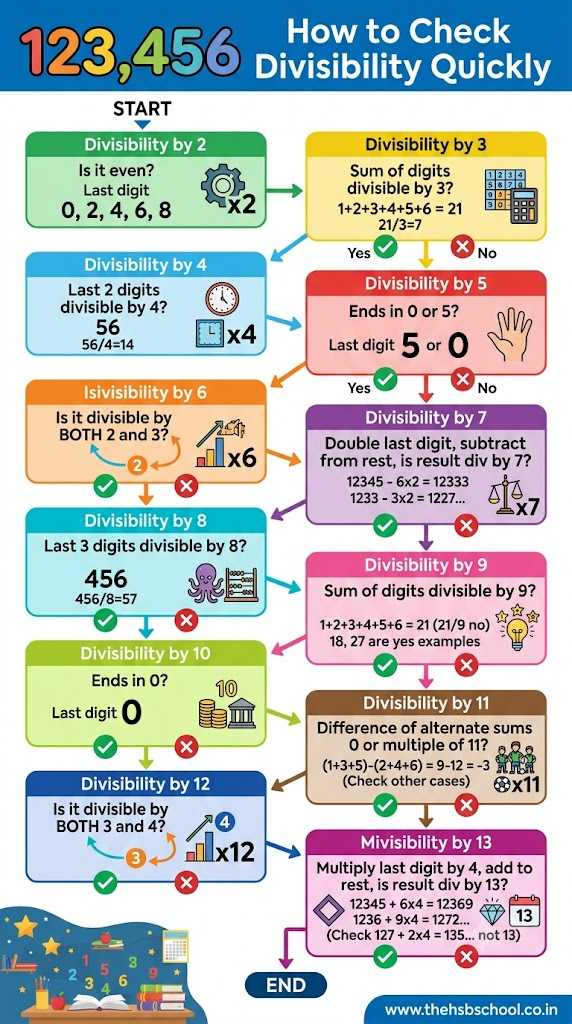
In this guide, you’ll learn the divisibility tricks from 2 to 13, understand why they work, see step-by-step examples, and pick up easy memory tips.
Table of Contents
What Are Divisibility Tricks?
A divisibility trick is a quick rule used to check whether a number can be divided by another number without leaving a remainder.
For example,
Is 248 divisible by 2?
Instead of dividing,
248 ÷ 2 = 124
you simply check the last digit.
Since 8 is an even number, 248 is divisible by 2.
That’s the power of divisibility rules—they help you solve problems in seconds.
Why Should You Learn Divisibility Rules?
Learning divisibility tricks offers many benefits:
- Solve math problems faster.
- Save valuable time during exams.
- Simplify fractions easily.
- Find HCF and LCM more quickly.
- Improve your mental calculation skills.
- Build a stronger understanding of number systems.
- Check answers without performing long division.
These rules are especially useful for students studying Class 4 to Class 10 Mathematics and for competitive exams involving arithmetic.
Divisibility Rule of 2
Rule
A number is divisible by 2 if its last digit is one of the following:
0, 2, 4, 6, or 8
In other words, every even number is divisible by 2.
Examples
| Number | Last Digit | Divisible by 2? |
|---|---|---|
| 124 | 4 | ✅ Yes |
| 986 | 6 | ✅ Yes |
| 450 | 0 | ✅ Yes |
| 513 | 3 | ❌ No |
| 777 | 7 | ❌ No |
Why Does This Rule Work?
The ones digit determines whether a number is even or odd. Every even number can be divided exactly by 2.
Memory Tip
Even = Divisible by 2
Divisibility Rule of 3
Rule
Add all the digits of the number.
If the sum of the digits is divisible by 3, then the original number is also divisible by 3.
Example 1
Is 528 divisible by 3?
Add the digits:
5 + 2 + 8 = 15
Since 15 is divisible by 3,
528 is divisible by 3.
Example 2
Is 743 divisible by 3?
7 + 4 + 3 = 14
14 is not divisible by 3.
Therefore,
743 is not divisible by 3.
More Examples
| Number | Sum of Digits | Divisible by 3? |
| 729 | 18 | ✅ Yes |
| 456 | 15 | ✅ Yes |
| 742 | 13 | ❌ No |
Why Does This Rule Work?
In our decimal number system, every power of 10 leaves a remainder of 1 when divided by 3. Because of this property, adding the digits gives the same divisibility result as the original number.
Memory Tip
Add the digits to check divisibility by 3.
Divisibility Rule of 4
Rule
Look only at the last two digits.
If those two digits form a number divisible by 4, then the entire number is divisible by 4.
Example 1
Is 516 divisible by 4?
Last two digits = 16
16 ÷ 4 = 4
Therefore,
516 is divisible by 4.
Example 2
Is 718 divisible by 4?
Last two digits = 18
18 is not divisible by 4.
Therefore,
718 is not divisible by 4.
More Examples
| Number | Last Two Digits | Divisible by 4? |
| 932 | 32 | ✅ Yes |
| 864 | 64 | ✅ Yes |
| 782 | 82 | ❌ No |
Why Does This Rule Work?
Every number before the last two digits is a multiple of 100, and 100 is divisible by 4. Therefore, only the last two digits affect divisibility by 4.
Memory Tip
Check only the last two digits.
Divisibility Rule of 5
Rule
A number is divisible by 5 if its last digit is:
- 0
- 5
Examples
| Number | Last Digit | Divisible by 5? |
| 785 | 5 | ✅ Yes |
| 340 | 0 | ✅ Yes |
| 625 | 5 | ✅ Yes |
| 786 | 6 | ❌ No |
Why Does This Rule Work?
Every multiple of 5 ends with either 0 or 5 in the decimal number system.
Memory Tip
Ends in 0 or 5 = Divisible by 5
Divisibility Rule of 6
Rule
A number is divisible by 6 only if:
- it is divisible by 2, and
- it is divisible by 3.
Both conditions must be true.
Example
Is 432 divisible by 6?
Step 1:
Last digit = 2
It is divisible by 2.
Step 2:
4 + 3 + 2 = 9
9 is divisible by 3.
Therefore,
432 is divisible by 6.
More Examples
| Number | Divisible by 2 | Divisible by 3 | Divisible by 6? |
| 612 | ✅ | ✅ | ✅ |
| 258 | ✅ | ✅ | ✅ |
| 214 | ✅ | ❌ | ❌ |
| 333 | ❌ | ✅ | ❌ |
Why Does This Rule Work?
Since 6 = 2 × 3, a number must be divisible by both 2 and 3 to be divisible by 6.
Memory Tip
6 = 2 × 3 (Check both rules together.)
Divisibility Rule of 7
The divisibility rule for 7 is slightly different but becomes easy with practice.
Rule
- Double the last digit.
- Subtract this value from the remaining part of the number.
- If the answer is 0 or a multiple of 7, then the original number is divisible by 7.
Example 1
Is 203 divisible by 7?
Last digit = 3
Double it:
3 × 2 = 6
Remaining number = 20
20 − 6 = 14
Since 14 is divisible by 7,
203 is divisible by 7.
Example 2
Is 301 divisible by 7?
Last digit = 1
Double it:
2
Remaining number = 30
30 − 2 = 28
28 is divisible by 7.
Therefore,
301 is divisible by 7.
More Examples
| Number | Result After Rule | Divisible by 7? |
| 203 | 14 | ✅ Yes |
| 301 | 28 | ✅ Yes |
| 215 | 11 | ❌ No |
Memory Tip
Double the last digit and subtract.
Divisibility Rule of 8
Rule
To check if a number is divisible by 8, look only at its last three digits.
If the number formed by the last three digits is divisible by 8, then the whole number is divisible by 8.
Example 1
Is 4,216 divisible by 8?
Last three digits = 216
216 ÷ 8 = 27
Therefore,
4,216 is divisible by 8.
Example 2
Is 7,314 divisible by 8?
Last three digits = 314
314 is not divisible by 8.
Therefore,
7,314 is not divisible by 8.
More Examples
| Number | Last Three Digits | Divisible by 8? |
|---|---|---|
| 6,120 | 120 | ✅ Yes |
| 1,008 | 008 | ✅ Yes |
| 5,234 | 234 | ❌ No |
Why Does This Rule Work?
Every digit before the last three represents a multiple of 1,000, and 1,000 is divisible by 8. Therefore, only the last three digits determine divisibility by 8.
Memory Tip
Last 3 digits → Rule of 8
Divisibility Rule of 9
Rule
Add all the digits of the number.
If the sum of the digits is divisible by 9, then the original number is divisible by 9.
Example
Is 729 divisible by 9?
7 + 2 + 9 = 18
Since 18 is divisible by 9,
729 is divisible by 9.
More Examples
| Number | Sum of Digits | Divisible by 9? |
| 999 | 27 | ✅ Yes |
| 5,472 | 18 | ✅ Yes |
| 832 | 13 | ❌ No |
Memory Tip
Add the digits—same as the rule for 3, but the sum must be divisible by 9.
Divisibility Rule of 10
Rule
A number is divisible by 10 if its last digit is 0.
Examples
| Number | Last Digit | Divisible by 10? |
| 430 | 0 | ✅ Yes |
| 7,810 | 0 | ✅ Yes |
| 2,345 | 5 | ❌ No |
Why Does This Rule Work?
Every multiple of 10 ends in 0.
Memory Tip
Ends in 0 = Divisible by 10
Divisibility Rule of 11
Rule
There are two common methods. The easiest is:
- Add the digits in the odd positions.
- Add the digits in the even positions.
- Find the difference between the two sums.
- If the difference is 0 or a multiple of 11, the number is divisible by 11.
Example
Is 50,611 divisible by 11?
Odd-position digits:
5 + 6 + 1 = 12
Even-position digits:
0 + 1 = 1
Difference:
12 − 1 = 11
Since 11 is a multiple of 11,
50,611 is divisible by 11.
Another Example
Is 4,884 divisible by 11?
Odd positions:
4 + 8 = 12
Even positions:
8 + 4 = 12
Difference = 0
Therefore,
4,884 is divisible by 11.
Memory Tip
Alternate sums → Difference should be 0 or 11.
Divisibility Rule of 12
Rule
A number is divisible by 12 if it is divisible by:
- 3, and
- 4
Both conditions must be satisfied.
Example
Is 264 divisible by 12?
Step 1:
2 + 6 + 4 = 12
12 is divisible by 3.
Step 2:
Last two digits = 64
64 ÷ 4 = 16
Both conditions are satisfied.
Therefore,
264 is divisible by 12.
More Examples
| Number | Rule of 3 | Rule of 4 | Divisible by 12? |
| 648 | ✅ | ✅ | ✅ |
| 936 | ✅ | ✅ | ✅ |
| 246 | ✅ | ❌ | ❌ |
Memory Tip
12 = 3 × 4, so check both rules.
Divisibility Rule of 13
Unlike the rules for 2, 3, or 5, the rule for 13 is less commonly taught, but it is still useful.
Rule
- Multiply the last digit by 4.
- Add the result to the remaining part of the number.
- Repeat if needed.
- If the final number is divisible by 13, then the original number is divisible by 13.
Example
Is 169 divisible by 13?
Last digit = 9
9 × 4 = 36
Remaining number = 16
16 + 36 = 52
52 ÷ 13 = 4
Therefore,
169 is divisible by 13.
Another Example
Is 273 divisible by 13?
Last digit = 3
3 × 4 = 12
Remaining number = 27
27 + 12 = 39
39 ÷ 13 = 3
Therefore,
273 is divisible by 13.
Memory Tip
Multiply the last digit by 4, then add.
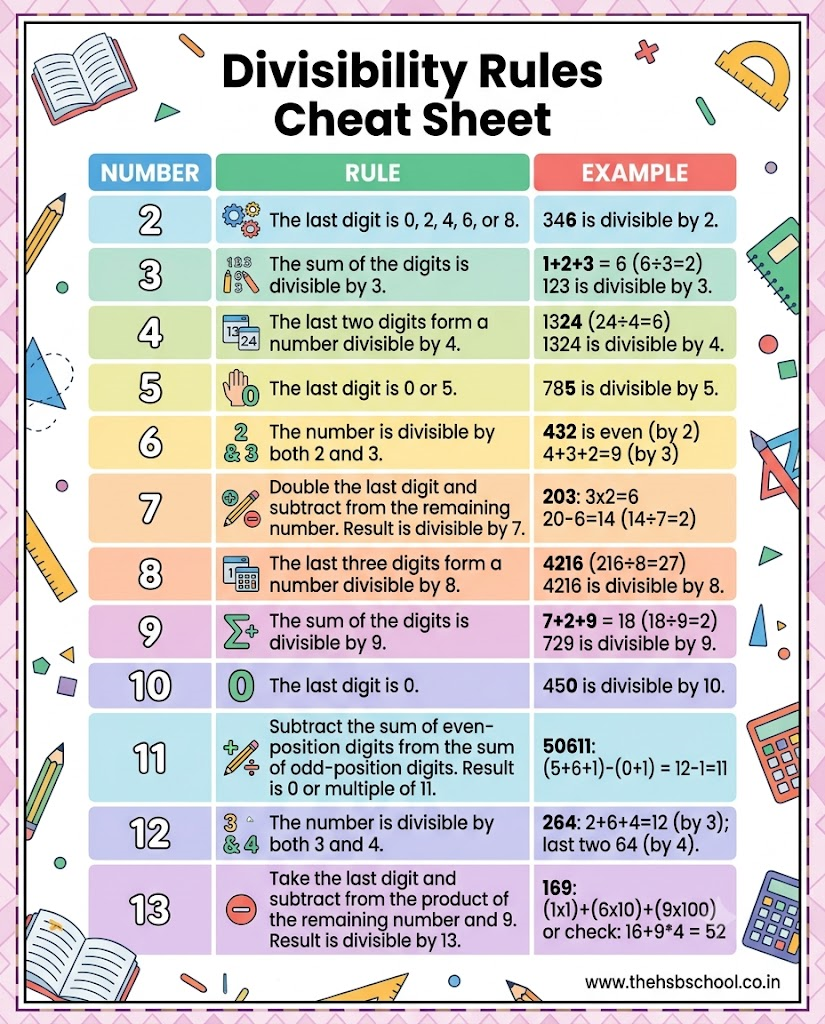
Divisibility Rules Chart (Quick Reference)
| Number | Divisibility Rule |
| 2 | Last digit is 0, 2, 4, 6, or 8 |
| 3 | Sum of digits is divisible by 3 |
| 4 | Last two digits are divisible by 4 |
| 5 | Last digit is 0 or 5 |
| 6 | Divisible by both 2 and 3 |
| 7 | Double the last digit and subtract from the remaining number |
| 8 | Last three digits are divisible by 8 |
| 9 | Sum of digits is divisible by 9 |
| 10 | Last digit is 0 |
| 11 | Difference between alternate digit sums is 0 or a multiple of 11 |
| 12 | Divisible by both 3 and 4 |
| 13 | Multiply the last digit by 4 and add it to the remaining number |
Common Mistakes Students Make
Avoid these common errors:
- Confusing the rules for 3 and 9.
- Checking only the last digit for divisibility by 4 instead of the last two digits.
- Forgetting that a number must satisfy both rules for 6 and 12.
- Mixing up the rules for 7 and 13.
- Using the divisibility rule for 11 incorrectly by ignoring alternate positions.
“`html
Divisibility Checker (2 to 13)
Enter any whole number to check whether it is divisible by numbers from 2 to 13.
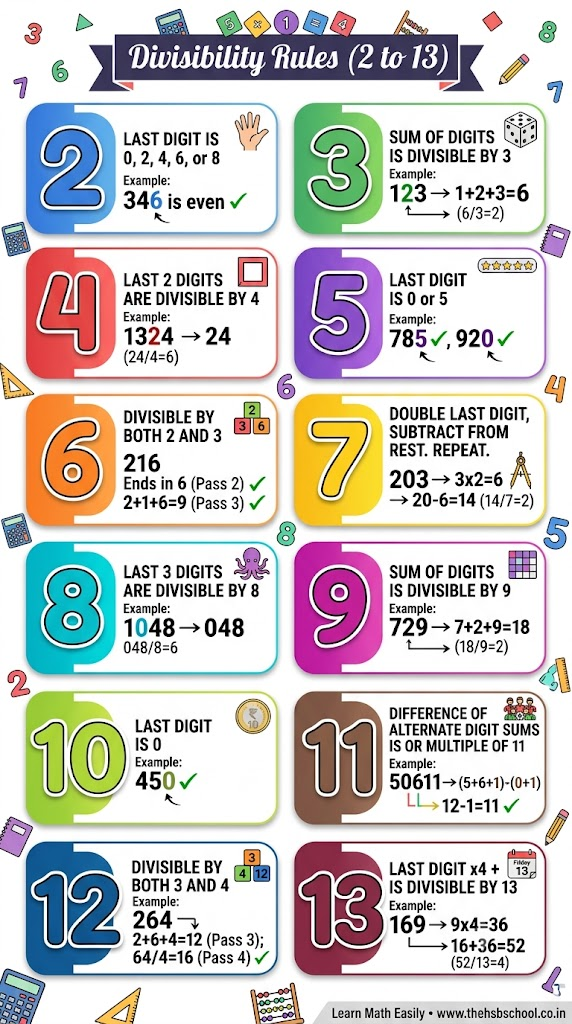
Easy Memory Tricks
| Number | Memory Trick |
| 2 | Even number |
| 3 | Add the digits |
| 4 | Last 2 digits |
| 5 | Ends in 0 or 5 |
| 6 | Rules of 2 + 3 |
| 7 | Double and subtract |
| 8 | Last 3 digits |
| 9 | Add the digits |
| 10 | Ends in 0 |
| 11 | Alternate digit sums |
| 12 | Rules of 3 + 4 |
| 13 | Multiply by 4 and add |
Practice Questions
Use the divisibility rules to answer the following without performing long division.
- Is 468 divisible by 3?
- Is 1,250 divisible by 5?
- Is 1,008 divisible by 8?
- Is 203 divisible by 7?
- Is 759 divisible by 9?
- Is 572 divisible by 11?
- Is 648 divisible by 12?
- Is 814 divisible by 2?
- Is 916 divisible by 4?
- Is 342 divisible by 6?
- Is 273 divisible by 13?
Answers
- ✅ Yes
- ✅ Yes
- ✅ Yes
- ✅ Yes
- ❌ No
- ✅ Yes
- ✅ Yes
- ✅ Yes
- ✅ Yes
- ✅ Yes
- ✅ Yes
Frequently Asked Questions (FAQs)
What are divisibility tricks?
Divisibility tricks are mathematical shortcuts used to determine whether one number can be divided exactly by another without performing long division.
Why are divisibility tricks useful?
Divisibility tricks help students solve problems more quickly, simplify fractions, find factors, calculate HCF and LCM, and save time during exams.
Which divisibility rule is the easiest?
The rules for 2, 5, and 10 are the easiest because you only need to look at the last digit.
How do I check if a number is divisible by 6?
A number is divisible by 6 if it is divisible by both 2 and 3.
How do I know if a number is divisible by 11?
Find the difference between the sums of digits in alternate positions. If the difference is 0 or a multiple of 11, the number is divisible by 11.
Is there a divisibility trivk for 13?
Yes. Multiply the last digit by 4, add it to the remaining number, and repeat if necessary. If the final result is divisible by 13, the original number is also divisible by 13.
Conclusion
Divisibility tricks are powerful mathematical shortcuts that make calculations faster and easier. By mastering these simple rules, you can quickly identify factors, simplify fractions, solve arithmetic problems efficiently, and improve your confidence in mathematics.
Start by memorizing the rules for 2, 3, 5, and 10, then gradually learn the more advanced rules for 7, 11, and 13. With regular practice, you’ll be able to recognize divisibility tricks almost instantly.
Keep practicing these divisibility tricks, and soon you’ll solve math problems faster than ever!