
🎯 Recommended Products for Students & Parents
Handpicked products specially selected for our visitors.

School Backpack Combo
✔ 29 L Spacious Backpack
✔ Includes Tiffin & Pouch
✔ Perfect for School & Coaching

Niacinamide Bright & Clear Skin Combo
✔ Brightens Skin
✔ Reduces Acne Marks
✔ Suitable for Daily Skincare
Disclosure: Some links on this page are affiliate links. We may earn a small commission if you purchase through them, at no additional cost to you.
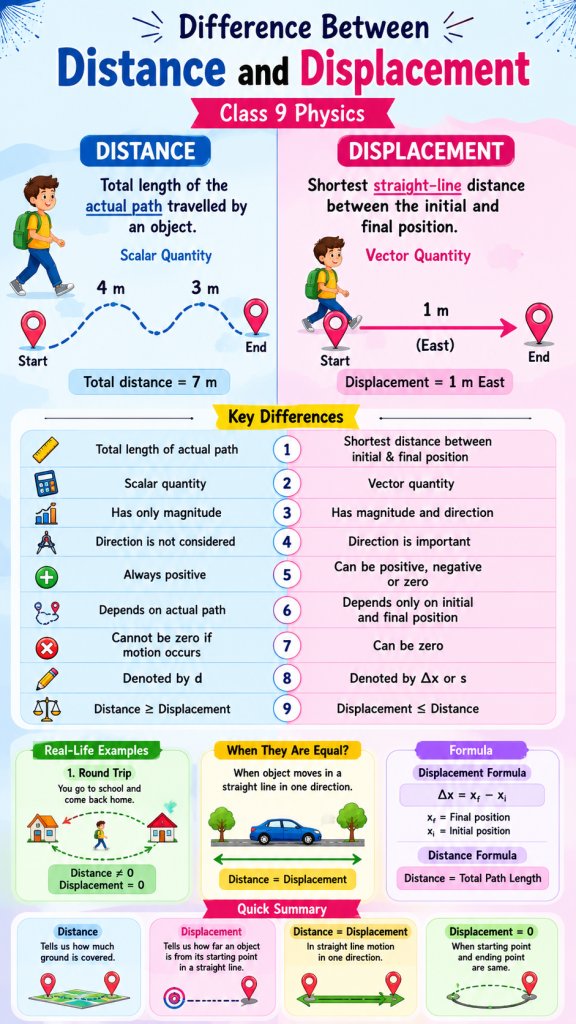
Understanding the difference between distance and displacement class 9 is one of the most important topics in Physics. Many students get confused because both terms seem similar, but they are completely different concepts.
In this article, you will learn:
- What is distance?
- What is displacement?
- Difference between distance and displacement class 9
- Real-life examples
- Formula and SI unit
- Comparison table
- Numerical examples
- FAQs
By the end of this article, you will clearly understand the difference between distance and displacement class 9 in a simple and easy way.
Table of Contents
What is Distance?
Distance is the total length of the actual path travelled by an object during motion.
It tells us how much ground an object has covered without considering direction. Distance is always positive.
Example:
If a boy walks:
- 4 m east
- then 3 m west
Total distance = 4 + 3 = 7 m
So, the total path covered is called distance.
What is Displacement?
Displacement is the shortest straight-line distance between the initial position and final position of an object.
Unlike distance, displacement also includes direction. It is a vector quantity.
Example:
If a person walks:
- 4 m east
- then 3 m west
Final position = 1 m east from starting point
So, displacement = 1 m east
Difference Between Distance and Displacement Class 9
The difference between distance and displacement class 9 can be understood easily using the table below.
| Distance | Displacement |
|---|---|
| Total length of actual path travelled | Shortest distance between initial and final position |
| Scalar quantity | Vector quantity |
| Has only magnitude | Has magnitude and direction |
| Direction is not considered | Direction is important |
| Always positive | Can be positive, negative, or zero |
| Depends on actual path | Depends only on initial and final position |
| Cannot be zero if motion occurs | Can be zero |
| Denoted by d | Denoted by Δx or s |
| Distance ≥ Displacement | Displacement ≤ Distance |
Formula of Distance and Displacement
Distance Formula
Distance=Total Path Length
Distance is calculated by adding the entire path travelled.
Displacement Formula
Displacement=xf−xi
Where:
- xf = Final position
- xi = Initial position
SI Unit of Distance and Displacement
The SI unit of both distance and displacement is:
SI Unit=metre (m)
Real-Life Example of Distance and Displacement
Imagine a student walks around a playground and returns to the starting point.
- Total path covered = 400 m
- Final position = Starting position
Therefore:
- Distance = 400 m
- Displacement = 0 m
This is one of the best examples to understand the difference between distance and displacement class 9.
Important Points About Distance and Displacement
Distance
- Scalar quantity
- Never negative
- Depends on complete path
- Measured using odometer in vehicles
Displacement
- Vector quantity
- Can be zero
- Has direction
- Always shortest path
When Distance and Displacement Become Equal
Distance and displacement become equal when an object moves:
- In a straight line
- In one direction only
- Without changing direction
Example:
A car moves 20 m east in a straight line.
- Distance = 20 m
- Displacement = 20 m east
Can Displacement Be Zero?
Yes, displacement can become zero.
This happens when the starting point and ending point are the same.
Example:
A runner completes one full round of a circular track and returns to the starting point.
- Distance ≠ 0
- Displacement = 0
Numerical Example
A boy walks:
- 5 m north
- then 12 m east
Find Distance
Distance = 5 + 12
Distance=17m
Find Displacement
Using Pythagoras theorem:
s=52+122s=25+144 s=169
s=13m
So,
- Distance = 17 m
- Displacement = 13 m
Why is Distance Always Greater Than or Equal to Displacement?
Displacement measures the shortest path between two points, while distance measures the entire path travelled.
Therefore:
Distance≥Displacement
FAQs on Difference Between Distance and Displacement Class 9
1. What is the main difference between distance and displacement?
Distance is the total path travelled, while displacement is the shortest straight-line distance between starting and ending points.
2. Is distance a scalar quantity?
Yes, distance is a scalar quantity because it has only magnitude.
3. Is displacement a vector quantity?
Yes, displacement is a vector quantity because it has both magnitude and direction.
4. Can displacement be negative?
Yes, displacement can be negative depending on direction.
5. Can distance be zero?
No, distance cannot be zero if an object moves.
Conclusion
Now you clearly understand the difference between distance and displacement class 9.
Distance tells us the total path travelled, while displacement tells us the shortest distance between two points along with direction.
Remember:
- Distance is scalar
- Displacement is vector
- Distance depends on path
- Displacement depends only on starting and ending positions
This topic is extremely important for Class 9 Physics and forms the base for understanding motion, speed, and velocity later.
This article is part of The HSB School’s Class 10 Science series. Also read: Difference Between Speed and Velocity | Difference Between Mass and Weight | Difference Between Heat and Temperature