
🎯 Recommended Products for Students & Parents
Handpicked products specially selected for our visitors.

School Backpack Combo
✔ 29 L Spacious Backpack
✔ Includes Tiffin & Pouch
✔ Perfect for School & Coaching

Niacinamide Bright & Clear Skin Combo
✔ Brightens Skin
✔ Reduces Acne Marks
✔ Suitable for Daily Skincare
Disclosure: Some links on this page are affiliate links. We may earn a small commission if you purchase through them, at no additional cost to you.
Chapter: Heredity and Evolution | Class: 10 | Subject: Biology | Board: CBSE
Difference Between Acquired and Inherited Traits
Table of Contents
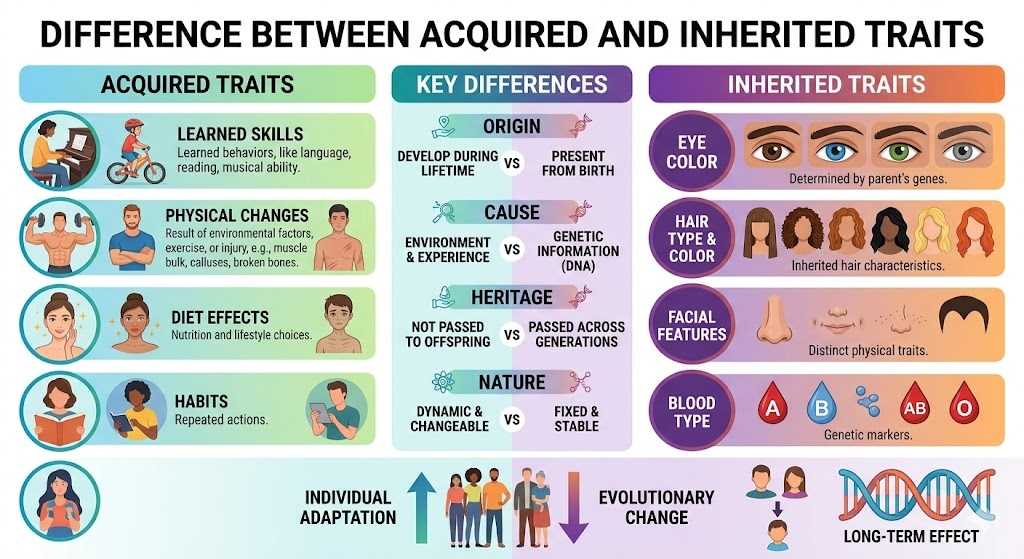
Have you ever noticed that you have your mother’s eyes but learned swimming just like your father did? Here is the important science behind this — your eye colour is an inherited trait, but your ability to swim is an acquired trait.
In Class 10 Science, Chapter 9 (Heredity and Evolution), understanding the difference between acquired and inherited traits is a very important concept. It is also a common question in board exams.
In this article, you will learn:
- What are inherited traits?
- What are acquired traits?
- Difference between acquired and inherited traits (with table)
- Real-life examples you can relate to
- Why acquired traits are NOT passed to the next generation
- Important exam questions and answers
What Are Inherited Traits?
Inherited traits are the characteristics that a living organism receives from its parents through genes at the time of birth.
Definition: Inherited traits are biological features that are passed from parents to their offspring through DNA and remain unchanged throughout the organism’s lifetime unless a genetic mutation occurs.
In simple words — these traits come pre-programmed in your genes before you were even born.
Key Features of Inherited Traits
- Present since birth
- Controlled by genes (DNA)
- Passed from one generation to the next
- Cannot be changed by environment or lifestyle
- Also called genetic traits or hereditary traits
Examples of Inherited Traits in Humans
| Trait | How It Is Inherited |
|---|---|
| Eye colour (brown, black, blue) | Passed through genes from parents |
| Blood group (A, B, AB, O) | Determined by genes at birth |
| Skin colour | Controlled by melanin-related genes |
| Hair colour and texture | Genetic inheritance |
| Height and body structure | Partly controlled by genes |
| Shape of nose and earlobes | Inherited through DNA |
| Tongue rolling ability | Genetic trait |
Examples of Inherited Traits in Animals and Plants
- A black cat giving birth to black kittens
- Tall pea plants producing tall offspring (Mendel’s experiment)
- A mango tree producing mangoes — not another fruit
- Colour patterns in butterflies passed from parent to offspring
What Are Acquired Traits?
Acquired traits are the characteristics that an organism develops during its own lifetime because of its experiences, environment, practice, or external factors.
Definition: Acquired traits are features developed by an organism after birth due to environmental influence, personal experience, or lifestyle. They are NOT coded in the DNA and therefore cannot be passed on to future generations.
In simple words — these are skills and changes you pick up during your life, not something you were born with.
Key Features of Acquired Traits
- Developed after birth
- NOT controlled by genes (DNA)
- Cannot be passed to the next generation
- Can be lost or changed over time
- Also called somatic variations
Examples of Acquired Traits in Humans
| Acquired Trait | How It Is Acquired |
|---|---|
| Ability to swim | Learned through practice |
| Speaking a language | Learned from surroundings |
| Muscle size of a bodybuilder | Developed through exercise |
| Scar on the body | Result of an injury |
| Reading and writing skill | Learned through education |
| Playing guitar or cricket | Skill developed through practice |
Examples of Acquired Traits in Animals
- A dog trained to sit on command — the training is not passed to its puppies
- A cat that learns to open a door — its kittens will not know how to do this
- A bird that develops stronger muscles by flying long distances — its offspring will not automatically have stronger muscles
Difference Between Acquired and Inherited Traits – Comparison Table
This is the most important table for your Class 10 board exam. Study it carefully.
| Point of Difference | Inherited Traits | Acquired Traits |
|---|---|---|
| Definition | Traits passed from parents to offspring through genes | Traits developed by an organism during its own lifetime |
| Present at Birth | Yes — present since birth | No — develops after birth |
| Controlled by Genes (DNA) | Yes | No |
| Can Be Passed to Next Generation | Yes | No |
| Type of Variation | Genetic variation | Somatic variation |
| Affected by Environment | No | Yes |
| Can Be Changed or Lost | No (unless genetic mutation) | Yes |
| Examples | Eye colour, blood group, height, skin colour | Swimming, language, scar, muscle mass |
| Role in Evolution | Play a major role in evolution | Do NOT contribute to evolution |
| Lamarck’s Theory | Not part of Lamarckism | Lamarck wrongly believed these are passed on |
Why Are Acquired Traits NOT Passed to the Next Generation?
This is a very commonly asked exam question. Here is the clear explanation:
Acquired traits are changes that happen in the body cells (somatic cells) of an organism. These body cells do NOT contribute to reproduction.
The cells responsible for reproduction are called germ cells (sperm and egg cells). Germ cells contain the DNA that is passed to the next generation.
When you build muscle by exercising, only your body (somatic) cells change. Your germ cells remain exactly the same. So when you have a child, they receive your original, unchanged germ cell DNA — not the acquired changes in your body.
Simple Example:
If a farmer cuts the tail of a mouse, its babies will still be born with tails. Because the tail removal is an acquired (somatic) change, not a change in DNA.
This is also why Charles Darwin’s Theory of Evolution is accepted over Lamarck’s Theory.
#Difference Between Acquired and Inherited Traits
Lamarck’s Theory vs. Darwin’s Theory
| Lamarck’s Theory | Darwin’s Theory | |
|---|---|---|
| Belief about acquired traits | Acquired traits CAN be inherited | Acquired traits CANNOT be inherited |
| Accepted today? | No — Rejected | Yes — Accepted |
| Example | Giraffes stretched their necks, and offspring were born with longer necks | Giraffes with naturally longer necks survived better (natural selection) |
Quick Recap: Acquired vs Inherited Traits
| Inherited | Acquired | |
|---|---|---|
| Born with it? | ✅ Yes | ❌ No |
| Coded in DNA? | ✅ Yes | ❌ No |
| Passed to children? | ✅ Yes | ❌ No |
| Can environment change it? | ❌ No | ✅ Yes |
#Difference Between Acquired and Inherited Traits
Real-Life Examples to Remember Easily
Example 1: The Bodybuilder’s Child
A father works hard and develops very large muscles through years of exercise. When he has a child, will the child be born with large muscles? No! Because the large muscles are an acquired trait — they developed due to exercise (environment), not through genes. The child will be born with normal muscle structure.
Example 2: Eye Colour
A mother has brown eyes. Her child is also born with brown eyes. This is an inherited trait — it was passed directly through genes (DNA) from the mother to the child, without any effort or learning.
Example 3: Language
You speak Hindi or Marathi because you grew up in that environment. If your parents had moved to Japan before you were born, you would speak Japanese. This is an acquired trait — language is learned, not inherited genetically.
Example 4: Scar
A person gets a deep scar on their arm. Their children will not be born with that scar. A scar is a change in body cells only, not in the DNA of germ cells.
Connection to Evolution (Class 10 Chapter 9)
Understanding acquired vs inherited traits is essential for Chapter 9 because:
- Only inherited traits play a role in evolution
- Variations in inherited traits, over many generations, lead to natural selection
- Acquired traits are lost when the organism dies — they do not contribute to the evolution of a species
- This is why Darwin’s theory (based on inherited variation) replaced Lamarck’s theory (based on acquired traits)
Important Exam Questions and Answers
Q1. Define acquired traits. Give two examples.
Answer: Acquired traits are characteristics developed by an organism during its own lifetime due to environmental influence, practice, or experience. They are not coded in the DNA and cannot be passed to the next generation. Examples: (1) Ability to swim (2) Speaking a language
Q2. Define inherited traits. Give two examples.
Answer: Inherited traits are characteristics passed from parents to offspring through genes (DNA). They are present from birth and are transmitted to the next generation. Examples: (1) Eye colour (2) Blood group
Q3. Why are acquired traits not passed on to the next generation?
Answer: Acquired traits involve changes in somatic (body) cells only, not in germ cells (sperm and egg). Since reproduction involves germ cells, the acquired changes in body cells are not transferred to the next generation.
Q4. A mouse’s tail is cut off for several generations. Will the offspring be born without a tail? Give a reason.
Answer: No. Cutting the tail is a change in somatic cells, not in the germ cell DNA. Since germ cell DNA remains unchanged, all offspring will continue to be born with tails.
Q5. Why did scientists reject Lamarck’s theory of inheritance of acquired characters?
Answer: Lamarck believed that traits acquired during an organism’s lifetime could be passed to offspring. However, scientists found that acquired traits occur only in somatic (body) cells and do not affect germ cell DNA. Since reproduction depends on germ cells, acquired traits are not inherited. This was experimentally proven and Lamarck’s theory was rejected.
Q6. Differentiate between acquired traits and inherited traits with two points each.
| Inherited Traits | Acquired Traits | |
|---|---|---|
| 1 | Present by birth; controlled by genes | Developed after birth; not controlled by genes |
| 2 | Passed to next generation | Not passed to next generation |
Summary
- Inherited traits come from genes passed by parents. They are present at birth, controlled by DNA, and are passed to the next generation.
- Acquired traits develop during an organism’s lifetime due to the environment or experience. They are NOT in the DNA and are NOT passed to offspring.
- Acquired traits involve changes in somatic cells only, not in germ cells.
- Only inherited traits play a role in evolution.
- Lamarck was wrong — acquired traits are not inherited. Darwin was right — only inherited variation leads to evolution.
Keywords to Remember for Board Exam
- Inherited traits = Genetic traits = Hereditary traits
- Acquired traits = Somatic variations
- Germ cells = Sperm and egg cells (carry DNA to next generation)
- Somatic cells = Body cells (do NOT pass DNA to next generation)
- Lamarck = Wrongly believed acquired traits are inherited
- Darwin = Correctly explained evolution through natural selection of inherited traits
This article is part of The HSB School’s Class 10 Science series. Also read: Difference Between Speed and Velocity | Difference Between Mass and Weight | Difference Between Heat and Temperature
#Difference Between Acquired and Inherited Traits