
🎯 Recommended Products for Students & Parents
Handpicked products specially selected for our visitors.
School Backpack Combo
✔ 29 L Spacious Backpack
✔ Includes Tiffin & Pouch
✔ Perfect for School & Coaching

Niacinamide Bright & Clear Skin Combo
✔ Brightens Skin
✔ Reduces Acne Marks
✔ Suitable for Daily Skincare
Disclosure: Some links on this page are affiliate links. We may earn a small commission if you purchase through them, at no additional cost to you.
Do you know why does a sharp knife cut better than a blunt knife ? Learn the science of pressure and area. Discover why a sharp knife cuts better than a blunt knife using the physics formula for pressure.
Have you ever tried to slice a tomato with a dull knife, only to end up squashing it instead? It’s a common kitchen frustration, but it’s also a perfect lesson in physics!
If you are studying Class 8 Science, you’ve likely come across the chapter on Force and Pressure. To understand why does a sharp knife cut better than a blunt knife, we need to look at the relationship between the force you apply and the surface area of the object you are using.
Table of Contents
The Science of Pressure
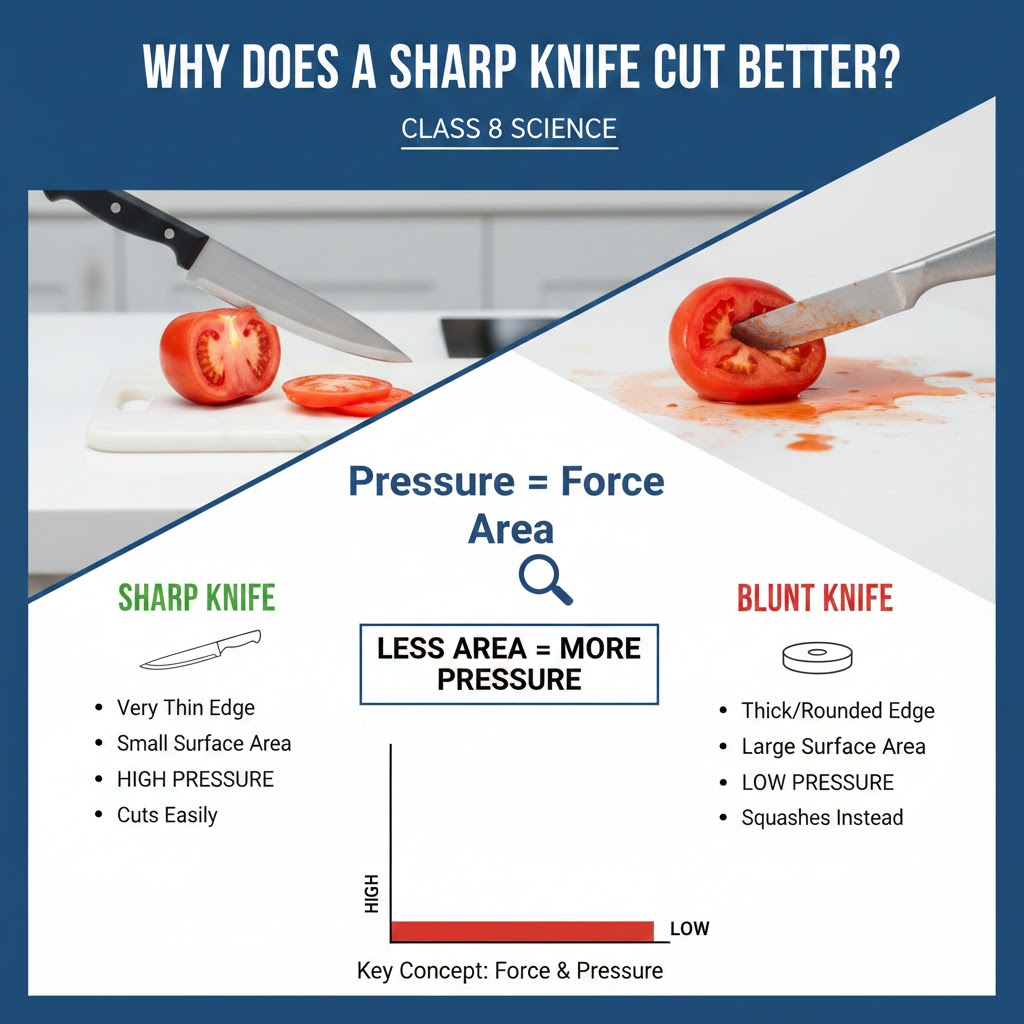
In physics, pressure is defined as the force acting per unit area of a surface. The formula is:
$$Pressure = \frac{Force}{Area}$$
The Rule of Thumb
Formula: Less Area = More Pressure
This simple equation tells us that pressure is inversely proportional to the area. If you keep the force the same but decrease the area, the pressure increases significantly.
Sharp vs. Blunt: The Comparison
So, why does a sharp knife cut better than a blunt knife? It all comes down to the thickness of the edge.
1. The Sharp Knife (Small Area)
A sharp knife has a very thin, fine edge. This means the contact area between the knife and the object (like a vegetable) is extremely small. When you apply force to the handle, that force is concentrated over a tiny area, creating high pressure. This high pressure easily pierces the surface of the object.
2. The Blunt Knife (Large Area)
A blunt or dull knife has a rounded, thicker edge. Because the edge is worn down, the contact area is much larger. Even if you push with the same amount of force, that force is spread out over a wider surface, resulting in low pressure. This is why a blunt knife often fails to cut unless you push much harder.
| Feature | Sharp Knife | Blunt Knife |
| Edge Thickness | Very Thin | Thick/Rounded |
| Surface Area | Small | Large |
| Pressure Produced | High | Low |
| Effort Required | Less | More |
Conclusion
The reason why does a sharp knife cut better than a blunt knife is purely down to the distribution of pressure. By sharpening a blade, we reduce its surface area, allowing us to generate enough pressure to break through materials with very little effort.
The next time you’re in the kitchen, remember: it’s not just about how hard you push, it’s about how small your contact point is!
Why are the Soles of Shoes Grooved?
Why is Friction Called a Necessary Evil?
Why Do We Slip When We Step on a Banana Peel?
Why Sound Cannot Travel Through Vacuum