
🎯 Recommended Products for Students & Parents
Handpicked products specially selected for our visitors.

School Backpack Combo
✔ 29 L Spacious Backpack
✔ Includes Tiffin & Pouch
✔ Perfect for School & Coaching

Niacinamide Bright & Clear Skin Combo
✔ Brightens Skin
✔ Reduces Acne Marks
✔ Suitable for Daily Skincare
Disclosure: Some links on this page are affiliate links. We may earn a small commission if you purchase through them, at no additional cost to you.
Learn Why Sound Cannot Travel Through Vacuum and how the Bell Jar Experiment proves that sound cannot travel through a vacuum. Perfect for Class 8 Science.
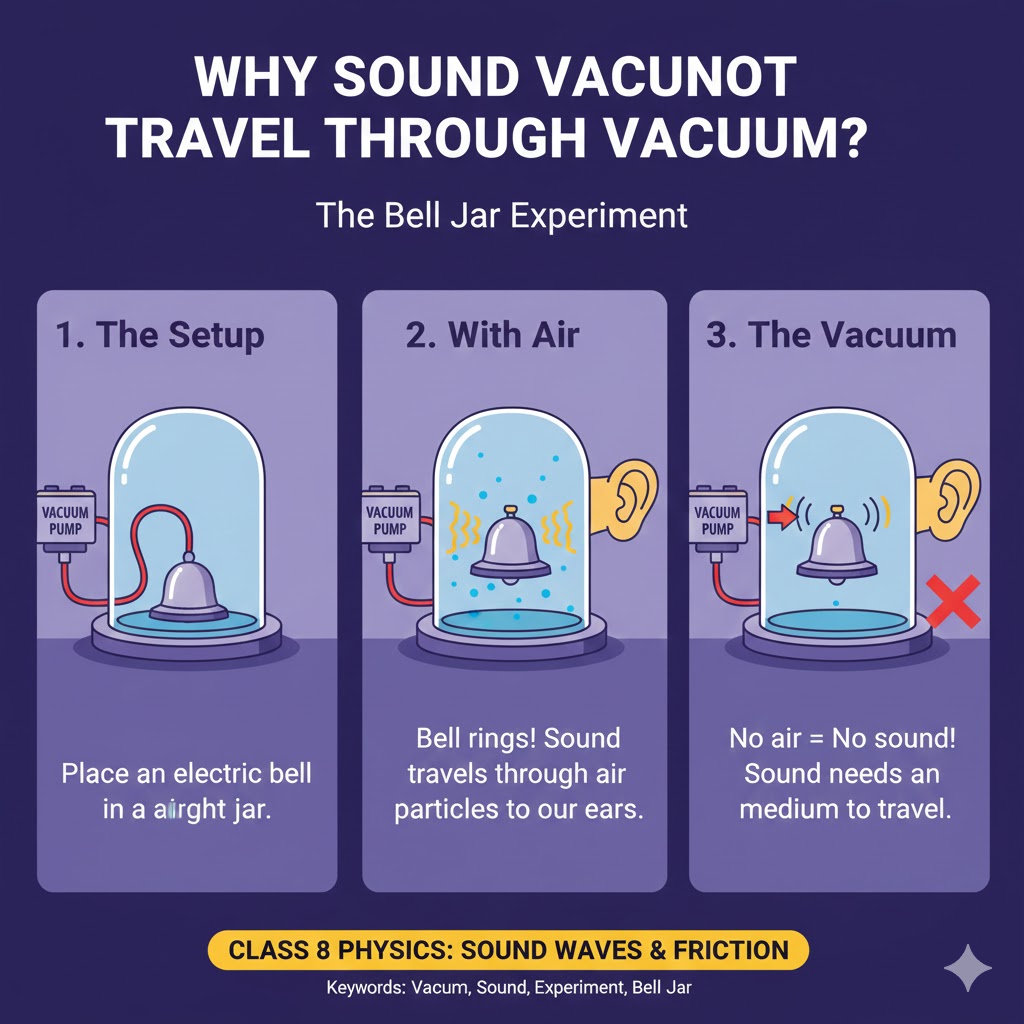
Table of Contents
Why Sound Cannot Travel Through Vacuum
In our daily lives, we hear sounds everywhere—from the chirping of birds to the ringing of a school bell. But did you know that if you were standing on the Moon, you wouldn’t be able to hear your friend shouting right next to you?
This is because of a fundamental rule of Physics: Sound needs a medium to travel.
1. What is Sound?
Sound is a form of energy produced by vibrations. When an object vibrates, it sets the particles of the surrounding medium (like air, water, or solid metal) into motion. These particles bump into each other, passing the vibration along until it reaches our ears.
2. Why the “Vacuum” is Silent
A vacuum is a space that is completely empty of matter—it has no air, no liquid, and no solids.
Since sound is a mechanical wave, it relies on the “domino effect” of particles hitting each other. In a vacuum, there are no molecules to carry these vibrations. No particles = No sound!
The Bell Jar Experiment
The best way to prove that sound cannot travel through a vacuum is the famous Bell Jar Experiment.
Apparatus Required:
- An airtight glass bell jar.
- An electric bell.
- A vacuum pump connected to the base of the jar.
The Procedure:
- The Setup: Place the electric bell inside the glass jar and connect it to a battery.
- Initial State: Switch on the bell. You will hear the ringing sound clearly because the jar is full of air.
- Creating the Vacuum: Now, start the vacuum pump to gradually remove the air from inside the jar.
- Observation: As the air is pumped out, the sound of the bell becomes fainter and fainter.
- Final Result: Once all the air is removed (creating a vacuum), you can still see the hammer hitting the bell, but no sound is heard.
Conclusion:
This experiment clearly demonstrates that sound requires a material medium (like air) for its propagation. When the medium is removed, the sound waves have nothing to travel through.
#Why Sound Cannot Travel Through Vacuum
Quick Summary for Exams
- Medium Required: Sound can travel through solids, liquids, and gases.
- Vacuum: Sound cannot travel through a vacuum because there are no particles to vibrate.
- Speed: Sound travels fastest in solids and slowest in gases.
Why are the Soles of Shoes Grooved?
Why is Friction Called a Necessary Evil?
Why Do We Slip When We Step on a Banana Peel?
#Why Sound Cannot Travel Through Vacuum