
🎯 Recommended Products for Students & Parents
Handpicked products specially selected for our visitors.

School Backpack Combo
✔ 29 L Spacious Backpack
✔ Includes Tiffin & Pouch
✔ Perfect for School & Coaching

Niacinamide Bright & Clear Skin Combo
✔ Brightens Skin
✔ Reduces Acne Marks
✔ Suitable for Daily Skincare
Disclosure: Some links on this page are affiliate links. We may earn a small commission if you purchase through them, at no additional cost to you.
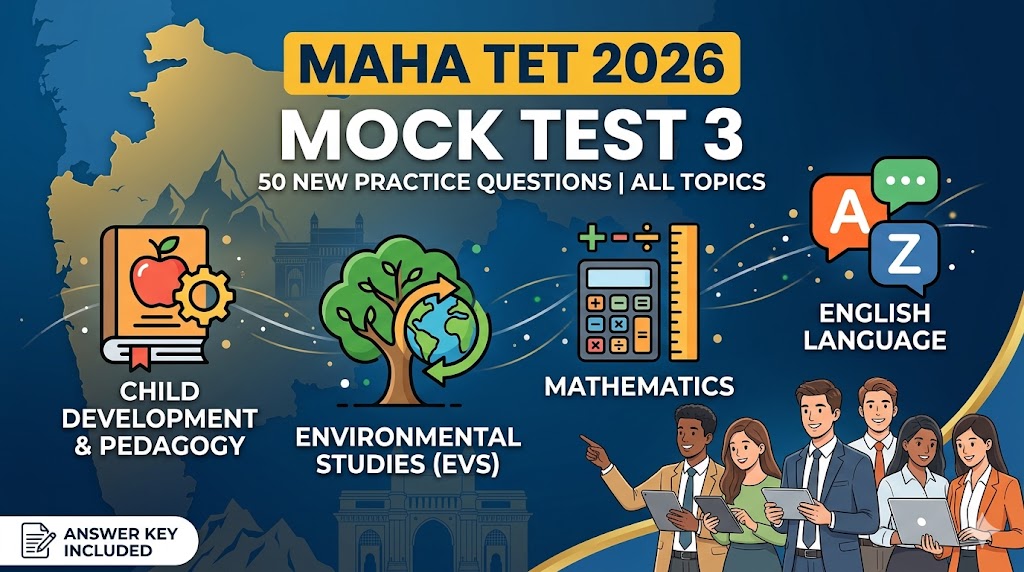
Welcome back to The HSB School! If you are serious about clearing the MAHA TET exam on your first attempt, you know that variety is the spice of preparation. While our first two mock tests covered the basics, this MAHA TET 2026 Mock Test 3 introduces a fresh set of challenging questions designed to test your deeper understanding of the syllabus.
The MAHA TET (Maharashtra Teacher Eligibility Test) requires candidates to be quick and accurate. By solving these questions without looking at the answers, you can simulate a real exam environment. This set is particularly useful for those targeting the latest MAHA TET 2026 pattern.
Table of Contents
Section 1: Child Development & Pedagogy
- Which psychologist defined adolescence as a “period of great stress, strain, storm, and strife”?
- What is the primary focus of ‘Micro-teaching’?
- According to the ‘Law of Effect’ by Thorndike, if a response is followed by a satisfying state of affairs, the strength of the connection is:
- ‘Individual differences’ in a classroom are best handled by:
- The ‘Discovery Learning’ model was developed by:
- Which type of intelligence is emphasized for a person who is a successful ‘Counselor’?
- ‘Object Permanence’ is a characteristic of which Piagetian stage?
- In the ‘Nature vs. Nurture’ debate, ‘Nurture’ refers to:
- What does ‘TLM’ stand for in the context of teaching?
- The concept of ‘Mental Age’ was first introduced by:
- Which learning theory focuses on ‘Observation and Imitation’?
- A child who struggles with social communication and repetitive behaviors may be showing signs of:
- Which assessment is conducted at the end of a course to certify a student?
- ‘Project Method’ of teaching was inspired by the philosophy of:
- The ‘National Curriculum Framework’ (NCF) was last updated in which year?
Section 2: Environmental Studies (EVS)
- Which Indian state is known as the ‘Tiger State’?
- The ‘Bishnoi Movement’ of Rajasthan was dedicated to the protection of:
- Which layer of the atmosphere is closest to the Earth’s surface?
- ‘Minamata Disease’ is caused by the consumption of fish contaminated with:
- The energy flow in an ecosystem is always:
- Which vitamin helps in the clotting of blood?
- ‘World Wetlands Day’ is observed on which date?
- The ‘Red Data Book’ is published by which organization?
- Which of the following is a ‘Secondary Pollutant’?
- The process of converting ammonia into nitrates is called:
- Which gas is known as the ‘Silent Killer’?
- The ‘Valmiki National Park’ is located in which state?
- Which bio-indicator is used to detect Air Pollution (specifically SO2)?
- The term ‘Ecosystem’ was coined by:
- ‘Kopli’ and ‘Dhura’ are traditional water harvesting systems found in:
Section 3: Mathematics & Logical Reasoning
- What is the difference between the largest 4-digit number and the smallest 3-digit number?
- If a car covers 120 km in 3 hours, what is its speed in meters per second?
- Find the value of $x$ if $2x + 15 = 45$.
- A person buys a pen for ₹20 and sells it for ₹25. Find the profit percentage.
- How many lines of symmetry does a regular Hexagon have?
- What is the sum of the first 10 natural numbers?
- If the radius of a circle is doubled, its area becomes how many times the original?
- Which of the following is NOT a perfect square: 121, 144, 169, 180?
- Convert 0.75 into a simple fraction.
- The measure of an angle which is four times its supplement is:
Section 4: English Language
- Choose the correct synonym for ‘Diligent’.
- Change to indirect speech: He said, “I am reading a book.”
- Fill in the blank: “If it rains, we ______ the match.”
- Identify the ‘Part of Speech’ for the word ‘Fast’ in: “He ran fast.”
- What is the feminine form of ‘Bachelor’?
- Choose the correct preposition: “The cat jumped ______ the table.”
- Give the one-word substitution for: “A person who knows many languages.”
- Which of these is a ‘Compound Sentence’?
- Identify the silent letter in the word ‘Psychology’.
- What is the antonym of ‘Vague’?
MAHA TET 2026: Mock Test 3 Answer Key
Compare your answers below to evaluate your MAHA TET preparation level.
Section 1: CDP
- Stanley Hall | 2. Skill acquisition | 3. Increased | 4. Differentiated instruction | 5. Jerome Bruner | 6. Interpersonal | 7. Sensory-motor | 8. Environment/Upbringing | 9. Teaching Learning Material | 10. Alfred Binet | 11. Social Learning Theory (Bandura) | 12. Autism | 13. Summative Assessment | 14. John Dewey (Kilpatrick) | 15. 2005 (though updated versions are emerging under NEP 2020)
Section 2: EVS
16. Madhya Pradesh | 17. Khejri Trees | 18. Troposphere | 19. Mercury | 20. Unidirectional | 21. Vitamin K | 22. February 2 | 23. IUCN | 24. Ozone (O3) | 25. Nitrification | 26. Carbon Monoxide (CO) | 27. Bihar | 28. Lichens | 29. A.G. Tansley | 30. Maharashtra
Section 3: Mathematics
31. 9899 ($9999 – 100$) | 32. 11.11 m/s ($40$ km/h $\div 3.6$) | 33. $15$ | 34. 25% | 35. 6 | 36. 55 | 37. 4 times | 38. 180 | 39. 3/4 | 40. 144°
Section 4: English
41. Hard-working | 42. He said that he was reading a book | 43. will cancel | 44. Adverb | 45. Spinster | 46. upon / onto | 47. Polyglot | 48. Sentences joined by ‘and’, ‘but’, or ‘so’ | 49. P | 50. Clear / Definite
How to prepare for MAHA TET 2026?
Don’t just memorize the answers. Try to understand the logic behind each question. Bookmark this page of The HSB School for more updates on the MAHA TET 2026 exam. Consistent practice is the only way to ensure your name appears in the final merit list!