
Understanding how to identify parts of speech with examples is one of the most important skills in English grammar. Many students struggle to recognize whether a word is a noun, verb, adjective, adverb, or something else—especially when the same word changes its role in different sentences.
If you’ve ever asked questions like:
- Is “book” a noun or a verb?
- Why is “fast” sometimes an adjective and sometimes an adverb?
- How do I quickly identify parts of speech in exams?
You’re in the right place. This guide is designed to be more practical, more problem-solving oriented, and more student-friendly than typical grammar explanations. By the end of this article, you’ll clearly understand how to identify parts of speech with examples and apply it confidently in exams, writing, and speaking.
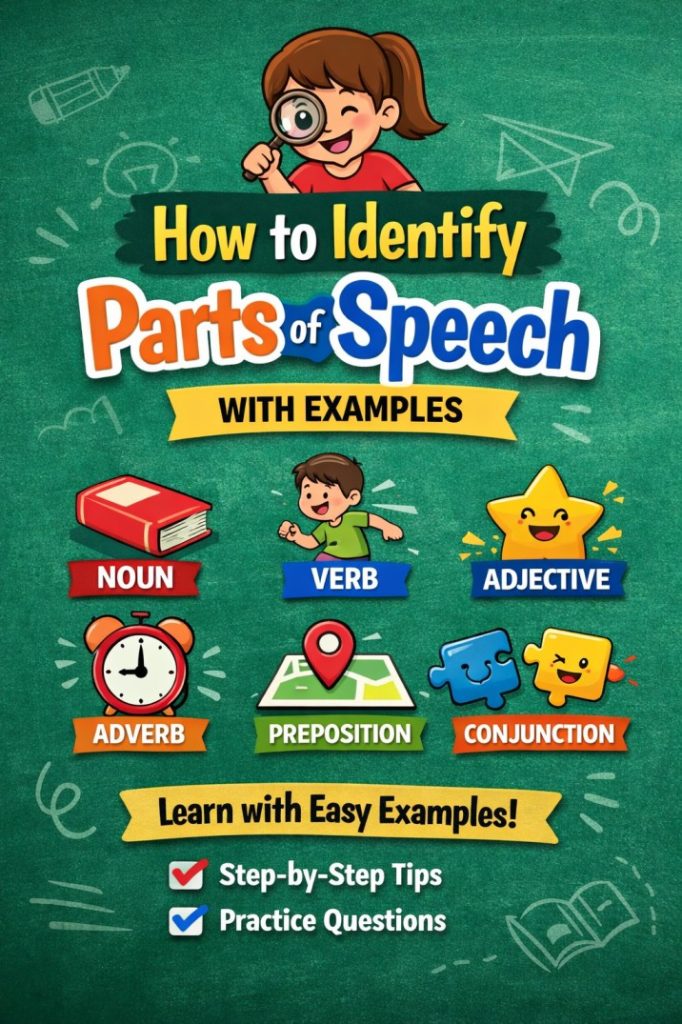
Table of Contents
What Are Parts of Speech?
Parts of speech are the categories of words based on their function in a sentence. In simple terms, they tell us what job a word is doing.
The main parts of speech in English are:
- Noun
- Pronoun
- Verb
- Adjective
- Adverb
- Preposition
- Conjunction
- Interjection
(Articles/Determiners are often included with adjectives)
To master how to identify parts of speech with examples, remember this golden rule:
👉 Do not identify a word by memorizing its meaning. Identify it by its function in the sentence.
Step-by-Step Method to Identify Parts of Speech (Problem-Solving Approach)
Instead of memorizing long definitions, use this 3-step thinking method whenever you face a grammar question:
Step 1: Find the Word’s Role in the Sentence
Ask: What is this word doing in this sentence?
Step 2: Ask the Right Question
Different parts of speech answer different questions:
- Noun → Who? What?
- Verb → What action? What state?
- Adjective → Which one? What kind? How many?
- Adverb → How? When? Where? To what extent?
- Preposition → Relationship between two words
- Conjunction → Joining words or clauses
Step 3: Replace the Word
Try replacing the word with a similar known word. If the sentence still makes sense, you’ve likely found the correct part of speech.
This simple logic-based method will greatly improve your skill in how to identify parts of speech with examples.
1. Noun – Naming Words (With Tricky Examples)
Definition: A noun names a person, place, thing, or idea.
Examples:
- Rahul is a good student.
- Mumbai is a big city.
- Honesty is the best policy.
Common Student Problem
Some words look like verbs but act as nouns.
👉 Example:
- I read a book. (noun)
- Please book a ticket. (verb)
Tip: If the word is naming something, it is a noun. This trick helps you master how to identify parts of speech with examples correctly.
2. Pronoun – Words That Replace Nouns
Definition: Pronouns replace nouns to avoid repetition.
Examples:
- Rahul is late because he missed the bus.
- This pen is mine. It is new.
Problem-Solving Tip
If the word is standing instead of a noun, it is a pronoun.
3. Verb – Action or State Words
Definition: A verb shows action or state of being.
Examples:
- She runs every morning.
- I am happy today.
Tricky Example
- I have a car. (main verb)
- I have finished my work. (helping verb)
So, while learning how to identify parts of speech with examples, always check whether the word is showing an action or helping another verb.
4. Adjective – Describing Nouns
Definition: An adjective describes a noun or pronoun.
Examples:
- She has a beautiful dress.
- This is an interesting book.
Common Confusion
Students often confuse adjectives and adverbs.
👉 Example:
- She is a fast runner. (adjective – describing noun)
- She runs fast. (adverb – describing verb)
This comparison is crucial in understanding how to identify parts of speech with examples accurately.
5. Adverb – Describing Verbs, Adjectives, or Other Adverbs
Definition: An adverb gives more information about how, when, where, or how much.
Examples:
- He speaks clearly.
- She is very smart.
- We will meet tomorrow.
Quick Trick
If the word answers how, when, where, or how much, it’s probably an adverb.
6. Preposition – Showing Relationship
Definition: A preposition shows the relationship between a noun/pronoun and another word.
Examples:
- The cat is on the table.
- The book is under the chair.
Easy Test
If you can imagine a position or direction, it’s usually a preposition.
7. Conjunction – Joining Words or Sentences
Definition: A conjunction joins words, phrases, or clauses.
Examples:
- I wanted to go, but it was raining.
- She likes tea and coffee.
Common Conjunctions
and, but, or, because, although, so
Understanding these helps in mastering how to identify parts of speech with examples in complex sentences.
8. Interjection – Expressing Emotion
Definition: An interjection expresses sudden feelings.
Examples:
- Wow! That’s amazing.
- Oh! I forgot my keys.
Mixed Practice: Identify Parts of Speech (Solved Examples)
Let’s apply what we learned about how to identify parts of speech with examples.
Sentence 1: She quickly finished her homework.
- She → Pronoun
- quickly → Adverb
- finished → Verb
- her → Adjective (possessive determiner)
- homework → Noun
Sentence 2: The little boy ran across the road.
- The → Article
- little → Adjective
- boy → Noun
- ran → Verb
- across → Preposition
- the → Article
- road → Noun
Common Mistakes Students Make
❌ Identifying by meaning instead of function
❌ Thinking one word always belongs to one part of speech
❌ Ignoring the word’s position in the sentence
Correct Approach:
Always check what the word is doing in the sentence. This mindset is the backbone of learning how to identify parts of speech with examples.
Simple Practice Exercise (Try Yourself)
Identify the parts of speech of the highlighted words:
- She quickly solved the problem.
- I have a light bag.
- They will play in the evening.
- The dog is under the table.
(Answers: quickly – adverb, light – adjective, play – verb, under – preposition)
Why Learning Parts of Speech Matters
When you master how to identify parts of speech with examples, you will:
- Write better sentences
- Speak more confidently
- Score higher marks in grammar exams
- Understand tenses and sentence structure easily
- Avoid common English mistakes
This is not just grammar—it’s the foundation of clear communication.
Final Thoughts
Learning how to identify parts of speech with examples does not have to be confusing or boring. The secret is to think logically, focus on the function of words, and practice with real sentences. Instead of memorizing rules, train your brain to ask simple questions like:
👉 What is this word doing in the sentence?
If you practice this daily for even 10 minutes, you’ll notice a huge improvement in your English grammar skills within a few weeks.
Check out our blog on Leave Application
Check out our blog on Formal letter
Check out our blog on How to Use Past Perfect Tense
Check out our blog on Difference between present perfect and past perfect tense
Check out our blog on Common Mistakes in English Grammar for Students
Check out our blog on Examples of Active and Passive Voice Sentences for Students