

Table of Contents
Introduction
Understanding English tenses is one of the biggest challenges for learners. Among all the tenses, students often get confused about the difference between present perfect and past perfect tense in English. Both tenses talk about past actions, but their usage, meaning, and context are different.
If you’ve ever wondered when to say “I have finished my work” and when to say “I had finished my work,” you’re not alone. In this article, we’ll clearly explain the difference between present perfect and past perfect tense in English, with simple rules, examples, comparison tables, common mistakes, and practice tips.
By the end of this guide, you’ll confidently know which tense to use in real-life speaking and writing.
What Is the Present Perfect Tense?
The present perfect tense is used to describe an action that happened in the past but is still connected to the present. The exact time of the action is usually not mentioned.
👉 Structure of Present Perfect
Subject + has/have + past participle (V3)
Examples:
- I have completed my homework.
- She has visited Mumbai.
- They have started the project.
👉 When to Use Present Perfect
We use the present perfect tense when:
- The result is important now
- The action happened at an unspecified time
- The action started in the past and continues till now
Examples:
- I have lost my keys. (I still can’t find them)
- He has worked here for five years.
- We have already eaten lunch.
So, the present perfect connects the past with the present.
What Is the Past Perfect Tense?
The past perfect tense is used to describe an action that was completed before another action in the past. It shows which event happened first.
👉 Structure of Past Perfect
Subject + had + past participle (V3)
Examples:
- I had finished my work before he arrived.
- She had left when I reached the office.
- They had booked the tickets earlier.
👉 When to Use Past Perfect
We use the past perfect tense when:
- One past action happened before another past action
- The sequence of past events needs to be clarified
Examples:
- The train had departed before we reached the station.
- He had studied well, so he passed the exam.
The past perfect helps us go further back in time.
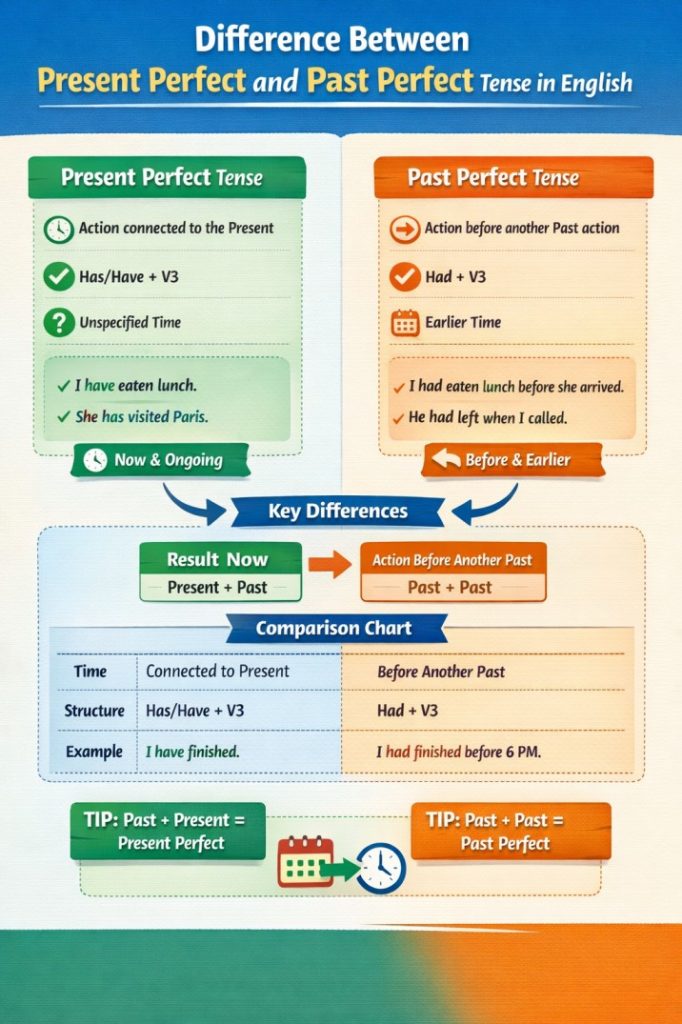
Difference Between Present Perfect and Past Perfect Tense in English
Now let’s clearly understand the difference between present perfect and past perfect tense in English with a comparison table:
| Feature | Present Perfect Tense | Past Perfect Tense |
|---|---|---|
| Time Reference | Past action connected to present | Past action before another past action |
| Structure | has/have + V3 | had + V3 |
| Example | I have eaten. | I had eaten before he arrived. |
| Focus | Result matters now | Sequence of past events |
| Usage | Unspecified past time | Earlier of two past actions |
This table highlights the core difference between present perfect and past perfect tense in English in a simple way.
Real-Life Examples for Better Understanding
Understanding grammar becomes easier with real-life examples. Let’s compare both tenses in similar situations:
Example 1
- Present Perfect: I have completed the report.
(Meaning: The report is completed now.) - Past Perfect: I had completed the report before the meeting started.
(Meaning: The report was completed earlier than another past event.)
Example 2
- Present Perfect: She has gone to the market.
(She is not here now.) - Past Perfect: She had gone to the market before I called her.
These examples show the practical difference between present perfect and past perfect tense in English.
Common Mistakes Students Make
Many learners mix up these two tenses. Let’s correct some common mistakes:
❌ Wrong: I had seen that movie already.
✅ Correct: I have seen that movie already.
❌ Wrong: I have finished my work before you came.
✅ Correct: I had finished my work before you came.
Remember:
- If the sentence talks about now, use present perfect.
- If the sentence compares two past actions, use past perfect.
Keywords Often Used with These Tenses
Certain words are commonly used with present perfect:
- already
- just
- yet
- ever
- never
- recently
Example:
- I have already done my work.
Past perfect is often used with:
- before
- after
- when
- by the time
Example:
- By the time he arrived, I had left.
These signal words help identify the difference between present perfect and past perfect tense in English.
Why Is This Difference Important?
Understanding the difference between present perfect and past perfect tense in English is important because:
- It improves spoken English fluency
- It makes writing clearer and more professional
- It helps in competitive exams and school grammar papers
- It avoids confusion in storytelling and narration
Using the wrong tense can change the meaning of a sentence completely.
Quick Practice Exercise
Fill in the blanks:
- I ______ (finish) my work, so I am free now.
- I ______ (finish) my work before the guests arrived.
Answers:
- have finished
- had finished
Simple Trick to Remember
Here’s an easy trick to remember the difference between present perfect and past perfect tense in English:
👉 Present Perfect = Past + Present connection
👉 Past Perfect = Past before Past
If the action affects now, use present perfect.
If the action happened before another past action, use past perfect.
Conclusion
To sum up, the difference between present perfect and past perfect tense in English lies in time reference and context. The present perfect connects the past to the present, while the past perfect talks about an action that happened before another past event.
Once you understand this simple logic, choosing the right tense becomes easy. Practice daily by forming small sentences, and soon you’ll use these tenses naturally in conversation and writing.
Mastering the difference between present perfect and past perfect tense in English will make your grammar stronger and your communication more confident.
Check out our blog on Leave Application
Check out our blog on Formal letter
Check out our blog on How to Use Past Perfect Tense