
Learning English grammar can be exciting — but it’s also full of traps that many learners fall into. In this guide, we’ll explore the most common mistakes in English grammar for students, explain why they happen, and, most importantly, show you how to solve them with simple and practical tips.
Whether you are writing an essay, preparing for an exam, or trying to speak more clearly, this article will help you become more confident with English grammar. Let’s get started!
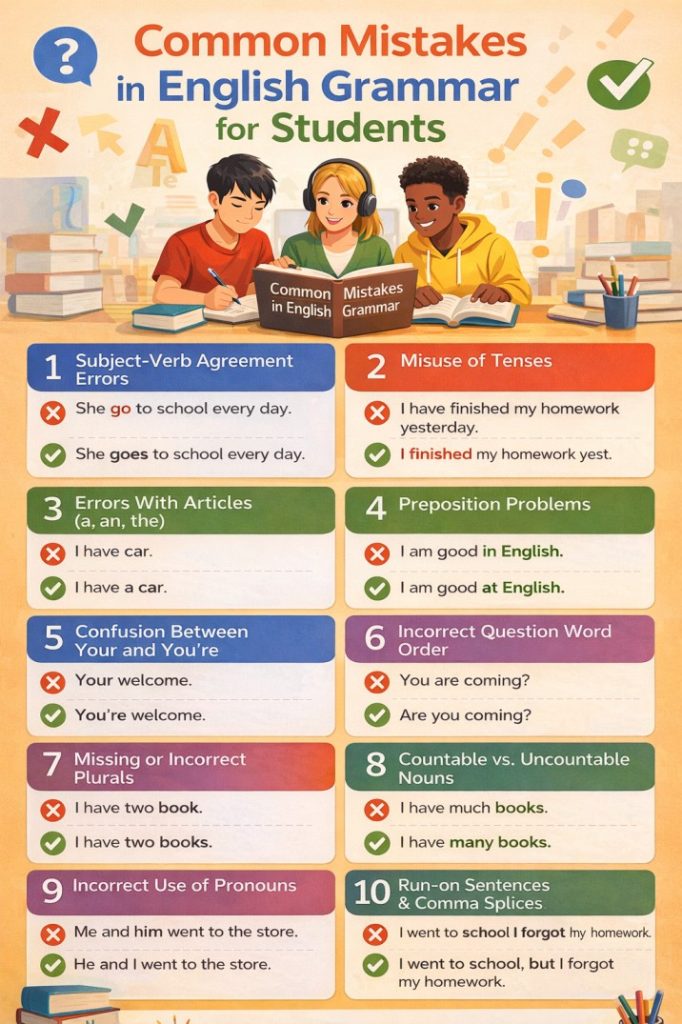
Common Mistakes in English Grammar for Students

Table of Contents
Why Students Make Grammar Mistakes
Before we dive into specific errors, it’s important to understand why these mistakes happen:
- Thinking in your native language and translating directly into English
- Learning rules without practice
- Memorizing patterns instead of understanding meaning
- Not reviewing incorrect answers or feedback
Knowing the reason behind the mistake is the first step toward fixing it.
1. Subject-Verb Agreement Errors
❌ Common Mistake:
People write:
“She go to school every day.”
✅ Correct:
“She goes to school every day.”
📌 Why it Happens:
Students often forget to change the verb form depending on the subject.
🧠 Tip to Fix:
Always match the verb with the subject:
- Singular subjects use verbs ending in –s (he goes, she reads)
- Plural subjects do not (they go, we read)
Practice Tip:
Write 10 sentences using different subjects (I, he, they, we) and check the verb form.
2. Misuse of Tenses
❌ Common Mistake:
“I have finished my homework yesterday.”
✅ Correct:
“I finished my homework yesterday.”
📌 Why it Happens:
Students often mix present perfect tense with definite past time references like yesterday, last year, in 2010.
🧠 Tip to Fix:
Use past simple with specific time expressions:
- I met her last week.
Use present perfect with unspecific time: - I have met her before.
Practice Tip:
Make a list of time words and decide which tense they need.
3. Errors With Articles (a, an, the)
❌ Common Mistake:
“I have car.”
✅ Correct:
“I have a car.”
📌 Why it Happens:
Articles are tricky because some languages don’t use them.
🧠 Tip to Fix:
- a / an — use before singular, countable nouns
• a book • an apple - the — use for specific things
• the car I bought
Practice Tip:
Read aloud and try adding/removing articles — does the sentence still make sense?
4. Preposition Problems
❌ Common Mistake:
“I am good in English.”
✅ Correct:
“I am good at English.”
📌 Why it Happens:
Prepositions don’t always translate directly between languages.
🧠 Tip to Fix:
Learn common collocations (words that go together):
- good at
- listen to
- interested in
- arrive in / at
Practice Tip:
Create flashcards with preposition + verb phrases and test yourself.
5. Confusion Between Your and You’re
❌ Common Mistake:
“Your welcome.”
✅ Correct:
“You’re welcome.”
📌 Why it Happens:
These words sound the same but mean different things.
🧠 Tip to Fix:
- your = possessive (your book)
- you’re = you are (you’re amazing)
Practice Tip:
Replace you’re with you are in your sentence—if it makes sense, it’s “you’re”! If not, use “your”.
6. Wrong Word Order in Questions
❌ Common Mistake:
“You are coming?”
✅ Correct:
“Are you coming?”
📌 Why it Happens:
Students sometimes apply word order from their native language.
🧠 Tip to Fix:
In questions, the auxiliary verb (do/are/is) comes before the subject:
- Are you ready?
- Do you like music?
Practice Tip:
Turn statements into questions to practice:
- She is happy. → Is she happy?
7. Missing or Incorrect Use of Plurals
❌ Common Mistake:
“I have two book.”
✅ Correct:
“I have two books.”
📌 Why it Happens:
English makes plurals by adding –s, which is easy to forget.
🧠 Tip to Fix:
Add –s for most plurals:
- apple → apples
Exception: irregular plurals - child → children
Practice Tip:
Write the plural form of common classroom nouns.
8. Countable vs. Uncountable Nouns
❌ Common Mistake:
“I have much books.”
✅ Correct:
“I have many books.”
📌 Why it Happens:
Words like water, information, and advice are uncountable.
🧠 Tip to Fix:
Use:
- many → with countable nouns
- much → with uncountable nouns
Examples:
- many bananas
- much milk
Practice Tip:
Make two lists: countable and uncountable nouns; practice using them with many/much.
9. Incorrect Use of Pronouns
❌ Common Mistake:
“Me and him went to the store.”
✅ Correct:
“He and I went to the store.”
📌 Why it Happens:
Students often use the wrong pronoun case.
🧠 Tip to Fix:
Use subject pronouns (I, he, she, we) in the subject:
- Correct: She and I are friends.
Use object pronouns (me, him, her) only after prepositions: - Give it to me.
Practice Tip:
Replace the combined subject with a single pronoun:
- Me went… → immediately sounds wrong.
10. Run-on Sentences and Comma Splices
❌ Common Mistake:
“I went to school I forgot my homework.”
✅ Correct:
“I went to school, but I forgot my homework.”
📌 Why it Happens:
Students join two independent ideas without linking words or proper punctuation.
🧠 Tip to Fix:
Use:
- a comma + a conjunction (and, but, so, or)
- a semicolon
- or make two sentences
Practice Tip:
Spot long sentences in your writing — split them if they have two complete thoughts.
How to Practice and Improve
Here are easy ways to stop making these common mistakes in English grammar for students:
✔️ Daily Writing Practice
Write short paragraphs and check for:
- verb forms
- articles
- tense consistency
✔️ Read Every Day
Reading helps you feel correct grammar instead of memorizing rules.
✔️ Use Grammar Checkers
Tools like Grammarly, Word’s editor, or sentence checkers help you catch errors.
✔️ Learn From Mistakes
Whenever someone corrects you, write it down and practice it again.
Common Mistakes in English Grammar for Students – Final Thoughts
Making mistakes is a natural part of learning. The trick is to understand each error, practice intentionally, and apply what you learn again and again.
This guide went beyond simple lists — it showed you why mistakes happen and how to fix them so you will see real improvement in your English.
As you continue studying, remember that mastering these common mistakes in English grammar for students will boost both your confidence and your communication skills.
Happy learning! 😊
Check out our blog on Leave Application
Check out our blog on Formal letter
Check out our blog on How to Use Past Perfect Tense
Check out our blog on Difference between present perfect and past perfect tense
#Common Mistakes in English Grammar for Students