
🎯 Recommended Products for Students & Parents
Handpicked products specially selected for our visitors.

School Backpack Combo
✔ 29 L Spacious Backpack
✔ Includes Tiffin & Pouch
✔ Perfect for School & Coaching

Niacinamide Bright & Clear Skin Combo
✔ Brightens Skin
✔ Reduces Acne Marks
✔ Suitable for Daily Skincare
Disclosure: Some links on this page are affiliate links. We may earn a small commission if you purchase through them, at no additional cost to you.
Use our free concrete calculator to instantly calculate cement bags, sand & aggregate for M10 to M40 grade concrete. Perfect for slabs, columns & footings.
🏗️ Concrete Calculator
Calculate cement, sand & aggregate quantities for any concrete mix grade (M5 – M40)
• 1 Bag of cement = 50 kg = 0.0347 m³
• Dry loose bulk density: Sand = 1650 kg/m³, Aggregate = 1500 kg/m³
• Dry volume = Wet volume × 1.54 (to account for voids & compaction)
• Add 5–10% wastage for on-site losses
Enter your local material rates to estimate total concrete cost.
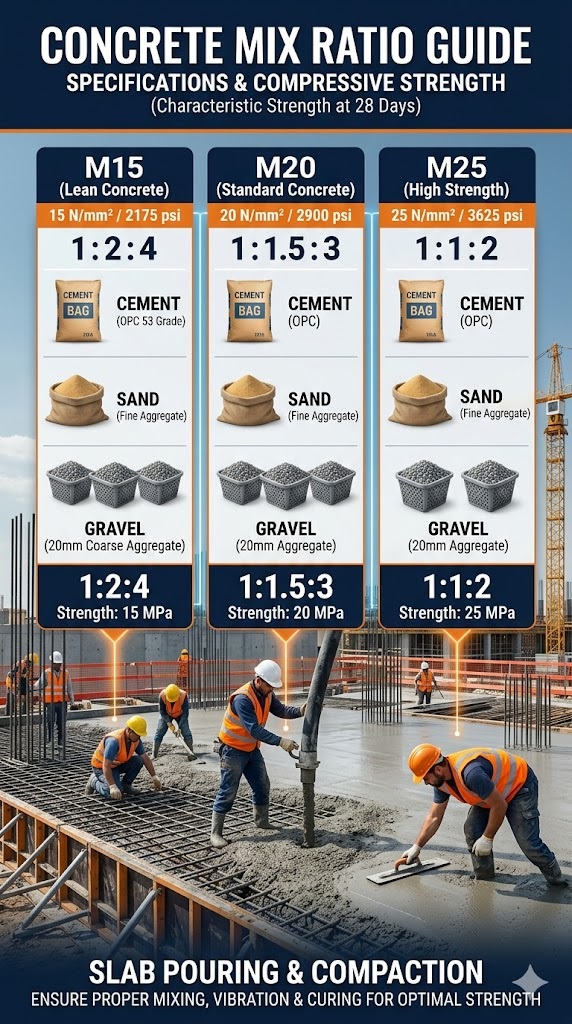
| Grade | Mix Ratio (C:S:A) | Compressive Strength | Common Use |
|---|---|---|---|
| M5 | 1:5:10 | 5 N/mm² | Mass concrete fills |
| M7.5 | 1:4:8 | 7.5 N/mm² | Lean mix, blinding |
| M10 | 1:3:6 | 10 N/mm² | PCC, lightly loaded |
| M15 | 1:2:4 | 15 N/mm² | PCC, pathways |
| M20 | 1:1.5:3 | 20 N/mm² | General RCC (most common) |
| M25 | 1:1:2 | 25 N/mm² | Beams, columns, slabs |
| M30 | Design Mix | 30 N/mm² | High-rise, bridges |
| M35 | Design Mix | 35 N/mm² | Pre-stressed concrete |
| M40 | Design Mix | 40 N/mm² | Marine, heavy structures |
1. Select the calculator type (Slab, Column, or Staircase)
2. Choose your concrete grade from the reference chart above
3. Enter dimensions in your preferred unit (metric or imperial)
4. Click Calculate — get bags of cement, tonnes of sand & aggregate instantly
5. Use the Cost Estimator tab to get a full material cost estimate
Concrete Calculator
What is a Concrete Calculator?
A concrete calculator is a free online tool that helps contractors, engineers, and homeowners estimate the exact quantity of cement, sand, and aggregate required for any concrete construction work. Whether you are building a slab, column, footing, staircase, or any RCC structure, a concrete calculator removes the guesswork and manual calculation errors from your project. By simply entering the dimensions of your structure and selecting the concrete grade (M10, M15, M20, M25, etc.), the calculator instantly gives you the number of cement bags, tonnes of sand, and tonnes of aggregate needed — saving you both time and money. Using a concrete calculator before starting construction ensures you never over-order or under-order materials, which directly reduces waste and keeps your project budget under control.
Why Should You Use a Concrete Calculator for Every Project?
Using a concrete calculator is one of the smartest decisions you can make before starting any construction project, big or small. Manual calculation of concrete materials involves complex formulas like dry volume conversion (multiplying wet volume by 1.54), ratio-based material splitting, and unit conversions — all of which are prone to human error. Our advanced concrete calculator handles all of this automatically and also accounts for wastage percentage, giving you a more realistic and accurate estimate. Whether you are a civil engineer planning a high-rise with M30 or M40 grade concrete, or a homeowner pouring a simple M15 garden path, this tool covers every scenario. It even breaks down the cost of materials when you enter local rates for cement, sand, and aggregate — making it a complete project planning solution in one place.
All Possible WH Questions About “Concrete Calculator”
What questions:
- What is a concrete calculator?
- What is the formula used in a concrete calculator?
- What are the inputs needed for a concrete calculator?
- What concrete grade should I use for a slab/column/footing?
- What is the difference between M15, M20, and M25 concrete?
- What is dry volume in concrete calculation?
- What is the mix ratio of M20 concrete?
How questions:
- How to calculate concrete quantity for a slab?
- How to use a concrete calculator?
- How many bags of cement do I need per m³ of concrete?
- How is dry volume calculated from wet volume?
- How to calculate sand and aggregate for M20 concrete?
- How much concrete do I need for a 10×10 slab?
- How to reduce concrete wastage on site?
Why questions:
- Why is a concrete calculator important?
- Why is dry volume 54% more than wet volume?
- Why do we add wastage percentage in concrete calculation?
- Why does concrete grade matter in construction?
Which questions:
- Which concrete grade is best for house construction?
- Which is better — M20 or M25 concrete for columns?
- Which concrete calculator is most accurate?
- Which mix ratio gives the highest compressive strength?
When questions:
- When should I use M10 vs M20 concrete?
- When is a concrete calculator needed on a construction site?
- When should concrete wastage factor be increased?
Where questions:
- Where is M20 concrete commonly used?
- Where can I find a free concrete calculator online?
- Where does concrete wastage occur on a construction site?
Who questions:
- Who uses a concrete calculator?
- Who should calculate concrete quantities before construction?
How much / How many questions:
- How much cement is needed for 1 m³ of M20 concrete?
- How many bags of cement per cubic metre?
- How much does concrete cost per m³ in India?
- How many cubic metres of concrete do I need for my project?
Free Paver Block Calculator – Calculate Manufacturing Cost of Pavers
Terrace Waterproofing Procedure
cement calculator
concrete mix
calculator concrete
quantity calculator
cement sand aggregate
calculator M20 concrete
calculator RCC concrete
calculator PCC concrete
calculator how to calculate concrete concrete material
calculator concrete
volume calculator
online concrete calculator
concrete calculator for slab
concrete calculator for column
concrete mix ratio calculator
construction material calculator
Concrete Calculator — Frequently Asked Questions
Everything you need to know about concrete calculation, mix ratios, grades & material estimation
Step 1: Wet Volume = Length × Width × Depth
Step 2: Dry Volume = Wet Volume × 1.54 (dry volume is 54% more due to voids)
Step 3: Cement Volume = (Cement Ratio / Sum of Ratios) × Dry Volume
Step 4: No. of Bags = Cement Volume ÷ 0.0347 m³
Step 5: Sand Volume = (Sand Ratio / Sum of Ratios) × Dry Volume
Step 6: Aggregate Volume = (Aggregate Ratio / Sum of Ratios) × Dry Volume
- Shape — Rectangle, Circle, or Triangle
- Dimensions — Length, Width, and Depth/Thickness of the structure
- Concrete Grade — M10, M15, M20, M25, M30, or custom ratio
- Unit System — Metric (metres) or Imperial (feet)
- Wastage Factor — Usually 5% to 10% for on-site losses
| Grade | Mix Ratio | Strength | Best Use |
|---|---|---|---|
| M15 | 1 : 2 : 4 | 15 N/mm² | PCC, pathways, non-structural |
| M20 | 1 : 1.5 : 3 | 20 N/mm² | General RCC, slabs, beams |
| M25 | 1 : 1 : 2 | 25 N/mm² | Columns, high-load structures |
Example: If you need 1 m³ of concrete, you need 1.54 m³ of dry materials.
- 1 part Cement
- 1.5 parts Fine Aggregate (Sand)
- 3 parts Coarse Aggregate (Gravel/Stone)
- Step 1: Measure Length, Width and Thickness of the slab in metres
- Step 2: Volume (m³) = Length × Width × Thickness
- Step 3: Multiply by 1.54 to get Dry Volume
- Step 4: Use the mix ratio to find Cement, Sand & Aggregate volumes
- Step 5: Add 5–10% for wastage
- 1. Select your structure type — Slab, Column, or Staircase
- 2. Choose shape — Rectangle, Circle, or Triangle
- 3. Select your unit system — Metric (m) or Imperial (ft)
- 4. Select the concrete grade — M10 to M40 or enter a custom ratio
- 5. Enter dimensions (length, width, depth)
- 6. Set wastage % (5% recommended)
- 7. Click Calculate — get instant results!
| Grade | Ratio | Bags per m³ | Cement (kg) |
|---|---|---|---|
| M10 | 1:3:6 | ~4.4 bags | ~220 kg |
| M15 | 1:2:4 | ~6.3 bags | ~316 kg |
| M20 | 1:1.5:3 | ~8.0 bags | ~400 kg |
| M25 | 1:1:2 | ~11.1 bags | ~554 kg |
The 1.54 factor = 1 (original) + 0.54 (voids in sand and aggregate that get filled during mixing)
- Volume = 10 × 10 × 0.33 = 33 cubic feet = 0.93 m³
- With M20 grade: ~7.5 bags cement, ~380 kg sand, ~695 kg aggregate
- Add 5% wastage → ~8 bags cement total
- ✅ Always calculate exact quantities using a concrete calculator before ordering
- ✅ Use proper formwork to prevent leakage
- ✅ Order ready-mix concrete in accurate quantities
- ✅ Train workers to handle materials carefully
- ✅ Keep a 5% (not more than 10%) wastage buffer — not 20–30%
- ✅ Use leftover concrete for non-structural fillings immediately
- Cost Saving — Prevents over-ordering of materials, which is a major cause of budget overrun
- Accuracy — Eliminates human errors in manual calculation
- Time Saving — Gives instant results instead of manual computation
- Project Planning — Helps schedule material delivery on time
- Quality Control — Ensures correct mix ratio is maintained
- Spillage during mixing and transportation
- Material stuck to equipment and tools
- Formwork imperfections causing leakage
- Surface irregularities requiring extra fill
- Human handling errors
- ❌ Structural failure under load
- ❌ Cracking and spalling over time
- ❌ Failure to pass structural inspections
- ❌ Reduced lifespan of the building
| Structural Element | Recommended Grade |
|---|---|
| PCC / Leveling Course | M10 or M15 |
| Floor Slab | M20 |
| Roof Slab | M20 or M25 |
| Beams & Lintels | M20 |
| Columns | M20 to M25 |
| Footings / Foundation | M20 |
| Staircase | M20 |
- Blinding/leveling layer under footings
- Mass concrete fillings
- Non-load-bearing garden paths
- Slabs, beams, columns, footings
- Any element that carries load
- All reinforced concrete structures
- Residential building slabs and roofs
- Beams and lintels over doors/windows
- RCC columns in low-rise buildings
- Foundation footings and raft slabs
- Retaining walls
- Staircase construction
- Industrial floor slabs
- Dry Volume = 1 × 1.54 = 1.54 m³
- Cement Volume = (1/5.5) × 1.54 = 0.28 m³
- Cement Bags = 0.28 ÷ 0.0347 = 8.07 bags ≈ 8 bags
- Cement Weight = 8.07 × 50 = 403.5 kg
- Sand = (1.5/5.5) × 1.54 × 1650 = 692 kg = 0.69 T
- Aggregate = (3/5.5) × 1.54 × 1500 = 1258 kg = 1.26 T
| Grade | Material Cost | With Labour |
|---|---|---|
| M15 | ₹4,500 – ₹5,500 | ₹5,500 – ₹7,000 |
| M20 | ₹5,500 – ₹6,500 | ₹6,500 – ₹8,500 |
| M25 | ₹6,500 – ₹8,000 | ₹8,000 – ₹10,000 |
| M30 | ₹8,000 – ₹10,000 | ₹10,000 – ₹13,000 |
| Project | Approx. Volume |
|---|---|
| 10×10 ft slab (4 inch thick) | ~0.93 m³ |
| 20×20 ft roof slab (5 inch thick) | ~4.65 m³ |
| Standard column (0.3×0.3×3m) | ~0.27 m³ |
| Single flight staircase (12 steps) | ~1.5–2 m³ |
| Strip footing (1m wide × 0.45m deep × 10m long) | ~4.5 m³ |
- 👷 Civil Engineers — for structural design and material estimation
- 🏗️ Contractors & Builders — for project tendering and procurement
- 🏠 Homeowners — for self-build projects and checking contractor quotes
- 📐 Quantity Surveyors — for Bill of Quantities (BOQ) preparation
- 🎓 Civil Engineering Students — for learning and academic projects
- 🏢 Architects — for preliminary material budgeting