
🎯 Recommended Products for Students & Parents
Handpicked products specially selected for our visitors.

School Backpack Combo
✔ 29 L Spacious Backpack
✔ Includes Tiffin & Pouch
✔ Perfect for School & Coaching

Niacinamide Bright & Clear Skin Combo
✔ Brightens Skin
✔ Reduces Acne Marks
✔ Suitable for Daily Skincare
Disclosure: Some links on this page are affiliate links. We may earn a small commission if you purchase through them, at no additional cost to you.
Many students get confused in difference between mass and weight because both are related to how heavy an object feels. In daily life, people often use these words as if they mean the same thing. For example, many people say, “My weight is 50 kg,” but in Physics, that is not fully correct.
In science, mass and weight are completely different concepts. Understanding the difference between mass and weight is very important for school exams, competitive exams, and basic Physics knowledge.
In this article, you will learn:
What is Mass?
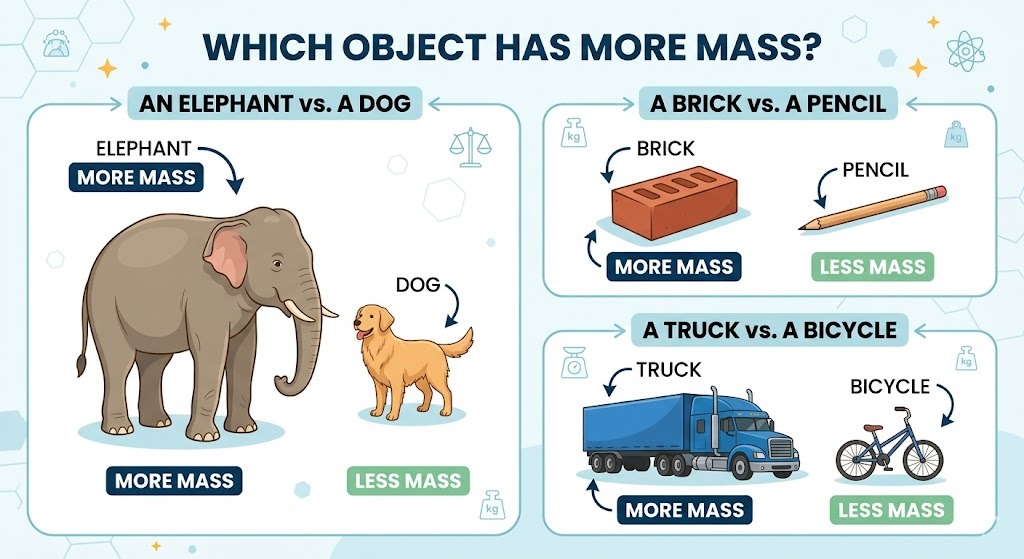
Mass is the amount of matter present in an object.
In simple words, mass tells us how much material or “stuff” is inside an object.
Examples of Mass
- A brick has more mass than a pencil because it contains more matter.
- An elephant has more mass than a dog.
- A truck has more mass than a bicycle.
Important Point About Mass
Mass never changes from place to place.
Whether you are:
- On Earth
- On the Moon
- On Mars
- Or floating in space
your mass will always remain the same.
SI Unit of Mass
The SI unit of mass is:
Kilogram (kg)
Instrument Used to Measure Mass
Mass is measured using:
What is Weight?
Weight is the force with which gravity pulls an object toward a planet.
In easy language, weight is the gravitational pull acting on an object.
Examples of Weight
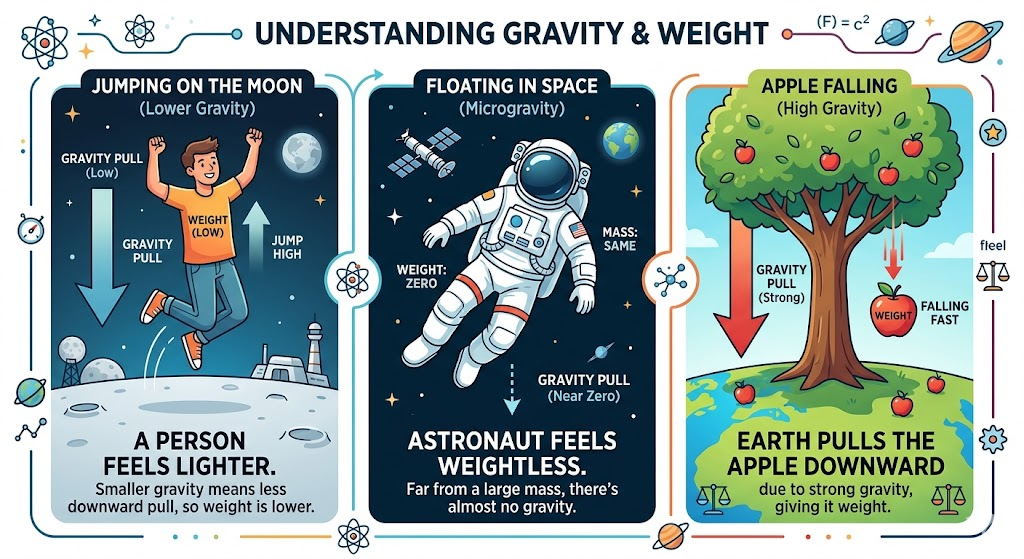
- A person feels lighter on the Moon because the Moon has less gravity.
- Astronauts feel weightless in space.
- A heavy object feels easier to lift underwater because of reduced effective weight.
Important Point About Weight
Weight changes from place to place because gravity is different everywhere.
This means:
- Your weight on Earth is more.
- Your weight on the Moon is less.
- Your weight on Jupiter would be much higher.
SI Unit of Weight
The SI unit of weight is:
Newton (N)
Because weight is a force, it is measured in Newtons.
Instrument Used to Measure Weight
Weight is measured using a:
Formula of Weight
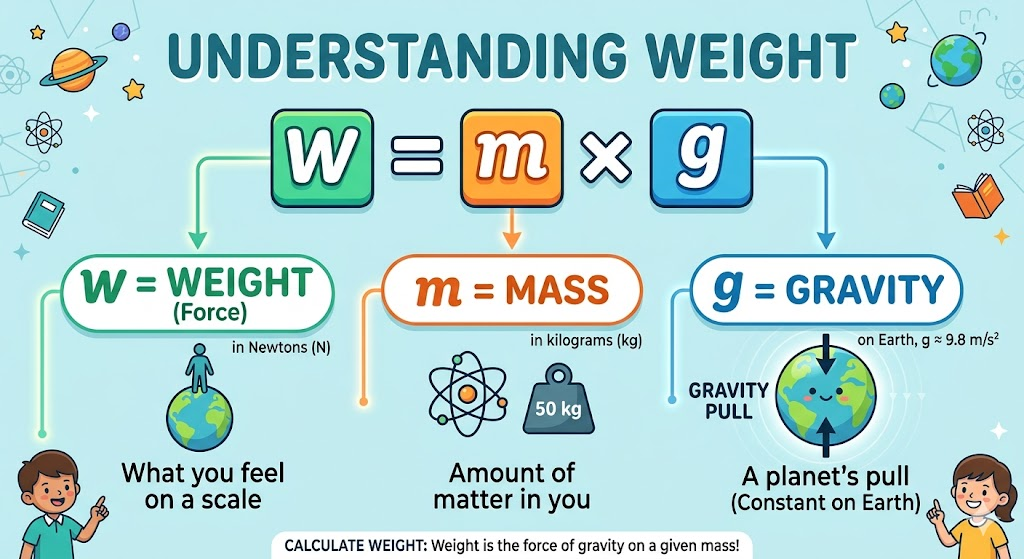
The formula used to calculate weight is:
Where:
- W = Weight
- m = Mass
- g = Acceleration due to gravity
On Earth:
Interactive Mass & Weight Simulator
Calculated Weight
588 N
This simulator uses the famous physics formula:
Weight = Mass × Gravity
Mass remains constant everywhere, but weight changes because every planet has different gravity.
Example of Mass and Weight
Suppose a student has a mass of 60 kg.
His weight on Earth will be:
Now if the same student goes to the Moon, his mass will still remain 60 kg, but his weight will become much smaller because the Moon’s gravity is weaker.
This proves that:
- Mass remains constant
- Weight changes with gravity
Weight on Different Planets
| Location | Mass (m) | Gravity (g) | Weight (W) |
|---|---|---|---|
| Earth | 60 kg | 9.8 m/s² | 588 N |
| Moon | 60 kg | 1.6 m/s² | 96 N |
| Mars | 60 kg | 3.7 m/s² | 222 N |
| Jupiter | 60 kg | 24.8 m/s² | 1488 N |
The table clearly shows that the mass stays the same everywhere, but the weight changes depending on gravity.
Weight on Different Planets Calculator
Enter your mass in kilograms (kg)
Difference Between Mass and Weight
| Mass | Weight |
|---|---|
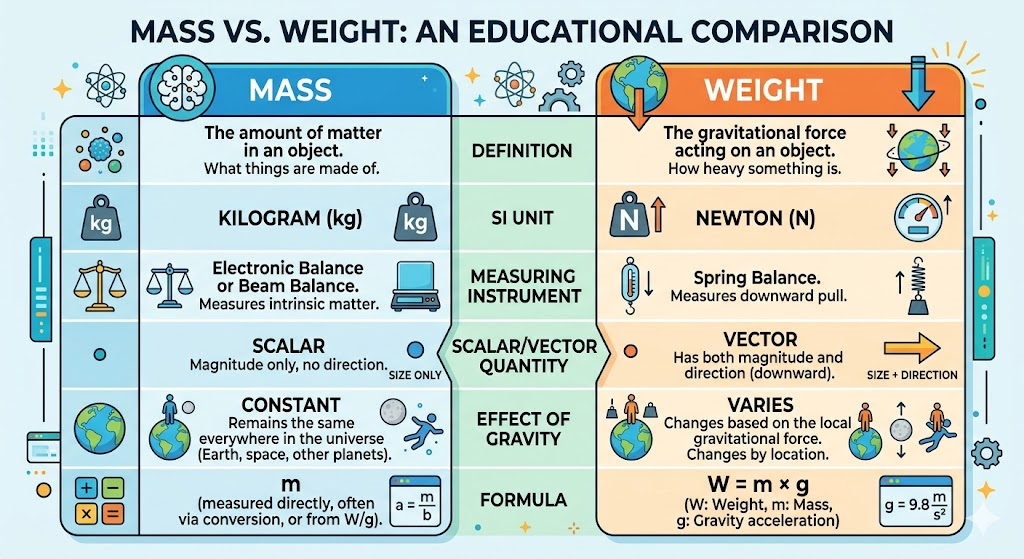
| Amount of matter in an object | Gravitational force acting on an object |
| Constant everywhere | Changes with gravity |
| Measured in kilograms (kg) | Measured in Newtons (N) |
| Scalar quantity | Vector quantity |
| Measured using beam balance | Measured using spring balance |
| Cannot become zero | Can become zero in space |
Scalar and Vector Quantity in Easy Words
Scalar Quantity
A scalar quantity has only size or amount.
Example:
- 5 kg rice
- 10 kg iron
Mass is a scalar quantity because it only tells “how much.”
Vector Quantity
A vector quantity has both size and direction.
Weight is a vector quantity because gravity always pulls objects downward toward the Earth.
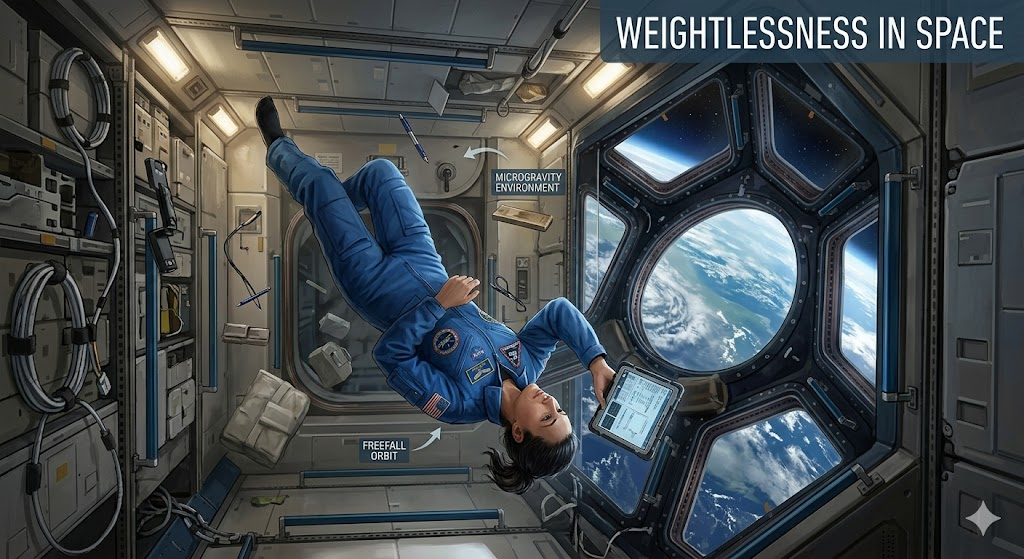
Why Do Astronauts Float in Space?
Astronauts float in space because they experience very little weight.
Their spacecraft and their bodies fall around Earth at the same speed, creating a feeling of weightlessness.
However, their mass does not change.
For example:
- A 70 kg astronaut on Earth still has a mass of 70 kg in space.
Quick Revision
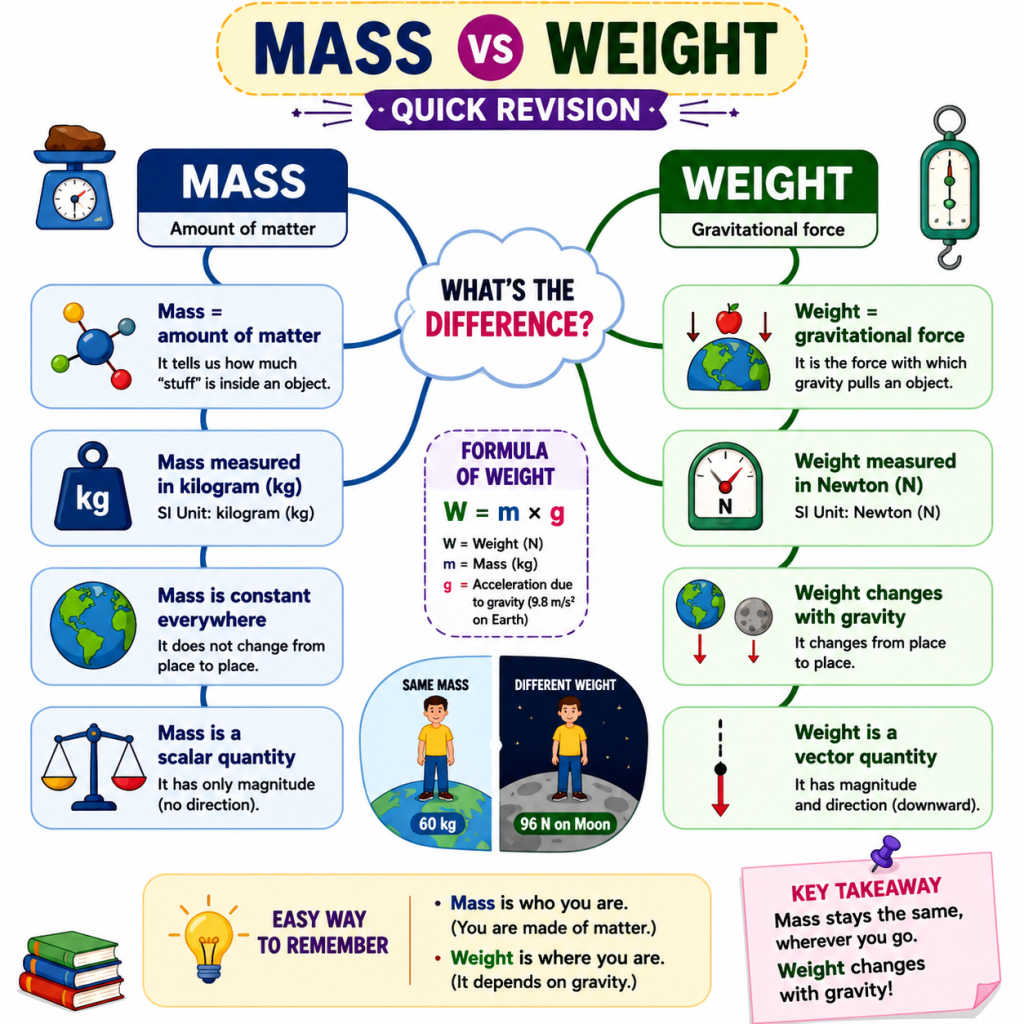
- Mass = Amount of matter
- Weight = Force due to gravity
- Mass is constant everywhere
- Weight changes from planet to planet
- Mass is measured in kg
- Weight is measured in Newtons
Conclusion
The difference between mass and weight is one of the most important topics in Physics.
Mass tells us how much matter an object contains, while weight tells us how strongly gravity pulls that object.
The easiest trick to remember is:
- Mass is constant
- Weight changes with gravity
Once you understand this simple idea, Physics becomes much easier and more interesting.
Frequently Asked Question
If a person has a mass of 50 kg on Earth, what will be their mass on the Moon?
The answer is:
50 kg
Because mass never changes with location.