
🎯 Recommended Products for Students & Parents
Handpicked products specially selected for our visitors.
School Backpack Combo
✔ 29 L Spacious Backpack
✔ Includes Tiffin & Pouch
✔ Perfect for School & Coaching

Niacinamide Bright & Clear Skin Combo
✔ Brightens Skin
✔ Reduces Acne Marks
✔ Suitable for Daily Skincare
Disclosure: Some links on this page are affiliate links. We may earn a small commission if you purchase through them, at no additional cost to you.
Synthetic Fibres and Plastics Class 8 : Comprehensive study resource for CBSE Class 8 Science Chapter 3 “Synthetic Fibres and Plastics”. Includes detailed revision notes covering types of synthetic fibres (Rayon, Nylon, Polyester, Acrylic), their properties, thermoplastics vs. thermosetting plastics, and the environmental impact of plastics (5R principle). Also provides subjective questions with answers and multiple-choice questions for exam preparation.
Table of Contents
📘 SECTION 1: DETAILED REVISION NOTES – Synthetic Fibres and Plastics Class 8
Synthetic Fibres and Plastics Class 8:
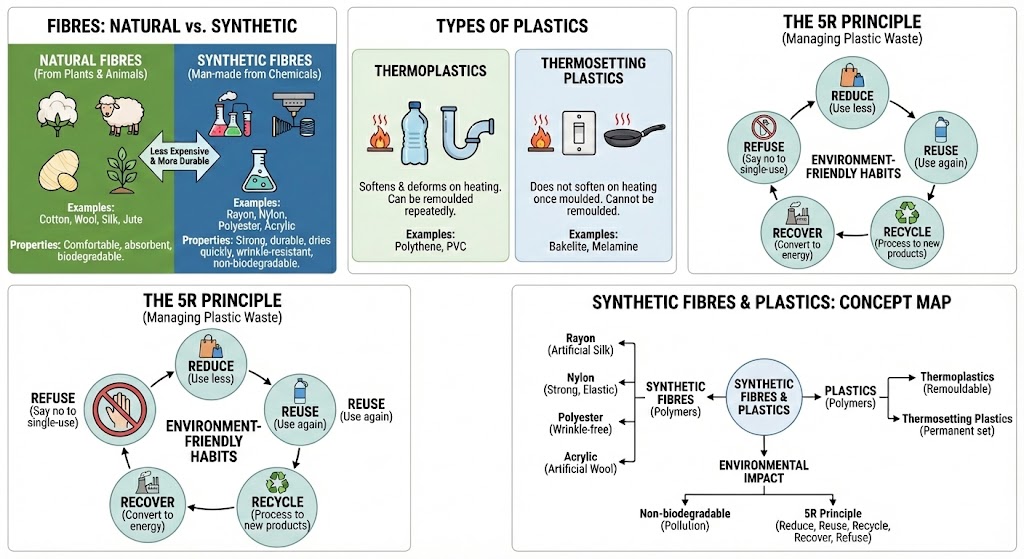
1. Introduction to Fibres Fibres are thin strands of materials used to make fabrics (clothes). They are broadly classified into two types:
- Natural Fibres: Obtained from plants or animals. Examples: Cotton, wool, silk, jute.
- Synthetic (Man-made) Fibres: Made by humans in laboratories or factories using chemical substances. Examples: Rayon, nylon, polyester, acrylic.
2. What are Synthetic Fibres?
- A synthetic fibre is a chain of small units joined together. Each small unit is a chemical substance called a monomer.
- Many monomers combine to form a large single unit called a polymer (Poly = many, mer = unit/part).
- Analogy: Think of a synthetic fibre like a necklace composed of many small beads joined together.
3. Types of Synthetic Fibres
- A. Rayon (Artificial Silk):
- Origin: Obtained by the chemical treatment of wood pulp. Although obtained from a natural source, it is considered man-made because of the extensive chemical processing.
- Properties: It has a silky appearance, is cheaper than silk, and can be dyed in many colours.
- Uses: Mixed with cotton to make bed sheets, or mixed with wool to make carpets.
- B. Nylon:
- Origin: Made from coal, water, and air. It was the first fully synthetic fibre (made without using any natural raw material from plants or animals).
- Properties: Strong, elastic, light, lustrous, and easy to wash.
- Uses: Very popular for clothing (socks), ropes, tents, toothbrushes, car seat belts, sleeping bags, curtains, and parachutes/ropes for rock climbing (due to its high strength—a nylon thread is stronger than a steel wire of the same thickness).
- C. Polyester:
- Properties: Fabric made from this fibre does not get wrinkled easily. It remains crisp and is easy to wash, making it suitable for dress materials.
- Types:
- Terylene: A popular polyester that can be drawn into very fine fibres.
- PET (Polyethylene terephthalate): Used for making bottles, utensils, films, wires, etc.
- Mixing: Polycot (polyester + cotton), Polywool (polyester + wool).
- D. Acrylic (Artificial Wool):
- Properties: It resembles wool but is cheaper than natural wool. It is durable and available in various colours. Clothes made from acrylic are relatively cheap.
- Uses: Sweaters, shawls, and blankets.
4. Characteristics of Synthetic Fibres (Advantages & Disadvantages)
- Advantages (Why they are popular): They dry up quickly, are durable, less expensive, readily available, and easy to maintain compared to natural fibres.
- Disadvantage (A major danger): Synthetic fibres melt on heating. If the clothes catch fire, the fabric melts and sticks to the body of the person wearing it, causing severe burns. Note: We should never wear synthetic clothes while working in the kitchen or a laboratory.
5. Plastics
- Plastic is also a polymer, like synthetic fibres.
- Classification based on reaction to heat:
- i) Thermoplastics: Plastics which get deformed easily on heating and can be bent easily. They can be melted and remoulded repeatedly.
- Examples: Polythene, PVC (Polyvinyl chloride).
- Uses: Manufacturing toys, combs, various types of containers.
- ii) Thermosetting Plastics: Plastics which, once moulded, cannot be softened by heating. They set permanently.
- Examples:
- Bakelite: Poor conductor of heat and electricity. Used for electrical switches, handles of utensils.
- Melamine: Versatile material that resists fire and tolerates heat better than other plastics. Used for floor tiles, kitchenware, and fabrics worn by firemen.
- Examples:
- i) Thermoplastics: Plastics which get deformed easily on heating and can be bent easily. They can be melted and remoulded repeatedly.
6. Plastics as Materials of Choice (Properties) Why are plastics used so widely?
- Plastic is Non-reactive: Unlike iron, plastics do not react with water and air. They do not corrode easily. Used to store many chemicals.
- Plastic is Light, Strong, and Durable: They are cheaper than metals and easy to handle. Used widely in industry and household articles.
- Plastics are Poor Conductors: They are poor conductors of heat and electricity. This is why electrical wires have plastic coverings, and handles of screw drivers and frying pans are made of plastic.
7. Plastics and the Environment The extensive use of plastics has created a major environmental problem because of how they decompose.
- Biodegradable: A material which gets decomposed through natural processes, such as the action of bacteria (e.g., paper, wood, leftover food).
- Non-biodegradable: A material which is not easily decomposed by natural processes (e.g., plastic bags, tin cans, metal items). Plastics take several years to decompose.
- Environmental Hazards of Plastics:
- Since they take many years to decompose, they are not environment-friendly and cause pollution.
- Burning plastics releases poisonous gases into the atmosphere, causing air pollution.
- Animals (like cows) sometimes eat plastic bags from garbage dumps, which can choke their respiratory system or line their stomachs, leading to death.
- Plastic bags clog drains and cause waterlogging.
- Solutions (The 5R Principle): To minimize the damage to the environment, we should follow the 5R principle:
- Reduce: Use less plastic.
- Reuse: Use things again and again (e.g., refill bottles).
- Recycle: Process waste materials to make new products (e.g., thermoplastics can be recycled).
- Recover: Convert waste into energy or materials.
- Refuse: Say no to single-use plastics (like polybags when shopping).
🗣️ SECTION 2: SUBJECTIVE QUESTION AND ANSWERS – Synthetic Fibres and Plastics Class 8
Q1. Explain why some fibres are called synthetic. Ans: Synthetic fibres are made by human beings in laboratories or factories using chemical substances, rather than being obtained directly from natural sources like plants or animals. They are polymers made up of small repeating units called monomers. Therefore, they are called synthetic or man-made fibres.
Q2. Rayon is different from synthetic fibres because it is obtained from a natural source. Explain. Ans: Rayon is obtained by the chemical treatment of wood pulp, which is a natural source. However, it is not considered a purely natural fibre like cotton or silk because the wood pulp undergoes extensive chemical processing to convert it into rayon fibres. It is generally considered a semi-synthetic or regenerated fibre.
Q3. Give examples to show that nylon fibres are very strong. Ans: Nylon is a very strong fibre. This is evident from its uses:
- It is used for making parachutes and ropes for rock climbing. A nylon thread is actually stronger than a steel wire of similar thickness.
- It is used in making seat belts for cars and tyre cords.
Q4. Explain the difference between thermoplastics and thermosetting plastics with examples. Ans:
- Thermoplastics: These are plastics that get deformed easily on heating and can be bent easily. They can be remoulded multiple times. Examples: Polythene, PVC.
- Thermosetting Plastics: These are plastics which, once moulded into a shape, cannot be softened or remoulded by heating again. Examples: Bakelite, Melamine.
Q5. Why should we not wear synthetic clothes while working in the kitchen? Ans: Synthetic clothes have a major disadvantage: they melt on heating. If a person wearing synthetic clothes is working in the kitchen near a fire, and the clothes accidently catch fire, the fabric will melt and stick to the person’s body, causing severe burns. Cotton clothes, on the other hand, do not melt.
Q6. Explain why the handles of cooking utensils and electrical switches are made of thermosetting plastics. Ans: Handles of cooking utensils and electrical switches are made of thermosetting plastics (like Bakelite) because:
- They are poor conductors of heat (so utensil handles don’t get hot).
- They are poor conductors of electricity (preventing shocks from switches).
- They do not soften or melt easily when heated, unlike thermoplastics.
Q7. State the advantages of synthetic fibres over natural fibres. Ans: Synthetic fibres are more popular than natural fibres because:
- They are cheaper than natural fibres.
- They are stronger and more durable.
- They dry quickly after washing.
- They do not wrinkle easily (require less ironing).
- They are not attacked by moths or insects easily.
Q8. Explain the 5R principle for managing plastic waste. Ans: The 5R principle is a guideline to be environment-friendly and manage waste:
- Reduce: Minimize the use of plastics (e.g., use a cloth bag instead of a plastic one).
- Reuse: Use plastic items repeatedly instead of throwing them away after one use.
- Recycle: Send plastic waste to industries to be processed into new products.
- Recover: Generate energy or new materials from waste.
- Refuse: Do not accept or buy items that create unnecessary plastic waste (like single-use straws or cutlery).
✅ SECTION 3: MULTIPLE CHOICE QUESTIONS (MCQs) – Synthetic Fibres and Plastics Class 8
1. Which of the following is a natural fibre? a) Nylon b) Rayon c) Wool d) Polyester
Correct Answer: c) Wool
2. The small units that combine to form a polymer are called: a) Cells b) Monomers c) Atoms d) Molecules
Correct Answer: b) Monomers
3. Which synthetic fibre is known as ‘artificial silk’? a) Nylon b) Polyester c) Acrylic d) Rayon
Correct Answer: d) Rayon
4. The first fully synthetic fibre was: a) Rayon b) Nylon c) Acrylic d) Polyester
Correct Answer: b) Nylon
5. Which fibre is used to make clothes that do not get wrinkled easily? a) Cotton b) Polyester c) Silk d) Wool
Correct Answer: b) Polyester
6. Which of the following is a thermosetting plastic? a) PVC b) Polythene c) Bakelite d) Nylon
Correct Answer: c) Bakelite
7. The material used for making non-stick coating on cookware is: a) PVC b) Polythene c) Teflon d) Melamine
Correct Answer: c) Teflon (Note: Teflon is a type of plastic often mentioned in this context).
8. Which plastic is used to make the uniform of firemen because it is flame resistant? a) Teflon b) Melamine c) Bakelite d) PVC
Correct Answer: b) Melamine
9. Plastics that can be deformed easily on heating and can be remoulded are called: a) Thermosetting plastics b) Thermoplastics c) Elastomers d) Biodegradable plastics
Correct Answer: b) Thermoplastics
10. Which of the following is NOT a part of the 5R principle? a) Reduce b) Reuse c) Remake d) Recycle
Correct Answer: c) Remake
11. Why are plastics considered an environmental hazard? a) They are biodegradable. b) They are non-biodegradable and take years to decompose. c) They enrich the soil. d) They dissolve easily in water.
Correct Answer: b) They are non-biodegradable and take years to decompose.
12. PET is a very familiar form of: a) Nylon b) Rayon c) Polyester d) Acrylic
Correct Answer: c) Polyester
#Synthetic Fibres and Plastics Class 8