
🎯 Recommended Study Resources & Courses
Handpicked online learning platforms and essential tools tailored for you.

Coursera Certificates & Skill Courses
✔ Top University & Industry Certificates
✔ Job-Ready Tech, Data & Business Skills
✔ Flexible Online Self-Paced Study

Recommended Exam Prep & Study Guide
✔ Comprehensive Syllabus Coverage & MCQs
✔ Perfect for School & Competitive Exams
✔ Trusted Resource for Daily Practice

Disclosure: Some links on this page are affiliate links. We may earn a small commission if you purchase or sign up through them, at no additional cost to you.
If you have ever stared at an English grammar worksheet wondering whether to write have gone, had gone, or went, you are definitely not alone. Verb tenses trip up even fluent speakers because English packs a lot of meaning into tiny helping words. The easiest fix? Keep a clear tenses rules chart nearby until those sentence patterns start feeling like second nature.
Rather than memorizing dozens of dry textbook definitions, it helps to see all twelve English tenses laid out side by side. Once you spot how a single verb shifts across past, present, and future, building accurate sentences gets much faster—whether you are writing a school essay, preparing for competitive exams, or just trying to speak with a bit more confidence.
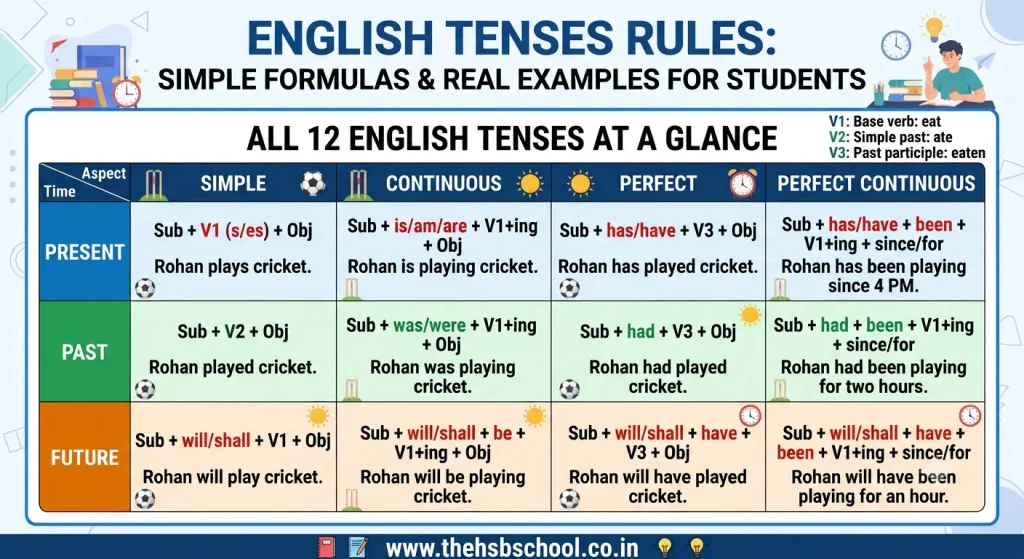
Table of Contents
All 12 English Tenses at a Glance
Before looking at the table below, keep three quick abbreviations in mind:
- V1 = Base verb (eat)
- V2 = Simple past form (ate)
- V3 = Past participle (eaten)
V3 = Past participle (eaten) — Tip: Mastering V3 verb forms also makes it much easier to convert active and passive voice sentences in exams.
Bookmark or screenshot this tenses rules chart whenever you need to double-check a sentence formula. Notice how the same example changes slightly in each box:
Verb tenses trip up even fluent speakers because English grammar rules pack a lot of meaning into tiny helping words.
| Time | Simple | Continuous | Perfect | Perfect Continuous |
| Present | Sub + V1 (s/es) + Obj Rohan plays cricket. | Sub + is/am/are + V1+ing + Obj Rohan is playing cricket. | Sub + has/have + V3 + Obj Rohan has played cricket. | Sub + has/have + been + V1+ing + since/for Rohan has been playing since 4 PM. |
| Past | Sub + V2 + Obj Rohan played cricket. | Sub + was/were + V1+ing + Obj Rohan was playing cricket. | Sub + had + V3 + Obj Rohan had played cricket. | Sub + had + been + V1+ing + since/for Rohan had been playing for two hours. |
| Future | Sub + will/shall + V1 + Obj Rohan will play cricket. | Sub + will/shall + be + V1+ing + Obj Rohan will be playing cricket. | Sub + will/shall + have + V3 + Obj Rohan will have played cricket. | Sub + will/shall + have + been + V1+ing + since/for Rohan will have been playing for an hour. |
How the Three Main Time Frames Work
Once you understand the logic behind each column in a tenses rules chart, you won’t have to guess which helping verb belongs where.
1. Present Tense: Habits and Ongoing Actions
We reach for the present tense when talking about daily routines, general facts, or things happening right in front of us.
- Simple Present handles regular habits and universal truths (Water boils at 100 degrees Celsius). Just remember to add -s or -es to the verb when your subject is singular, like he, she, or it.
- Present Continuous captures actions happening at this exact moment (My sister is studying for her science test).
- Present Perfect connects a finished action to the present moment (I have lost my house keys—meaning I am still locked outside right now).
- Present Perfect Continuous shows something that started earlier and hasn’t stopped yet (They have been waiting for the bus since morning).
2. Past Tense: Completed Stories and Earlier Events
Whenever an action is over and done with, you are in past-tense territory.
- Simple Past describes an event that finished at a known time (We visited Jaipur last winter).
- Past Continuous sets the background scene, often when another action interrupts it (I was cooking dinner when the lights went out).
- Past Perfect helps sort out two past events so the reader knows which happened first (The train had already left before we reached the platform).
- Past Perfect Continuous highlights how long an activity lasted before something else occurred (She had been practicing the piano for three years before her first concert).
Past Perfect helps sort out two past events so the reader knows which happened first (The train had already left before we reached the platform). If you often mix these two up, check out our detailed guide on the difference between present perfect and past perfect tense.
3. Future Tense: Plans and Predictions
English relies on helping words like will or shall to push an action forward in time.
- Simple Future covers quick decisions, promises, or guesses about tomorrow (I will call you after class).
- Future Continuous describes an activity that will be mid-progress at a specific hour later on (At 8 PM tonight, we will be watching the match).
- Future Perfect looks ahead to a deadline when a task will be wrapped up (By next month, he will have finished his syllabus).
- Future Perfect Continuous measures how long an ongoing action will have lasted by a future milestone (By 2027, my family will have been living in this town for a decade).
Quick Rules That Prevent Common Grammar Mistakes
Even with a tenses rules chart open in front of you, a few tricky spots catch students off guard during tests:
- Look for time clues in the sentence: Words like usually, always, or every day almost always point to Simple Present, whereas yesterday, last night, or ago signal Simple Past.
- Don’t mix up since and for: Use since when naming an exact starting point (since Monday, since 2022) and for when counting a block of time (for ten minutes, for six months).
- Never pair V2 with did: In negative sentences or questions in the Simple Past, switch back to the base verb. Write “Did you go there?” instead of “Did you went there?”
Save or print this tenses rules chart and tuck it into your notebook—a quick two-minute glance before revising your essays will help you catch most verb slips right away.