
🎯 Recommended Products for Students & Parents
Handpicked products specially selected for our visitors.

School Backpack Combo
✔ 29 L Spacious Backpack
✔ Includes Tiffin & Pouch
✔ Perfect for School & Coaching

Niacinamide Bright & Clear Skin Combo
✔ Brightens Skin
✔ Reduces Acne Marks
✔ Suitable for Daily Skincare
Disclosure: Some links on this page are affiliate links. We may earn a small commission if you purchase through them, at no additional cost to you.
Ever find yourself needing to divide fractions or deal with slopes in geometry? There’s one tiny, powerful concept behind all of it: the reciprocal.
In this post, I’m going to break down the Reciprocal Meaning Maths in the simplest way possible. Forget the textbook definitions for a minute—you’ll learn what it is, how to calculate it for any number, and why we actually care about it in the real world.
Let’s dive in!
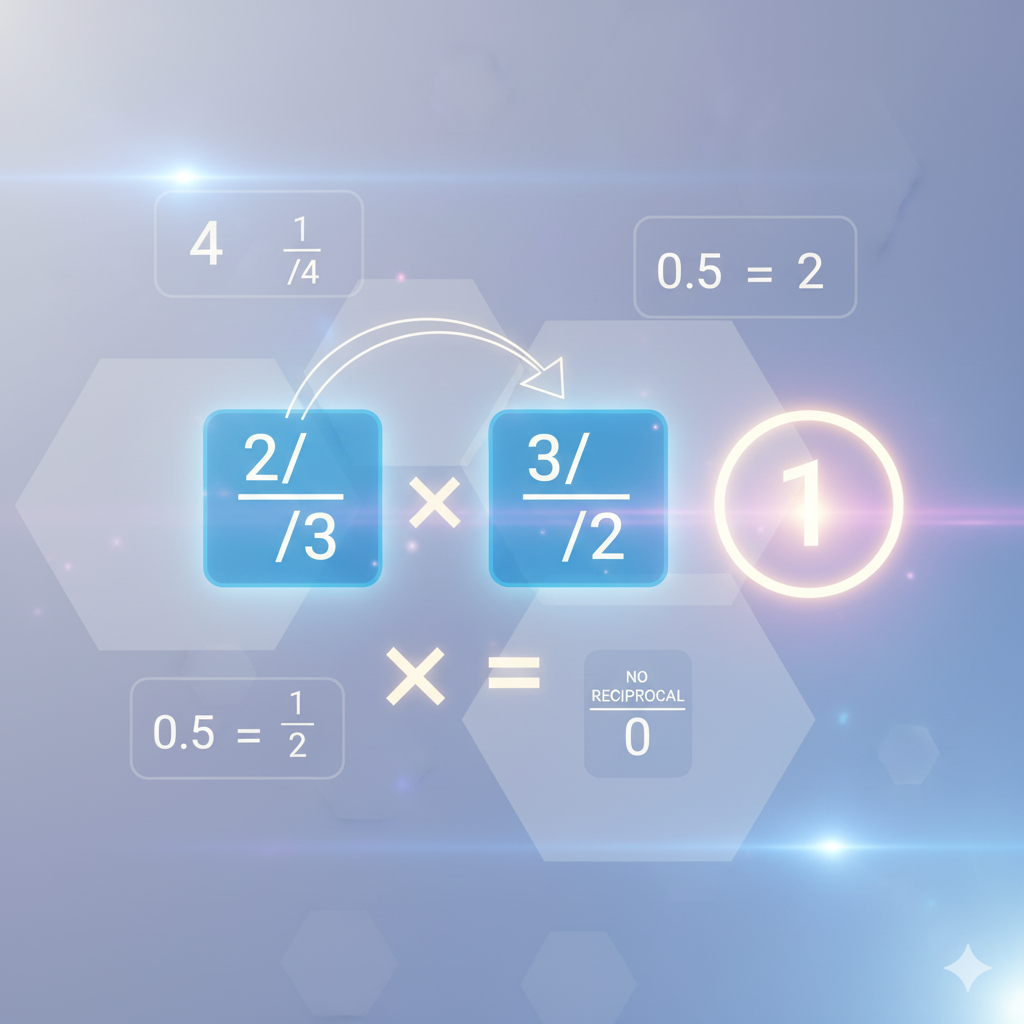
Table of Contents
💡 What the Reciprocal Really Means
At its heart, the reciprocal is the number you multiply a starting number by to get 1. That’s it!
Think of it as the multiplicative inverse. It undoes the original number. $\frac{1}{x}$
- If your starting number is $x$, its reciprocal is $\frac{1}{x}$.
- The math rule is: $x \times \frac{1}{x} = 1$.
In simple terms, finding the reciprocal means flipping the number upside down.
*A Crucial Side Note: You can’t divide by zero, so 0 has no reciprocal. Don’t forget that!
🔢 How to Find the Reciprocal for Any Number
The “flip it” trick works for all kinds of numbers:
1. Whole Numbers
Just put a ‘1’ over the number.
- The reciprocal of 4 is $\frac{1}{4}$.
- The reciprocal of 10 is $\frac{1}{10}$.
2. Fractions (The Easiest!)
This is where the “flipping” idea comes from. Swap the top (numerator) and bottom (denominator).
- The reciprocal of $\frac{2}{3}$ is $\frac{3}{2}$.
- The reciprocal of $\frac{5}{8}$ is $\frac{8}{5}$.
3. Decimals
The easiest way is to convert the decimal to a fraction first, or just remember to divide 1 by the number.
- The reciprocal of 0.5 (which is $\frac{1}{2}$) is $2$.
- The reciprocal of 0.25 (which is $\frac{1}{4}$) is $4$.
4. Negative Numbers
The sign always stays the same! The negative is part of the number’s identity.
- The reciprocal of -3 is $-\frac{1}{3}$.
- The reciprocal of −52 is $-\frac{5}{2}$.
🧠 Reciprocals in Action: Properties & Algebra
The concept of Reciprocal Meaning Maths is the foundation for a few powerful rules:
- You always get 1: The number multiplied by its reciprocal is always 1. (e.g., $7 \times \frac{1}{7} = 1$).
- Double Flip Gets You Back: If you take the reciprocal of a reciprocal, you get the original number back. (e.g., The reciprocal of $\frac{1}{5}$ is $5$).
In Algebra, we use this all the time to simplify expressions:
- Reciprocal of 2x is $\frac{1}{2x}$.
- Reciprocal of 3x is $\frac{3}{x}$.
We often multiply by the reciprocal to solve division problems (remember: dividing by a fraction is the same as multiplying by its reciprocal!).
🌍 Where Reciprocals Show Up in the Real World
This isn’t just theory—reciprocals are constantly working in the background:
- Speed and Time: If you travel at 60 kilometers per hour, the reciprocal ($\frac{1}{60}$ hours per km) helps you quickly calculate how long it takes to travel a single kilometer.
- Slopes: In geometry, two lines are perpendicular if their slopes are negative reciprocals of each other (e.g., a line with a slope of $2$ is perpendicular to a line with a slope of $-\frac{1}{2}$).
- Music and Sound: The frequency of a sound wave is the reciprocal of its period (the time it takes for one wave cycle).
🏁 Quick Check
| Number | Reciprocal |
| $3$ | $\frac{1}{3}$ |
| $\frac{5}{2}$ | $\frac{2}{5}$ |
| $-4$ | $-\frac{1}{4}$ |
| $0.25$ | $4$ |
| $7$ | $\frac{1}{7}$ |
The next time you’re facing a tricky division problem, just remember: you don’t need to divide—you just need to flip and multiply! Happy calculating!
Check out my post on Positive Words