
Complete study guide for Reaching the Age of Adolescence Class 8 Science Chapter 10 . Includes detailed revision notes, important Q&A, MCQs, and visual aids for exam preparation.
📘 Reaching the Age of Adolescence Class 8 Science Chapter 10
📝 A. Revision Notes – Reaching the Age of Adolescence Class 8
1. Adolescence and Puberty
- Adolescence: The period of life, when the body undergoes changes, leading to reproductive maturity, is called adolescence. It generally begins around the age of 11 and lasts up to 18 or 19 years of age. Since this period covers the ‘teen’ years (13 to 19), adolescents are also called ‘teenagers‘.
- Puberty: The human body undergoes several changes during adolescence. These changes mark the onset of puberty. The most important change which marks puberty is that boys and girls become capable of reproduction. Puberty ends when an adolescent reaches reproductive maturity.
2. Changes at Puberty
- Increase in Height: The most conspicuous change is the sudden increase in height due to the elongation of long bones (arms and legs).
- Change in Body Shape:
- Boys: Shoulders generally broaden as a result of growth. Muscles of the body grow more prominently.
- Girls: The region below the waist becomes wider.
- Voice Change: At puberty, the voice box or the larynx begins to grow. Boys develop larger voice boxes, often visible as a protruding part of the throat called the Adam’s apple. Girls have a high-pitched voice, while boys have a deep voice.
- Increased Activity of Sweat and Sebaceous Glands: Many young people get acne and pimples on the face at this time due to the increased activity of these glands in the skin.
- Development of Sex Organs: In boys, the testes and penis develop completely; the testes begin to produce sperm. In girls, the ovaries enlarge and eggs begin to mature.
- Reaching Mental, Intellectual, and Emotional Maturity: Adolescents become more independent and self-conscious. It is also a period when the capacity for learning is maximum.
3. Secondary Sexual Characters These are features that help to distinguish the male from the female. They are controlled by hormones.
- In Boys: Growth of facial hair (moustaches and beard) and hair on the chest.
- In Girls: Breast development begins.
- Both: Hair grows in the armpits and the pubic region.
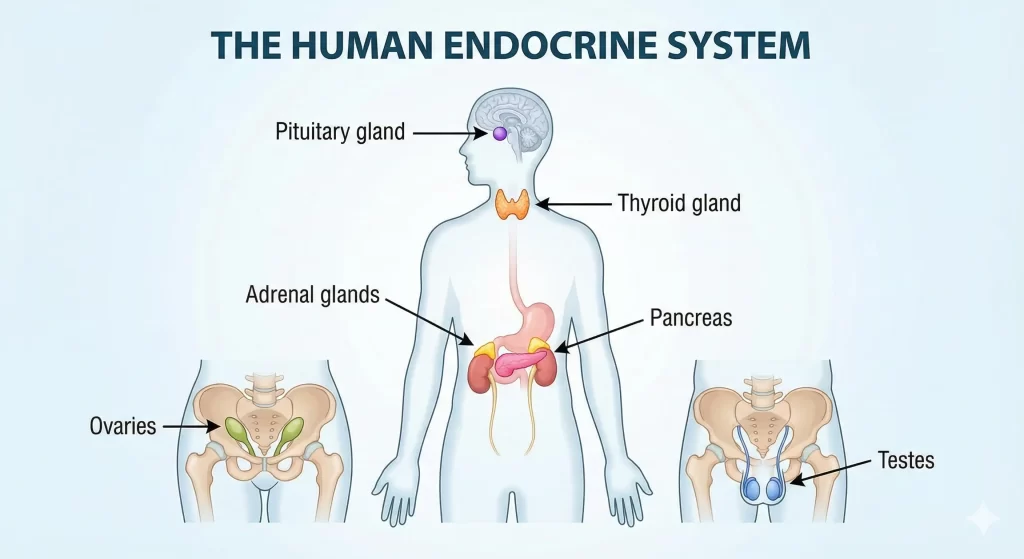
4. Role of Hormones Hormones are chemical substances secreted by endocrine glands (ductless glands) directly into the bloodstream to reach a target site.
Reaching the Age of Adolescence Class 8
- Testosterone: The male hormone secreted by the testes. It causes changes in boys like the growth of facial hair.
- Estrogen: The female hormone secreted by the ovaries. It makes the breasts develop.
- Pituitary Gland: The “master gland” located in the brain. It secretes hormones that control the production of testosterone and estrogen, along with growth hormones.
5. Reproductive Phase of Life in Humans Adolescents become capable of reproduction when their testes and ovaries begin to produce gametes.
- In Females (Menstrual Cycle): The reproductive phase begins at puberty (10–12 years) and lasts until approximately 45–50 years of age.
- Menarche: The first menstrual flow begins at puberty.
- Menstruation: Once in about 28 to 30 days, an egg is released by one of the ovaries. If it is not fertilized, the egg, along with the thickened lining of the uterus and its blood vessels, are shed off. This causes bleeding called menstruation.
- Menopause: Stoppage of menstruation around 45-50 years of age.
6. How is the Sex of the Baby Determined?
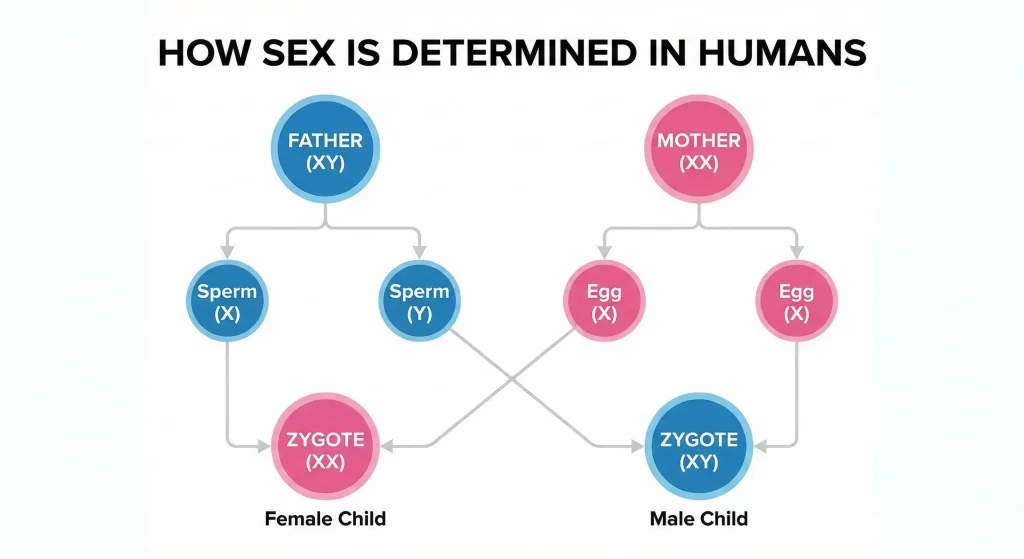
- All human beings have 23 pairs of chromosomes in the nuclei of their cells. Two chromosomes out of these are the sex chromosomes, named X and Y.
- A female has two X chromosomes (XX).
- A male has one X and one Y chromosome (XY).
- Gametes (egg and sperm) have only one set of chromosomes. An unfertilized egg always has one X chromosome.
- Sperms are of two kinds: One kind has an X chromosome, and the other kind has a Y chromosome.
- If a sperm containing X chromosome fertilizes the egg (X) -> The zygote becomes XX (Female child).
- If a sperm containing Y chromosome fertilizes the egg (X) -> The zygote becomes XY (Male child).
- Conclusion: The sex of the unborn child depends on whether the zygote has an X or Y chromosome present in the sperm that fertilizes the egg.
Reaching the Age of Adolescence Class 8
7. Other Important Hormones
- Thyroid Gland: Secretes Thyroxine. Deficiency causes Goitre.
- Pancreas: Secretes Insulin. Deficiency causes Diabetes.
- Adrenal Glands: Secretes Adrenaline. It helps the body adjust to stress like anger, embarrassment, or worry.
8. Reproductive Health To keep the body healthy during this period of rapid growth, adolescents need:
- Balanced Diet: Intake of proteins, carbohydrates, fats, and vitamins in required proportions (e.g., roti, rice, dal, vegetables, milk, fruits). Iron-rich food (leafy vegetables, jaggery) is good for blood.
- Personal Hygiene: Daily baths are essential because the increased activity of sweat glands makes the body smelly. Girls should take special care of cleanliness during menstruation.
- Physical Exercise: Walking and playing in fresh air keeps the body fit and healthy.
- Say “NO” to Drugs: Adolescence is a period of insecurity, making one vulnerable to drugs. Drugs are addictive and harm the body in the long run.
🗣️ B. Reaching the Age of Adolescence Class 8 : Subjective Question and Answers
Q1: What is the difference between adolescence and puberty? Answer: Adolescence is the period of time in life (usually aged 11-19) when the body undergoes changes leading to reproductive maturity. Puberty is the process of physical changes that happens during adolescence that makes an individual capable of reproduction.
Q2: Why do many young people get acne and pimples during adolescence? Answer: During puberty, the secretion of the sweat glands and sebaceous glands (oil glands) increases significantly. The excess oil and sweat can clog the skin pores, leading to bacterial infections that cause acne and pimples.
Q3: Explain the term ‘Adam’s apple’. Answer: At puberty, the voice box or the larynx begins to grow. In boys, the voice box grows larger and is often visible as a protruding part of the throat. This is called the Adam’s apple.
Q4: What determines the sex of an unborn baby? Explain briefly. Answer: The sex of the baby is determined by the sex chromosomes present in the sperm that fertilizes the egg. A female has XX chromosomes, so all eggs have an X chromosome. A male has XY chromosomes, so half the sperm carry X and half carry Y.
- If an X-carrying sperm fertilizes the egg (X + X = XX), the baby will be a girl.
- If a Y-carrying sperm fertilizes the egg (X + Y = XY), the baby will be a boy.
Q5: Why is it essential for adolescents to maintain personal hygiene? Answer: It is essential because the increased activity of sweat and sebaceous glands during this stage makes the body smelly. If cleanliness is not maintained, there are chances of catching bacterial or fungal skin infections.
✅ C. Reaching the Age of Adolescence Class 8 : Multiple Choice Questions (MCQs)
1. The period of life that leads to reproductive maturity is called: a) Childhood b) Adulthood c) Adolescence d) Senescence
Correct Answer: c) Adolescence
2. The hormone responsible for the development of secondary sexual characters in boys is: a) Estrogen b) Adrenaline c) Testosterone d) Thyroxine
Correct Answer: c) Testosterone
3. Which gland is known as the “master gland” because it controls other endocrine glands? a) Thyroid b) Pituitary c) Adrenal d) Pancreas
Correct Answer: b) Pituitary
4. The first menstrual flow that begins at puberty is termed as: a) Menopause b) Menstruation c) Menarche d) Ovulation
Correct Answer: c) Menarche
5. The number of chromosome pairs present in the nucleus of a human cell is: a) 22 b) 23 c) 46 d) 2
Correct Answer: b) 23
6. Goitre is a disease caused by the deficiency of which hormone? a) Insulin b) Adrenaline c) Growth Hormone d) Thyroxine
Correct Answer: d) Thyroxine