
Complete notes and important questions for NCERT Class 6 Science Chapter 8 – Body Movements. Learn about joints, skeleton system, muscles, types of movement, and movement in animals. Includes diagrams, examples, and exam-ready questions.
🌟 Class 6 Science Chapter 8 NOTES
BODY MOVEMENTS
Table of Contents
⭐ 1. Types of Movements
Class 6 Science Chapter 8 : Organisms show different kinds of movement:
- Walking
- Running
- Jumping
- Bending
- Stretching
- Swimming
- Flying
Movement = change in the position of the body.
⭐ 2. Human Body and Its Movements
Class 6 Science Chapter 8:
A. Bones
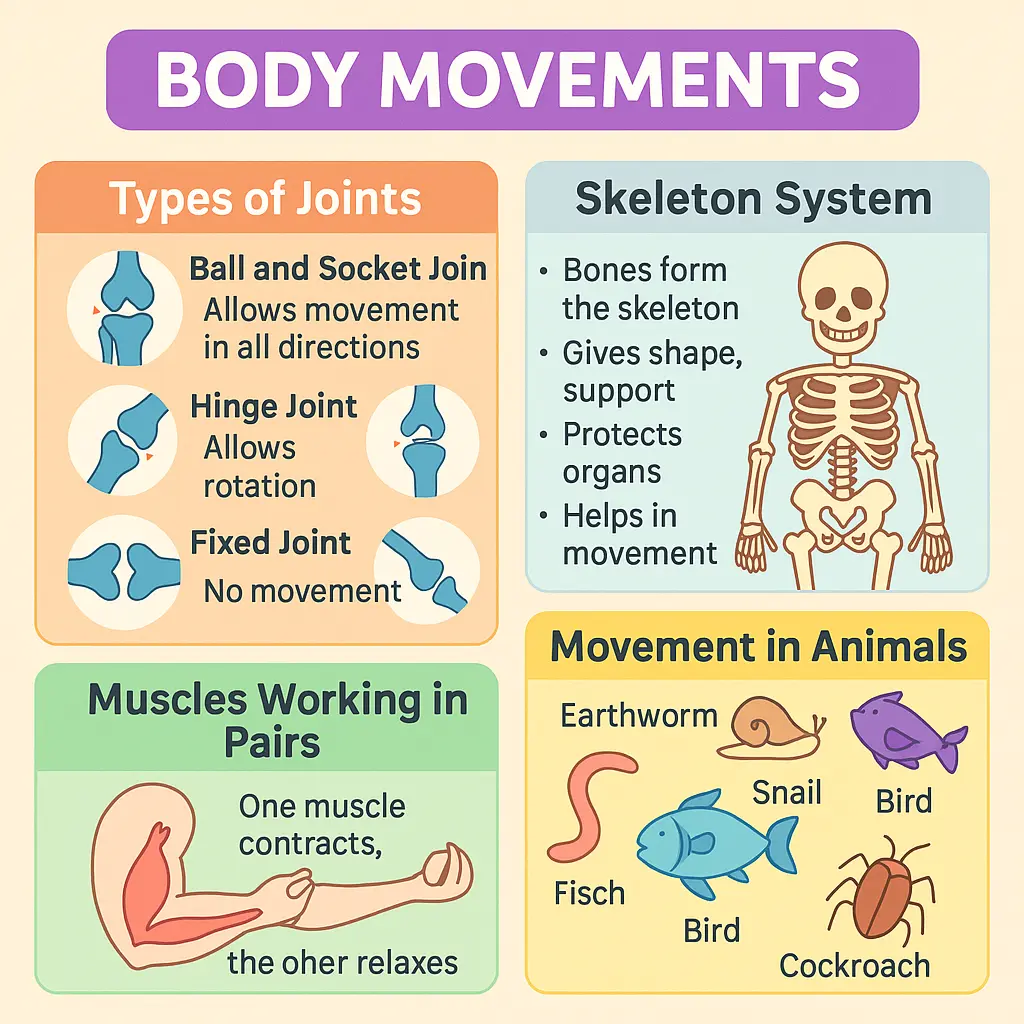
Bones form the skeleton system which:
- Gives shape
- Protects organs
- Helps in movement
The framework of bones is called the skeleton.
A newborn baby has 300 bones, adults have 206.
B. Joints
A joint is a place where two bones meet.
Types of Joints:
1️⃣ Ball and Socket Joint
- Allows movement in all directions
- Example: Shoulder, Hip
2️⃣ Hinge Joint
- Allows movement in one direction (like a door)
- Example: Elbow, Knee, Fingers
3️⃣ Pivot Joint
- Allows rotation
- Example: Joint between the head and neck
4️⃣ Fixed Joint
- No movement
- Example: Bones in the skull
C. Muscles
- Muscles work in pairs
- One muscle contracts → the other relaxes
Example: Bending the arm
- Front muscle contracts
- Back muscle relaxes
⭐ 3. Skeleton System
Class 6 Science Chapter 8:
Main parts:
- Skull
- Ribcage
- Spine / Backbone
- Limb bones
- Shoulder and pelvic bones
Backbone
- Made of 33 small bones called vertebrae
- Protects the spinal cord
⭐ 4. Movement in Animals
Class 6 Science Chapter 8:
Earthworm
- Moves by alternating contraction and relaxation
- Front end extends → grips surface → pulls body forward
Snail
- Moves on a muscular foot
- Leaves a slimy path
- Shell is hard and does NOT help in movement
Fish
- Moves using fins
- Streamlined body helps reduce friction
Birds
- Hollow bones → light weight
- Wings + strong chest muscles help in flight
Cockroach
- Moves using three pairs of legs
- Can also fly with wings
⭐ 5. Importance of Skeleton
Class 6 Science Chapter 8:
- Supports body
- Protects organs
- Helps in movement
- Gives shape
- Produces blood cells (bone marrow)
📘 IMPORTANT QUESTIONS & ANSWERS – CHAPTER 8
Class 6 Science Chapter 8:
✅ 1 Mark Questions
1. What is a joint?
A joint is the place where two bones meet.
2. Give an example of a hinge joint.
Elbow.
3. How many bones does an adult human have?
206 bones.
4. Name the framework of bones in our body.
Skeleton.
5. What type of joint helps the head rotate?
Pivot joint.
✅ 2 Mark Questions
6. What are the functions of the skeleton?
Support, shape, protection, and movement.
7. Write two examples of animals with streamlined bodies.
Fish, birds.
8. Why do muscles work in pairs?
Because one muscle contracts while the other relaxes.
✅ 3 Mark Questions
9. Explain the movement of an earthworm.
- Uses muscles to extend and contract its body.
- Front end fixes to the ground.
- Rest of the body pulls forward.
10. Describe the ball and socket joint.
- One bone is rounded; fits into the socket of another bone.
- Allows movement in all directions.
- Examples: hip, shoulder.
11. What are fixed joints? Where are they found?
Joints that do not allow movement.
Found in the skull.
✅ 5 Mark Questions
12. Explain movement in fish, birds, and snakes.
Fish:
- Move using fins.
- Streamlined body reduces resistance.
Birds:
- Wings + chest muscles.
- Hollow bones make them lightweight.
Snakes:
- Move in S-shaped loops (slithering).
- Muscles and scales help movement.
13. Describe different types of joints with examples.
- Ball and Socket: Shoulder, hip
- Hinge: Knee, elbow
- Pivot: Head and neck
- Fixed: Skull
- Gliding (optional): Wrist, ankle
⭐ HOTS Questions
14. Why can’t humans rotate their arms in a full circle at the elbow?
Because elbow has a hinge joint, allowing movement only in one direction.
15. Why do earthworms find it difficult to move on a dry surface?
Because they need moisture for grip and movement.