
Class 6 Science Chapter 6: Changes Around Us (NCERT)
Table of Contents
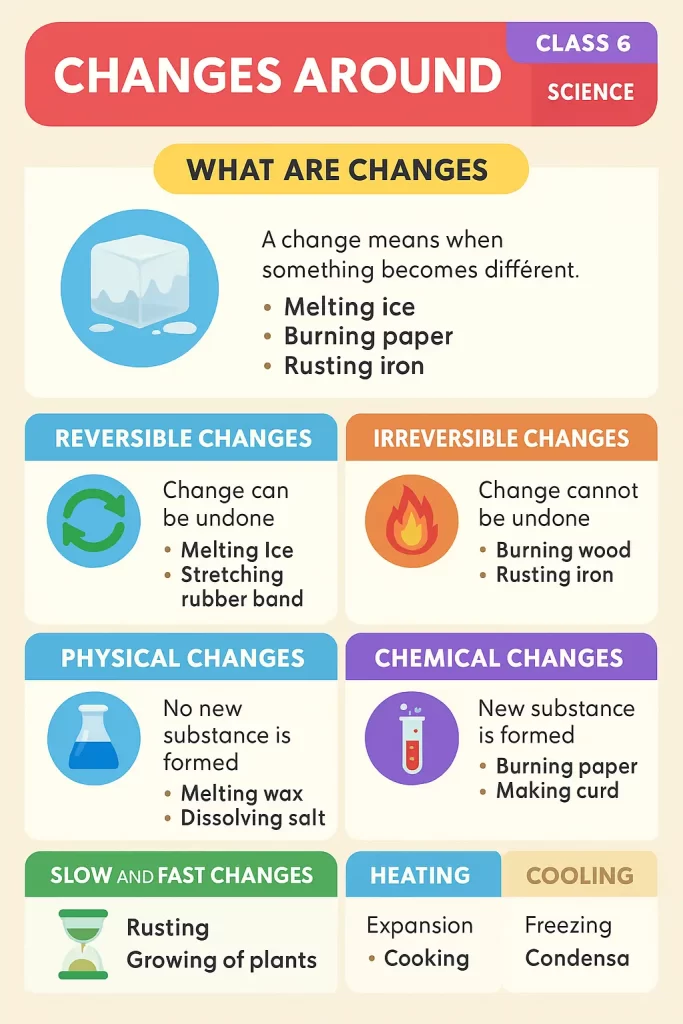
⭐ 1. What Are Changes?
Class 6 Science Chapter 6:
A change means when something becomes different from its original form.
Example:
- Melting ice
- Burning paper
- Rusting iron
Changes happen around us all the time.
⭐ 2. Types of Changes
Class 6 Science Chapter 6:
A. Reversible Changes
Changes that can be undone to get back the original substance.
Examples:
- Melting ice → water → ice again
- Stretching a rubber band
- Folding paper
B. Irreversible Changes
Changes that cannot be undone to get back the original substance.
Examples:
- Burning wood
- Cooking food
- Rusting of iron
- Breaking a glass
C. Physical Changes
Only the shape, size, or state changes, but not the chemical composition.
Examples:
- Melting wax
- Dissolving salt in water
- Freezing water
D. Chemical Changes
A new substance is formed.
Examples:
- Burning paper
- Rusting of iron
- Making curd from milk
⭐ 3. Slow and Fast Changes
Class 6 Science Chapter 6:
Slow Changes
Changes that take a long time.
Examples:
- Rusting
- Growing a plant
- Erosion of soil
Fast Changes
Changes that happen quickly.
Examples:
- Bursting crackers
- Burning a matchstick
- Boiling water
⭐ 4. Changes Caused by Heating
Heating can cause:
- Expansion (metal rod expands when heated)
- Melting (ice → water)
- Cooking (raw → cooked food)
Some changes caused by heating are reversible, some are not.
⭐ 5. Changes Caused by Cooling
Cooling can cause:
- Freezing (water → ice)
- Condensation (steam → water)
These changes are mostly reversible.
⭐ 6. Expansion and Contraction
When heated → objects expand (increase in size).
When cooled → objects contract (shrink).
Examples:
- Metal lid loosens when heated
- Electric wires hang loose in summer (expand)
- Wires shrink in winter (contract)
⭐ 7. Mixing and Dissolving
- Salt dissolving in water → reversible
- Making curd → irreversible
📘 Important Questions & Answers – Chapter 6
Class 6 Science – Changes Around Us
✅ A. Very Short Answer Questions (1 Mark)
1. What is a reversible change?
A change that can be undone to get back the original substance.
2. Give one example of an irreversible change.
Burning paper.
3. What type of change is freezing water?
Reversible change.
4. What type of change is rusting?
Irreversible and chemical change.
5. Give one example of a fast change.
Bursting crackers.
✅ B. Short Answer Questions (2 Marks)
6. What is an irreversible change? Give two examples.
A change that cannot be undone.
Examples: burning, cooking.
7. How does heating cause changes?
Heating may cause expansion, melting, or formation of a new substance (cooking).
8. What are slow and fast changes? Give examples.
- Slow: take long time (rusting).
- Fast: happen quickly (burning matchstick).
✅ C. Short Answer Questions (3 Marks)
9. Explain the difference between physical and chemical changes.
| Physical Change | Chemical Change |
|---|---|
| No new substance is formed | New substance is formed |
| Usually reversible | Usually irreversible |
| Example: melting ice | Example: burning wood |
10. State three changes caused by heating.
- Melting of ice
- Cooking food
- Expansion of metals
✅ D. Long Answer Questions (5 Marks)
11. Explain reversible and irreversible changes with examples.
- Reversible changes can be undone.
Examples: melting ice, dissolving sugar, stretching rubber. - Irreversible changes cannot be undone.
Examples: burning paper, rusting, cooking food.
12. Describe how heating and cooling cause changes in substances.
Heating can melt, expand, or change substances chemically.
Cooling can freeze or condense substances.
Examples:
- Ice melts when heated and freezes when cooled.
- Metal expands when heated and contracts when cooled.
✅ E. HOTS (Higher Order Thinking Skills)
13. Why does a metal lid on a glass jar open easily when heated?
Because metal expands more than glass when heated.
14. Why are electric wires loose in summer and tight in winter?
- In summer: wires expand → become loose
- In winter: wires contract → become tight
15. Is making curd from milk a reversible change? Why?
No, because a new substance (curd) is formed; milk cannot be obtained back.