
Class 6 Science Chapter 4 : Complete notes and important questions and answers for NCERT Class 6 Science Chapter 4 – Sorting Materials and Groups. Covers properties of materials, grouping, transparency, solubility, hardness, conductors, insulators, and exam-based Q&A. Perfect for CBSE Class 6 students, teachers, and revision.
Table of Contents
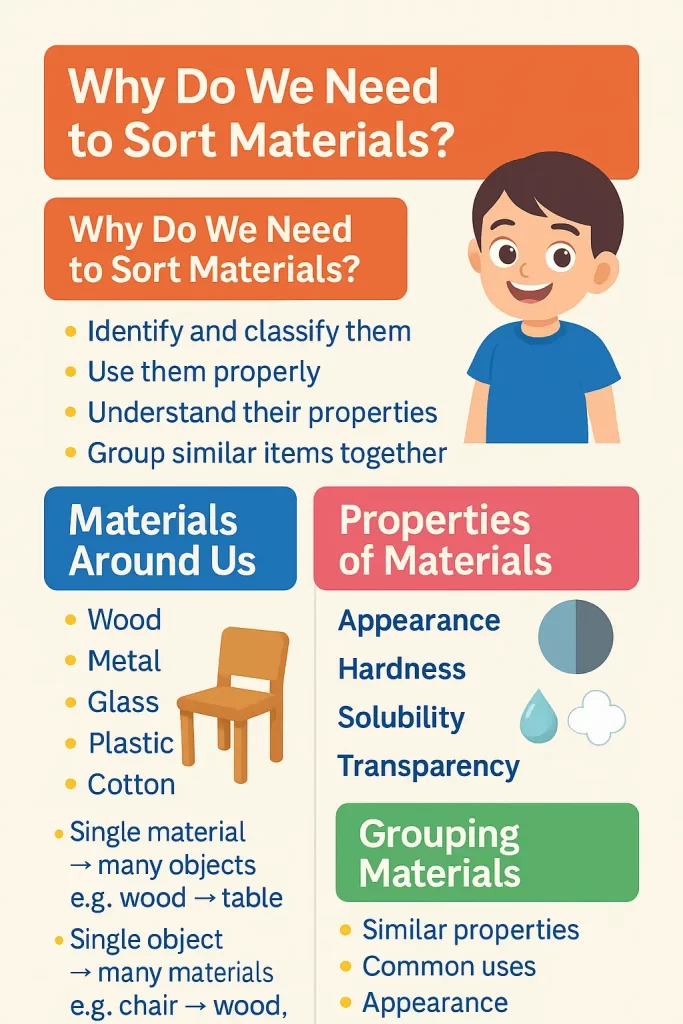
⭐ 1. Why Do We Need to Sort Materials?
We sort materials to:
- Identify and classify them
- Use them properly
- Understand their properties
- Group similar items together
⭐ 2. Materials Around Us
Different objects are made from different materials such as:
- Wood
- Metal
- Glass
- Plastic
- Paper
- Cotton
A single material can be used to make many objects, e.g., wood → table, chair, toys.
A single object can be made of many materials, e.g., chair → wood, metal, plastic.
⭐ 3. Properties of Materials
A. Appearance
Materials may be shiny or dull.
- Shiny: metals (iron, copper, aluminium)
- Dull: wood, paper
B. Hardness
- Hard: metal, stone
- Soft: cotton, rubber, sponge
C. Solubility
- Soluble in water: salt, sugar
- Insoluble: sand, chalk powder, oil
D. Transparency
- Transparent: glass, clean water
- Translucent: oiled paper, thin cloth
- Opaque: wood, metal
E. Float or Sink
- Float: plastic, dry wood
- Sink: stone, iron, metal
F. Conductors and Insulators
Heat Conductors
- Metals
Heat Insulators
- Wood, plastic, rubber
Electric Conductors
- Metals
Electric Insulators
- Plastic, rubber, glass
⭐ 4. Grouping Materials
Materials are grouped based on:
- Similar properties
- Common uses
- Appearance
- Function
Grouping helps us organise and understand the world better.
📘 Important Questions & Answers – Class 6 Science Chapter 4
Class 6 Science Chapter 4 – Sorting Materials and Groups
✅ A. Very Short Answer Questions (1 Mark)
Class 6 Science Chapter 4
1. What is a material?
A material is a substance used to make objects.
2. Give one example of a transparent material.
Glass.
3. Name two insoluble substances.
Sand and chalk powder.
4. What are conductors?
Materials that allow heat or electricity to pass through them.
5. Name one soft material.
Cotton.
✅ B. Short Answer Questions (2 Marks)
Class 6 Science Chapter 4
6. Why do we group materials?
- To study them easily
- To find similarities
- To classify items based on use
- To stay organised
7. What is the difference between transparent and opaque materials?
- Transparent: Allow light to pass through (e.g., glass).
- Opaque: Do not allow any light to pass through (e.g., wood).
8. What makes a material float or sink in water?
Materials with lower density float, while higher density materials sink.
9. Give two examples each: soluble and insoluble substances.
- Soluble: sugar, salt
- Insoluble: sand, oil
✅ C. Short Answer Questions (3 Marks)
10. Explain the property of solubility with examples.
- Some substances dissolve in water → soluble (salt, sugar).
- Some do not dissolve → insoluble (sand, chalk).
Solubility helps us identify and classify materials.
11. Distinguish between conductors and insulators.
| Conductors | Insulators |
|---|---|
| Allow heat/electricity to pass | Do not allow heat/electricity to pass |
| Examples: metals | Examples: plastic, wood |
12. What is hardness? Give examples.
Hardness is the ability of a material to resist being scratched or pressed.
- Hard: iron, stone
- Soft: cotton, rubber
✅ D. Long Answer Questions (5 Marks)
13. Explain different properties of materials with examples.
- Appearance: Metals are shiny; wood is dull.
- Hardness: Stones are hard; sponge is soft.
- Solubility: Sugar dissolves; sand does not.
- Transparency: Glass is transparent; paper is translucent; wood is opaque.
- Floating/Sinking: Wood floats; iron sinks.
- Conductivity: Metals conduct electricity; plastic does not.
14. Describe the importance of grouping materials.
Grouping helps in:
- Organising things
- Studying properties
- Choosing right materials for different purposes
- Making the environment systematic
For example, metals are grouped for making tools because they are strong and shiny.
✅ E. HOTS (Higher Order Thinking Skills)
15. Why are cooking utensils made of metal but handled with plastic or wood?
Metals are good conductors of heat, so utensils heat up quickly.
Plastic/wood is a bad conductor, so handles remain cool and safe.
16. Why is glass used for making windows?
Because it is transparent, allowing light to pass through.
17. A metal spoon sinks in water but a metal boat floats. Why?
Because the shape of the boat increases the volume and reduces density, allowing it to float.