
Easy and complete notes for NCERT Class 6 Science Chapter 15 – Air Around Us. Learn about the composition of air, properties of air, importance of oxygen and carbon dioxide, water vapour, dust, and the atmosphere. Includes solved important questions and answers for Class 6 exam preparation.
Table of Contents
🌬️ Class 6 Science Chapter 15 – NOTES
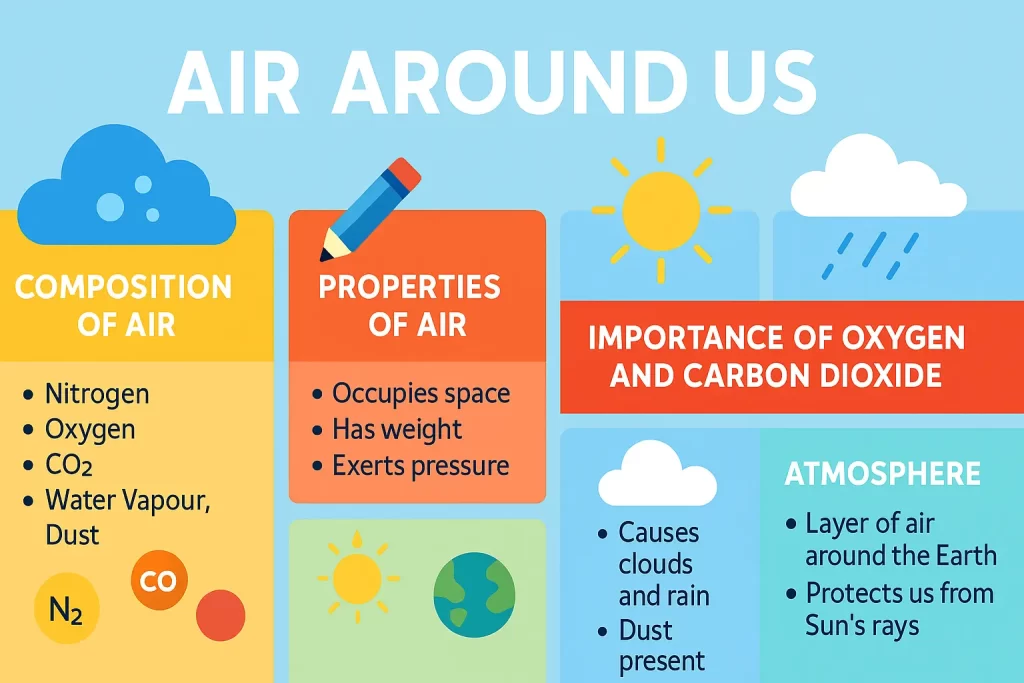
Air Around Us
⭐ 1. Introduction
Air is a mixture of gases that surrounds the Earth.
This blanket of air is called the atmosphere.
Air is essential for life, breathing, burning, and weather.
⭐ 2. Composition of Air
| Component | Percentage | Importance |
|---|---|---|
| Nitrogen | ~78% | Helps plants make proteins |
| Oxygen | ~21% | Needed for breathing & burning |
| Carbon dioxide | ~0.03% | Used by plants in photosynthesis |
| Water vapour | Varies | Causes clouds, rain, humidity |
| Dust & smoke | Small amount | Pollute the air |
| Other gases | Small amount | Argon, neon, etc. |
⭐ 3. Properties of Air
- Air occupies space
(Balloon inflates when air is filled) - Air has weight
(Evidence from scientific experiments) - Air exerts pressure
(Air pressure helps in drinking with a straw) - Air contains gases, water vapour, and dust
⭐ 4. Oxygen in Air
- Supports breathing in humans and animals.
- Helps in burning.
⭐ 5. Carbon Dioxide in Air
- Used by plants to make food (photosynthesis).
- Produced during burning and breathing.
⭐ 6. Water Vapour in Air
- Air always contains some moisture.
- Causes humidity, clouds, and rain.
⭐ 7. Dust & Smoke
- Present in varying amounts.
- More in polluted areas and unhealthy for humans.
⭐ 8. Importance of Air
- Needed for breathing
- Helps in burning
- Plants need CO₂
- Water cycle
- Weather and wind formation
⭐ 9. Atmosphere Layers
(Not in-depth for class 6, but basic)
- The atmosphere protects us from harmful rays of the Sun.
- It keeps Earth warm for living organisms.
⭐ 10. Air Pollution (Intro level)
- Caused by vehicles, factories, burning waste.
- Harmful to lungs, environment, and weather.
📘 IMPORTANT QUESTIONS & ANSWERS – Class 6 Science Chapter 15
✅ 1 Mark Questions
1. What is the atmosphere?
The blanket of air surrounding the Earth.
2. Which gas is the major part of air?
Nitrogen (~78%).
3. Which gas supports burning?
Oxygen.
4. Which gas do plants use for photosynthesis?
Carbon dioxide.
5. What causes clouds and rain?
Water vapour in the air.
✅ 2 Mark Questions
6. Write any two properties of air.
- Air occupies space.
- Air contains gases like oxygen and nitrogen.
7. What is the role of oxygen in the air?
It helps in breathing and burning.
8. Why does a balloon inflate when air is blown into it?
Because air occupies space.
✅ 3 Mark Questions
9. Explain the composition of air.
Air is a mixture of gases:
- 78% nitrogen
- 21% oxygen
- 0.03% carbon dioxide
- Small amounts of water vapour, dust, and other gases
10. What is the importance of carbon dioxide in air?
- Used by plants to make food (photosynthesis).
- Helps maintain balance of oxygen in the atmosphere.
11. How do we know air contains dust and smoke?
Dust can be seen in sunlight coming through windows.
Smoke is visible near factories or burning materials.
✅ 5 Mark Questions
12. Explain the different components of air and their importance.
- Nitrogen: helps plants grow
- Oxygen: required for breathing and burning
- Carbon dioxide: used in photosynthesis
- Water vapour: causes rain and humidity
- Dust & smoke: affect health and pollution
Each component plays a role in life, weather, and environment.
13. What is air pressure? Give examples.
Air exerts pressure in all directions.
Examples:
- Straw sucking works due to air pressure
- Syringes work when air pressure pushes liquid
- Balloons expand due to air pressure inside them
⭐ HOTS Questions
14. Why is oxygen replaced by carbon dioxide in a closed room with many people?
Because people exhale CO₂ while breathing.
15. Why does a burning candle go out when covered with a glass jar?
The candle uses up oxygen and cannot burn without it.
16. Why does wet clothes dry faster on a windy day?
Because wind increases the evaporation rate.
# Class 6 Science Chapter 15