
🎯 Recommended Products for Students & Parents
Handpicked products specially selected for our visitors.

School Backpack Combo
✔ 29 L Spacious Backpack
✔ Includes Tiffin & Pouch
✔ Perfect for School & Coaching

Niacinamide Bright & Clear Skin Combo
✔ Brightens Skin
✔ Reduces Acne Marks
✔ Suitable for Daily Skincare
Disclosure: Some links on this page are affiliate links. We may earn a small commission if you purchase through them, at no additional cost to you.
Learning English grammar becomes easier when we understand how words work in a sentence. Noun and pronoun examples are especially important because nouns and pronouns are used in almost every English sentence. A noun names a person, place, animal, thing, or idea, while a pronoun is used in place of a noun.
In this article, we will learn noun and pronoun examples with simple definitions, different types, examples in sentences, a comparison between nouns and pronouns, and practice questions. This guide is useful for students preparing for school examinations and English grammar tests.
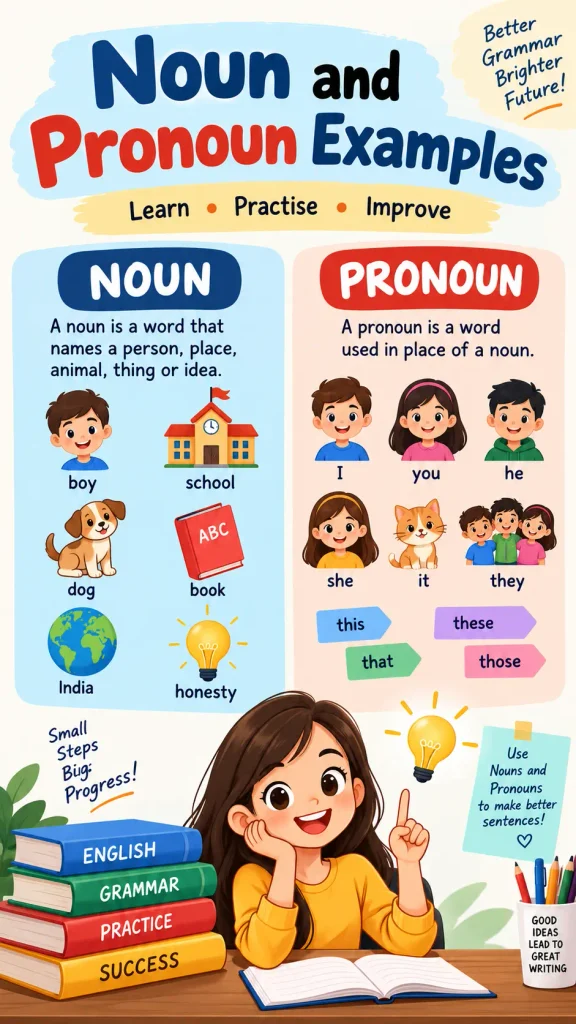
Table of Contents
Noun and Pronoun Examples
What Is a Noun?
A noun is a word that names a person, place, animal, thing, or idea.
For example:
- Rahul is my friend.
- Mumbai is a large city.
- The dog is barking.
- I have a book.
- Honesty is a good quality.
In these sentences, Rahul, Mumbai, dog, book, and honesty are nouns.
Simple Definition of a Noun
A noun is a naming word. It tells us who or what we are talking about.
Examples of Nouns
| Category | Examples |
|---|---|
| Person | boy, teacher, doctor, Riya |
| Place | school, city, India, park |
| Animal | dog, cat, elephant, tiger |
| Thing | book, table, pencil, computer |
| Idea/Quality | honesty, kindness, freedom, happiness |
These basic noun examples are useful for understanding how nouns are used in everyday English.
What Is a Pronoun?
A pronoun is a word that is used in place of a noun. Pronouns help us avoid repeating the same noun again and again.
For example:
Riya is a student. Riya studies every day.
The sentence repeats the name “Riya.” We can improve it by using a pronoun:
Riya is a student. She studies every day.
Here, Riya is a noun and she is a pronoun.
This is one of the simplest noun and pronoun examples for students.
Simple Definition of a Pronoun
A pronoun is a word used instead of a noun.
Common pronouns include:
I, we, you, he, she, it, they, me, us, him, her, them, this, that, these, those, who, which, someone, nobody
Noun and Pronoun Examples
Let’s understand the difference through some simple sentences.
| Noun | Pronoun | Example |
|---|---|---|
| Rahul | He | Rahul is playing. He is happy. |
| Riya | She | Riya is reading. She likes books. |
| The dog | It | The dog is hungry. It wants food. |
| Rahul and Amit | They | Rahul and Amit are friends. They play together. |
| The children | They | The children are studying. They are preparing for the test. |
| My parents | They | My parents are at home. They are busy. |
These noun and pronoun examples show how pronouns replace nouns and make sentences less repetitive.
Difference Between Noun and Pronoun
A noun and a pronoun have different functions in English grammar.
| Noun | Pronoun |
|---|---|
| A noun names a person, place, animal, thing, or idea. | A pronoun is used in place of a noun. |
| Example: Rahul | Example: He |
| Example: school | Example: it |
| Example: children | Example: they |
| Nouns can be proper, common, collective, abstract, etc. | Pronouns can be personal, possessive, reflexive, relative, etc. |
| A noun identifies the person or thing. | A pronoun avoids repetition of the noun. |
Example
Rahul went to Rahul’s school because Rahul had an examination.
This sounds repetitive.
We can write:
Rahul went to his school because he had an examination.
Here:
- Rahul = noun
- his = pronoun
- he = pronoun
This is an important example of how nouns and pronouns work together.
Types of Nouns with Examples
There are several types of nouns in English grammar. Understanding these categories will make it easier to identify nouns in sentences.
1. Common Noun
A common noun refers to a general person, place, animal, or thing.
Examples:
- boy
- girl
- school
- city
- teacher
- animal
- book
Sentence:
The boy is reading a book.
Here, boy and book are common nouns.
2. Proper Noun
A proper noun is the specific name of a person, place, organization, or thing. Proper nouns usually begin with a capital letter.
Examples:
- Rahul
- India
- Maharashtra
- Pune
- Monday
- The HSB School
Sentence:
Rahul lives in Pune.
Here, Rahul and Pune are proper nouns.
3. Collective Noun
A collective noun refers to a group of people, animals, or things.
Examples:
- team
- army
- class
- crowd
- bunch
- flock
- herd
Sentences:
- A team of players won the match.
- A flock of birds flew across the sky.
- A herd of cattle was grazing.
Collective nouns are frequently asked in school grammar examinations.
4. Abstract Noun
An abstract noun refers to an idea, quality, feeling, or state that cannot usually be seen or touched.
Examples:
- honesty
- bravery
- kindness
- happiness
- freedom
- childhood
- wisdom
Sentence:
Honesty is the best policy.
Here, honesty is an abstract noun.
5. Concrete Noun
A concrete noun refers to something that can be experienced through the senses.
Examples:
- apple
- chair
- pencil
- dog
- flower
- house
Sentence:
The flower is beautiful.
Here, flower is a concrete noun.
6. Singular and Plural Nouns
A singular noun refers to one person, place, animal, or thing.
Examples:
- boy
- book
- apple
- teacher
A plural noun refers to more than one.
Examples:
- boys
- books
- apples
- teachers
Example:
The boy has two books.
Here, boy is singular and books is plural.
Types of Pronouns with Examples
Pronouns are also divided into different categories.
1. Personal Pronouns
Personal pronouns refer to people or things.
Examples:
I, we, you, he, she, it, they, me, us, him, her, them
Sentences:
- She is my sister.
- They are playing football.
- He is a teacher.
- We are ready.
2. Possessive Pronouns
Possessive pronouns show ownership or possession.
Examples:
- mine
- ours
- yours
- his
- hers
- theirs
Sentences:
- This book is mine.
- That house is theirs.
- The blue bag is hers.
3. Reflexive Pronouns
Reflexive pronouns refer back to the subject of the sentence.
Examples:
- myself
- yourself
- himself
- herself
- itself
- ourselves
- yourselves
- themselves
Sentences:
- I completed the work myself.
- She hurt herself.
- They enjoyed themselves.
4. Demonstrative Pronouns
Demonstrative pronouns point to particular people or things.
Examples:
- this
- that
- these
- those
Sentences:
- This is my book.
- That is your bag.
- These are my shoes.
- Those are beautiful flowers.
5. Interrogative Pronouns
Interrogative pronouns are used to ask questions.
Examples:
- who
- whom
- whose
- which
- what
Sentences:
- Who is at the door?
- What is your name?
- Which is your book?
- Whose pencil is this?
6. Relative Pronouns
Relative pronouns connect a clause to a noun or pronoun.
Common relative pronouns include:
- who
- whom
- whose
- which
- that
Example:
The boy who won the race is my friend.
Here, who is a relative pronoun.
7. Indefinite Pronouns
Indefinite pronouns refer to people or things without naming them specifically.
Examples:
- someone
- somebody
- everyone
- nobody
- anything
- something
- many
- few
Sentences:
- Someone is knocking at the door.
- Everyone enjoyed the program.
- Nobody knows the answer.
Noun and Pronoun Examples in Sentences
Here are more useful examples for students:
- Amit is a good student. He studies regularly.
- Riya has a new bicycle. She rides it every morning.
- The dog is hungry. It is looking for food.
- The students are preparing for an examination. They are studying hard.
- My mother is a teacher. She teaches English.
- The book is interesting. It has many stories.
- Rahul and Neha are friends. They study together.
- The teacher gave the students homework. She explained the questions.
- My brother lost his pen. He is searching for it.
- The children finished their work. They went outside to play.
These noun and pronoun examples demonstrate how pronouns make sentences shorter and more natural.
Noun vs Pronoun: Easy Trick to Remember
A simple way to remember the difference is:
Noun = Naming Word
A noun gives a name to someone or something.
Rahul, school, dog, book, honesty
Pronoun = Replacement Word
A pronoun takes the place of a noun.
He, she, it, they, this, that
Remember:
Noun → Names
Pronoun → Replaces
Why Are Nouns and Pronouns Important?
Nouns and pronouns are essential parts of English grammar.
Nouns help us identify people, places, animals, objects, and ideas. Without nouns, it would be difficult to communicate exactly what we are talking about.
Pronouns make communication smoother because they prevent unnecessary repetition.
For example:
Riya went to Riya’s room because Riya wanted Riya’s book.
This sentence is awkward.
A better sentence is:
Riya went to her room because she wanted her book.
Therefore, learning noun and pronoun examples helps students write clearer and more effective sentences.
Common Mistakes in Using Nouns and Pronouns
Mistake 1: Repeating the noun unnecessarily
Incorrect:
Rahul said Rahul would complete Rahul’s homework.
Correct:
Rahul said he would complete his homework.
Mistake 2: Using the wrong pronoun
Incorrect:
Riya is my friend. He is very helpful.
Correct:
Riya is my friend. She is very helpful.
Mistake 3: Confusing possessive pronouns
Incorrect:
This book is her.
Correct:
This book is hers.
Mistake 4: Incorrect subject pronoun
Incorrect:
Me and Rahul went to school.
Correct:
Rahul and I went to school.
Practising noun and pronoun examples can help students avoid these common grammar mistakes.
15+ MCQs on Nouns and Pronouns
Test your understanding with these multiple-choice questions.
1. Which of the following is a noun?
A. Quickly
B. Beautiful
C. School
D. She
Answer: C. School
2. Which word is a pronoun?
A. Rahul
B. Table
C. They
D. School
Answer: C. They
3. Identify the noun in the sentence: “The boy is playing.”
A. The
B. Boy
C. Is
D. Playing
Answer: B. Boy
4. Identify the pronoun: “She is reading a book.”
A. Reading
B. Book
C. She
D. Is
Answer: C. She
5. Which pronoun can replace “Riya”?
A. He
B. She
C. They
D. It
Answer: B. She
6. Which pronoun can replace “Rahul”?
A. She
B. It
C. He
D. They
Answer: C. He
7. Which of the following is a proper noun?
A. city
B. school
C. India
D. country
Answer: C. India
8. Which of the following is a collective noun?
A. Team
B. Boy
C. Pencil
D. Honesty
Answer: A. Team
9. Which of the following is an abstract noun?
A. Chair
B. Dog
C. Honesty
D. School
Answer: C. Honesty
10. Which word is a personal pronoun?
A. Happiness
B. They
C. School
D. Teacher
Answer: B. They
11. Choose the correct pronoun:
“Ravi is a student. ___ is intelligent.”
A. She
B. It
C. He
D. They
Answer: C. He
12. Choose the correct pronoun:
“Riya and Neha are sisters. ___ live in Pune.”
A. She
B. He
C. It
D. They
Answer: D. They
13. Which word is a possessive pronoun?
A. Mine
B. Me
C. I
D. Myself
Answer: A. Mine
14. Identify the reflexive pronoun:
“I completed the project myself.”
A. I
B. Completed
C. Project
D. Myself
Answer: D. Myself
15. Which of the following is a demonstrative pronoun?
A. He
B. This
C. Who
D. Mine
Answer: B. This
16. Identify the interrogative pronoun:
“Who is your teacher?”
A. Who
B. Your
C. Teacher
D. Is
Answer: A. Who
17. Choose the correct pronoun:
“The children are playing. ___ are happy.”
A. He
B. She
C. It
D. They
Answer: D. They
18. Which sentence uses a pronoun correctly?
A. Riya is my friend. He is kind.
B. Rahul is my brother. She is helpful.
C. Amit is my friend. He is helpful.
D. The boys are playing. She are happy.
Answer: C. Amit is my friend. He is helpful.
19. What is the main purpose of a pronoun?
A. To describe a noun
B. To replace a noun
C. To show an action
D. To describe an action
Answer: B. To replace a noun
20. Which sentence contains both a noun and a pronoun?
A. He runs.
B. Rahul runs.
C. Rahul said he was tired.
D. Quickly running.
Answer: C. Rahul said he was tired.
Quick Revision: Noun and Pronoun Examples
| Grammar Term | Meaning | Examples |
|---|---|---|
| Noun | Naming word | Rahul, school, dog, honesty |
| Pronoun | Replaces a noun | he, she, it, they |
| Common Noun | General name | boy, city, school |
| Proper Noun | Specific name | Rahul, India, Pune |
| Collective Noun | Name of a group | team, flock, herd |
| Abstract Noun | Idea or quality | honesty, kindness |
| Personal Pronoun | Refers to people/things | I, he, she, they |
| Possessive Pronoun | Shows possession | mine, yours, theirs |
| Reflexive Pronoun | Refers back to subject | myself, herself, themselves |
| Demonstrative Pronoun | Points to something | this, that, these, those |
Frequently Asked Questions
What is a noun?
A noun is a naming word used for a person, place, animal, thing, or idea. Examples include teacher, India, dog, book, and honesty.
What is a pronoun?
A pronoun is a word used in place of a noun. Examples include he, she, it, they, we, and you.
What is the difference between a noun and a pronoun?
A noun names a person, place, animal, thing, or idea, whereas a pronoun replaces a noun to avoid repetition.
What are some examples of nouns and pronouns?
Examples include Rahul–he, Riya–she, dog–it, and children–they.
What are the main types of nouns?
Common types include common nouns, proper nouns, collective nouns, abstract nouns, concrete nouns, singular nouns, and plural nouns.
What are the main types of pronouns?
Common types include personal, possessive, reflexive, demonstrative, interrogative, relative, and indefinite pronouns.
Why are pronouns used?
Pronouns are used mainly to replace nouns and avoid repeating the same noun unnecessarily.
How can I identify a noun in a sentence?
Ask yourself whether the word names a person, place, animal, thing, or idea. If it does, it may be a noun.
How can I identify a pronoun?
Look for a word that takes the place of a noun, such as he, she, it, they, we, this, that, who, or someone.
Conclusion
Understanding nouns and pronouns is an important part of learning English grammar. Nouns are naming words, while pronouns are words that replace nouns. Once students understand this basic difference, identifying and using them in sentences becomes much easier.
The noun and pronoun examples in this article can help students understand different types of nouns and pronouns, their uses, and their role in sentences. Students should practise the examples and MCQs regularly to improve their grammar and perform better in examinations.
For more useful English grammar lessons, examples, worksheets, and practice questions, keep learning with The HSB School.