
🎯 Recommended Products for Students & Parents
Handpicked products specially selected for our visitors.

School Backpack Combo
✔ 29 L Spacious Backpack
✔ Includes Tiffin & Pouch
✔ Perfect for School & Coaching

Niacinamide Bright & Clear Skin Combo
✔ Brightens Skin
✔ Reduces Acne Marks
✔ Suitable for Daily Skincare
Disclosure: Some links on this page are affiliate links. We may earn a small commission if you purchase through them, at no additional cost to you.
CBSE Class 10 Syllabus 2026-27 for Maths, Science, English, Social Science, Hindi and Sanskrit. Check complete chapters, marks distribution and latest syllabus details.
CBSE Class 10 Syllabus 2026-27
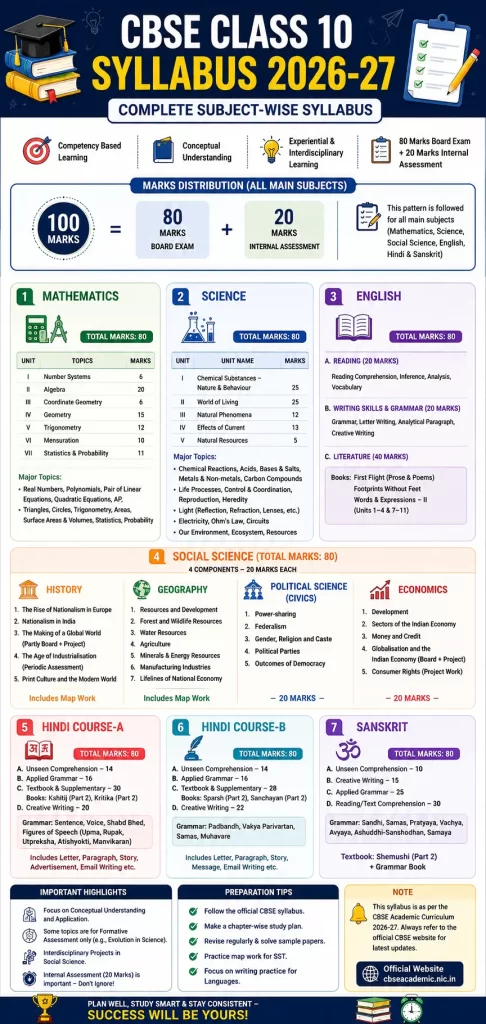
The CBSE Class 10 Syllabus 2026-27 is based on the latest curriculum issued by the Central Board of Secondary Education for the academic session 2026–27. CBSE has made the official curriculum available through its Academic portal, with separate curriculum documents for languages, Mathematics, Science and Social Science.
Class 10 is an important academic year because students prepare for the CBSE Board Examination. The syllabus covers compulsory subjects such as Mathematics, Science and Social Science along with the languages selected by the student.
For the 2026–27 session, CBSE continues to emphasise competency-based learning, conceptual understanding, application of knowledge, experiential learning and interdisciplinary connections.
The CBSE Class 10 Syllabus 2026-27 therefore focuses not only on remembering information but also on understanding concepts and applying them to real-life situations.
Class 10 Main Subjects
| Subject | Board Examination | Internal Assessment | Total |
|---|---|---|---|
| Mathematics | 80 | 20 | 100 |
| Science | 80 | 20 | 100 |
| Social Science | 80 | 20 | 100 |
| English Language & Literature | 80 | 20 | 100 |
| Hindi Course-A / Course-B | 80 | 20 | 100 |
| Sanskrit | 80 | 20 | 100 |
Students may select their languages according to the CBSE scheme of studies. For Class X, CBSE lists Language 1 and Language 2 under Group-L, Mathematics and Science under Group-A1, and Social Science as a compulsory subject.
CBSE Class 10 Maths Syllabus 2026-27
The CBSE Class 10 Syllabus 2026-27 for Mathematics has a strong focus on algebra, geometry, trigonometry, statistics, probability and mathematical reasoning.
The Mathematics curriculum has seven major units carrying a total of 80 marks in the annual examination.
Mathematics Marks Distribution
| Unit | Topics | Marks |
|---|---|---|
| I | Number Systems | 6 |
| II | Algebra | 20 |
| III | Coordinate Geometry | 6 |
| IV | Geometry | 15 |
| V | Trigonometry | 12 |
| VI | Mensuration | 10 |
| VII | Statistics and Probability | 11 |
| Total | Mathematics Theory | 80 |
Complete Mathematics Syllabus
| Chapter / Topic | Major Concepts |
|---|---|
| Real Numbers | Fundamental Theorem of Arithmetic; irrationality of √2, √3 and √5 |
| Polynomials | Zeros of polynomial; relationship between zeros and coefficients |
| Pair of Linear Equations in Two Variables | Graphical method, consistency, substitution and elimination |
| Quadratic Equations | Factorisation, quadratic formula, discriminant, real-life problems |
| Arithmetic Progressions | nth term, sum of first n terms and applications |
| Coordinate Geometry | Distance formula, section formula and coordinate applications |
| Triangles | Similarity, proportionality and related theorems |
| Circles | Tangents and properties of tangents |
| Introduction to Trigonometry | Trigonometric ratios and identities |
| Applications of Trigonometry | Heights and distances |
| Areas Related to Circles | Areas of sectors and segments |
| Surface Areas and Volumes | Combination of solids and related applications |
| Statistics | Mean, median and mode |
| Probability | Classical probability and related problems |
The 2026–27 Mathematics curriculum also highlights mathematical modelling, data analytics, computational thinking, real-life applications and Indian contributions to mathematics.
CBSE Class 10 Science Syllabus 2026-27
The CBSE Class 10 Syllabus 2026-27 for Science follows an integrated approach covering Chemistry, Biology, Physics and related scientific understanding.
The annual examination carries 80 marks, while internal assessment carries 20 marks.
Science Marks Distribution
| Unit | Unit Name | Marks |
|---|---|---|
| I | Chemical Substances – Nature and Behaviour | 25 |
| II | World of Living | 25 |
| III | Natural Phenomena | 12 |
| IV | Effects of Current | 13 |
| V | Natural Resources | 5 |
| Total | Theory | 80 |
Complete Science Syllabus
| Unit | Topics Included |
|---|---|
| Chemical Substances – Nature and Behaviour | Chemical Reactions and Equations; Periodic Classification of Elements; Acids, Bases and Salts; Metals and Non-metals; Carbon and its Compounds |
| World of Living | Life Processes; Control and Coordination; Reproduction; Heredity |
| Natural Phenomena | Reflection of Light; Refraction of Light; Spherical Mirrors; Lenses; Human Eye; Defects of Vision; Prism; Dispersion and Scattering |
| Effects of Current | Electric Current; Potential Difference; Ohm’s Law; Resistance; Resistivity; Series and Parallel Combination; Heating Effect; Electric Power |
| Natural Resources | Our Environment; Ecosystem; Food Chains; Environmental Issues and Sustainable Use of Resources |
An important point for students is that some topics are identified by CBSE for formative assessment only. For example, Evolution is included for learning and reinforcement but is not added to the summative assessment.
The Science syllabus is designed to develop scientific inquiry, observation, analysis, evidence-based thinking and connections between Science, Technology and Society.
CBSE Class 10 English Syllabus 2026-27
The official CBSE Class 10 Syllabus 2026-27 for English Language and Literature is divided into three major sections:
| Section | Area | Marks |
|---|---|---|
| A | Reading Comprehension | 20 |
| B | Writing Skills and Grammar | 20 |
| C | Language through Literature | 40 |
| Total | Theory | 80 |
Section A – Reading Skills
Students will be assessed on:
- Reading comprehension
- Conceptual understanding
- Decoding
- Analysis
- Inference
- Interpretation
- Vocabulary
Section B – Writing Skills and Grammar
This section evaluates:
- Grammar in context
- Creative expression
- Opinion and reasoning
- Appropriate format and tone
- Accuracy and fluency
- Formal letter writing
- Analytical paragraph writing
Section C – Literature
The prescribed NCERT books are First Flight and Footprints Without Feet.
First Flight – Prose
| No. | Chapter |
|---|---|
| 1 | A Letter to God |
| 2 | Nelson Mandela – Long Walk to Freedom |
| 3 | Stories About Flying |
| 4 | From the Diary of Anne Frank |
| 5 | Glimpses of India |
| 6 | Mijbil the Otter |
| 7 | Madam Rides the Bus |
| 8 | The Sermon at Benares |
| 9 | The Proposal |
First Flight – Poems
| No. | Poem |
|---|---|
| 1 | Dust of Snow |
| 2 | Fire and Ice |
| 3 | A Tiger in the Zoo |
| 4 | How to Tell Wild Animals |
| 5 | The Ball Poem |
| 6 | Amanda! |
| 7 | The Trees |
| 8 | Fog |
| 9 | The Tale of Custard the Dragon |
| 10 | For Anne Gregory |
Footprints Without Feet
| No. | Chapter |
|---|---|
| 1 | A Triumph of Surgery |
| 2 | The Thief’s Story |
| 3 | The Midnight Visitor |
| 4 | A Question of Trust |
| 5 | Footprints Without Feet |
| 6 | The Making of a Scientist |
| 7 | The Necklace |
| 8 | Bholi |
| 9 | The Book That Saved the Earth |
CBSE also prescribes Words and Expressions – II, with Units 1–4 and 7–11 specified in the curriculum.
CBSE Class 10 Social Science Syllabus 2026-27
Social Science is one of the most important components of the CBSE Class 10 Syllabus 2026-27. It includes four disciplines:
- History
- Geography
- Political Science/Civics
- Economics
Each discipline carries 20 marks in the course structure, making a total of 80 marks for the written examination.
CBSE Class 10 History Syllabus 2026-27
The History syllabus is based on India and the Contemporary World – II.
History Syllabus
| Chapter | Topic | Assessment |
|---|---|---|
| 1 | The Rise of Nationalism in Europe | Board Examination |
| 2 | Nationalism in India | Board Examination |
| 3 | The Making of a Global World | Partly Board + Interdisciplinary Project |
| 4 | The Age of Industrialisation | Periodic Assessment |
| 5 | Print Culture and the Modern World | Board Examination |
The History section carries 20 marks including map pointing. The Making of a Global World is divided between board examination content and interdisciplinary project work. The Age of Industrialisation is assessed through periodic assessment.
Major Areas of Study
Students will study:
- The French Revolution and nationalism
- Formation of nation-states in Europe
- Nationalism in India
- Gandhian movements
- The global economy
- Industrialisation
- Colonialism
- Development of print culture
- Impact of printing on society and politics
CBSE Class 10 Geography Syllabus 2026-27
Geography is based on Contemporary India – II.
Geography Syllabus
| Chapter | Topic |
|---|---|
| 1 | Resources and Development |
| 2 | Forest and Wildlife Resources |
| 3 | Water Resources |
| 4 | Agriculture |
| 5 | Minerals and Energy Resources |
| 6 | Manufacturing Industries |
| 7 | Lifelines of National Economy |
Geography carries 20 marks including map pointing. The theory component carries 17 marks and map pointing carries 3 marks.
Important areas include:
- Resource planning
- Land resources
- Forest conservation
- Biodiversity
- Water conservation
- Agriculture
- Mineral resources
- Energy resources
- Manufacturing industries
- Transport and communication
- International trade
- Tourism
The curriculum also connects Geography with interdisciplinary learning, particularly through the chapters on Lifelines of National Economy, Globalisation and the Making of a Global World.
CBSE Class 10 Civics Syllabus 2026-27
Civics is officially covered under Political Science – Democratic Politics-II.
Political Science / Civics Syllabus
| Chapter | Topic |
|---|---|
| 1 | Power-sharing |
| 2 | Federalism |
| 3 | Gender, Religion and Caste |
| 4 | Political Parties |
| 5 | Outcomes of Democracy |
The Political Science section carries 20 marks.
Students learn about:
- Power sharing in democracies
- Federalism in India
- Gender and political participation
- Religion and caste in politics
- Political parties
- Elections
- Democratic outcomes
- Accountability and participation
The emphasis is on understanding democracy through real-world examples rather than simply memorising definitions.
CBSE Class 10 Economics Syllabus 2026-27
Although Economics was not specifically listed in the requested subjects, it is an essential part of Class 10 Social Science and therefore should not be left out of a complete CBSE Class 10 Syllabus 2026-27 guide.
The prescribed textbook is Understanding Economic Development.
Economics Syllabus
| Chapter | Topic | Assessment |
|---|---|---|
| 1 | Development | Board Examination |
| 2 | Sectors of the Indian Economy | Board Examination |
| 3 | Money and Credit | Board Examination |
| 4 | Globalisation and the Indian Economy | Board + Interdisciplinary Project |
| 5 | Consumer Rights | Project Work |
The Economics component carries 20 marks in the Social Science course structure.
Important concepts include:
- Development and its different indicators
- Per capita income
- Human development
- Primary, secondary and tertiary sectors
- Organised and unorganised sectors
- Money and credit
- Formal and informal sources of credit
- Globalisation
- Multinational corporations
- World Trade Organisation
- Consumer rights
CBSE Class 10 Hindi Syllabus 2026-27
CBSE offers Hindi Course-A (002) and Hindi Course-B (085) at Class 10 level. Students should follow the course selected by their school.
Hindi Course-A
Hindi Course-A carries 80 marks for the annual examination and 20 marks for internal assessment. The paper covers:
| Section | Area | Marks |
|---|---|---|
| A | Unseen Comprehension | 14 |
| B | Applied Grammar | 16 |
| C | Textbook & Supplementary Reader | 30 |
| D | Creative Writing | 20 |
| Total | 80 |
Hindi Course-A Grammar
The prescribed grammar areas include:
- Sentence classification based on structure
- Voice
- Word identification
- Figures of speech
- Upma
- Rupak
- Utpreksha
- Atishyokti
- Manvikaran
Hindi Course-A Books
| Book | Content |
|---|---|
| Kshitij Part 2 | Prose and Poetry |
| Kritika Part 2 | Supplementary Reader |
The syllabus specifies that certain chapters/poems from these books are not to be assessed in the board examination, including selected portions identified by CBSE.
Hindi Course-A Writing
Students may be assessed on:
- Paragraph writing
- Letter writing
- Advertisement writing
- Dialogue writing
- Short story writing
- Message writing
- E-mail writing
- Curriculum vitae/resume
- Information writing
Hindi Course-B
Hindi Course-B is the second-language Hindi option and carries 80 marks for the board examination plus 20 marks internal assessment.
| Section | Area | Marks |
|---|---|---|
| A | Unseen Comprehension | 14 |
| B | Applied Grammar | 16 |
| C | Textbook & Supplementary Reader | 28 |
| D | Creative Writing | 22 |
| Total | 80 |
Hindi Course-B Grammar
The syllabus includes:
- Padbandh
- Sentence transformation based on structure
- Samas
- Muhavare
The prescribed books are:
- Sparsh Part 2
- Sanchayan Part 2
Certain portions from Sparsh Part 2 have been excluded from question-paper assessment, while no chapter has been removed from Sanchayan Part 2.
CBSE Class 10 Sanskrit Syllabus 2026-27
Sanskrit is another language option included in the CBSE Class 10 Syllabus 2026-27.
The Sanskrit paper carries 80 marks.
Sanskrit Marks Distribution
| Section | Area | Marks |
|---|---|---|
| A | Unseen Comprehension | 10 |
| B | Creative Writing | 15 |
| C | Applied Grammar | 25 |
| D | Reading/Prescribed Text Comprehension | 30 |
| Total | 80 |
Sanskrit Creative Writing
Students prepare:
- Formal/informal letter writing
- Picture description
- Paragraph writing
- Translation from Hindi/English into Sanskrit
Sanskrit Grammar
| Topic | Major Areas |
|---|---|
| Sandhi | Swar Sandhi, Vyanjan Sandhi, Visarga Sandhi |
| Samasa | Tatpurusha, Bahuvrihi, Avyayibhava, Dvandva |
| Pratyaya | Krit, Taddhita and Stri Pratyaya |
| Vachya | Sentence transformation |
| Samaya | Writing time in words |
| Avyaya | Prescribed indeclinable words |
| Ashuddhi-Sanshodhan | Correction based on grammar |
Sanskrit Prescribed Texts
The prescribed textbook is Shemushi Part 2, along with grammar/practice books.
The specified chapters include:
| Chapter | Title |
|---|---|
| 1 | शुचिपर्यावरणम् |
| 2 | बुद्धिर्बलवती सदा |
| 3 | शिशुलालनम् |
| 4 | जननी तुल्यवत्सला |
| 5 | सुभाषितानि |
| 6 | सौहार्दं प्रकृतेः शोभा |
| 7 | विचित्रः साक्षी |
| 8 | सूक्तयः |
| 10 | अन्योक्तयः |
Important Changes and Features in CBSE Class 10 Syllabus 2026-27
The latest curriculum places greater emphasis on competency-based learning and practical application.
1. Competency-Based Learning
Students are expected to understand concepts and apply them in unfamiliar situations.
2. Experiential Learning
Activities, projects, investigations and real-life applications have an important role in learning.
3. Interdisciplinary Learning
Some Social Science topics are connected through interdisciplinary projects. For example, History, Geography and Economics contain linked themes around globalisation and the national economy.
4. Formative Assessment
Certain topics are included for classroom learning and reinforcement but are not necessarily included in the summative board examination. Science specifically identifies Evolution as a formative-assessment area.
5. Internal Assessment
The overall pattern for major subjects generally combines:
80 marks Board Examination + 20 marks Internal Assessment = 100 marks
Students should therefore not ignore school-based assessment, projects, portfolios, periodic tests and subject-enrichment activities.
How to Prepare for CBSE Class 10 Syllabus 2026-27
Students should begin preparation by dividing the syllabus into manageable sections.
Step 1 – Download the Official Syllabus
Always use the latest CBSE curriculum rather than relying on old PDFs or coaching websites.
Step 2 – Make a Chapter Checklist
Create a checklist for every subject and mark each chapter as:
- Not Started
- In Progress
- Completed
- Revised
- Test Completed
Step 3 – Focus on Concepts
For Mathematics and Science, understanding concepts is more important than memorising answers.
Step 4 – Practise Writing
For English and Hindi, students should regularly practise:
- Letters
- Paragraphs
- Analytical writing
- Grammar
- Literature answers
- Unseen passages
Step 5 – Practise Maps
History and Geography students should regularly practise the prescribed map work.
Step 6 – Solve Competency-Based Questions
Students should practise application-based, case-based, assertion-reasoning and source-based questions wherever applicable.
Frequently Asked Questions About CBSE Class 10 Syllabus 2026-27
Is the CBSE Class 10 Syllabus 2026-27 released?
Yes. CBSE has released the curriculum for the 2026–27 academic session on its official Academic portal.
What are the main subjects in Class 10?
The main compulsory academic subjects include Mathematics, Science, Social Science and two languages according to the student’s selected combination. CBSE also provides optional skill and academic subjects.
How many marks are there in the Class 10 board examination?
For major subjects such as Mathematics, Science, Social Science and English, the written board examination carries 80 marks, with 20 marks allocated to internal assessment.
Is Economics included in Class 10 Social Science?
Yes. Social Science includes History, Geography, Political Science/Civics and Economics. Each component is represented in the Social Science course structure.
Are Hindi Course-A and Hindi Course-B the same?
No. Hindi Course-A and Hindi Course-B have different prescribed books, grammar components and assessment structures. Students should follow the course selected by their school.
Is Sanskrit available in Class 10?
Yes. Sanskrit is listed among the Group-L language options in the CBSE Class X curriculum.
Final Words
The CBSE Class 10 Syllabus 2026-27 provides students with a structured academic framework covering languages, Mathematics, Science and Social Science. The latest curriculum places considerable importance on conceptual understanding, application, competency-based questions, experiential learning and interdisciplinary connections.
Students should download the official curriculum, prepare a subject-wise chapter checklist and revise regularly instead of waiting until the final months before the board examination.
For the most reliable and updated information, students and parents should refer to the official CBSE Academic curriculum portal because CBSE may issue clarifications, amendments or additional instructions during the academic session.
Official CBSE Curriculum 2026-27: CBSE Academic – Curriculum 2026-27
CBSE Class 10 Syllabus 2026-27 should therefore be treated as the primary roadmap for planning the entire academic year and preparing systematically for the Class 10 Board Examination.
Phrasal Verbs for Students: Learn 160+ Essential Phrasal Verbs with Easy Meanings & Examples