
🎯 Recommended Products for Students & Parents
Handpicked products specially selected for our visitors.

School Backpack Combo
✔ 29 L Spacious Backpack
✔ Includes Tiffin & Pouch
✔ Perfect for School & Coaching

Niacinamide Bright & Clear Skin Combo
✔ Brightens Skin
✔ Reduces Acne Marks
✔ Suitable for Daily Skincare
Disclosure: Some links on this page are affiliate links. We may earn a small commission if you purchase through them, at no additional cost to you.
Phrasal verbs are everywhere in English.
We use them when we wake up in the morning, get ready for school, look for a missing notebook, write down homework, find out an answer, catch up with classmates, and give up something we no longer want to do.
That is why learning phrasal verbs for students can make a big difference to a student’s English.
Instead of memorising hundreds of expressions without context, it is much easier to understand phrasal verbs through their meanings and example sentences.
In this guide, you will learn:
Table of Contents
Let’s begin.
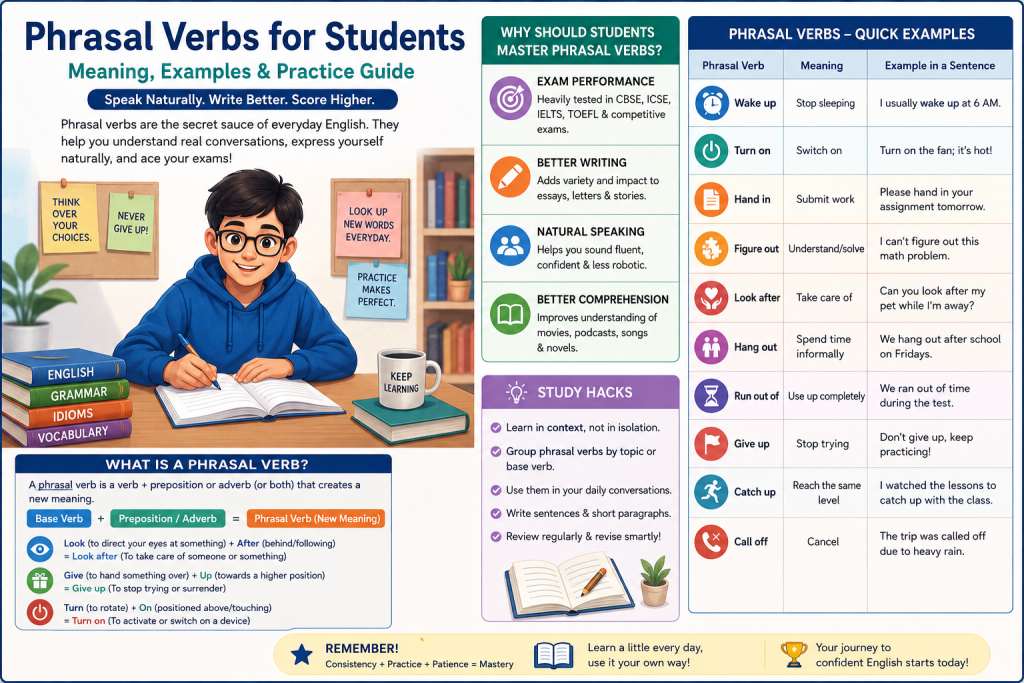
What Is a Phrasal Verb?
A phrasal verb is a multi-word verb formed from a verb together with one or more particles, usually an adverb or preposition.
The combination often has a meaning different from the meaning of the original verb.
For example:
give + up = give up
The verb give usually means to provide something to someone.
But give up means to stop trying or stop doing something.
More Examples
| Base Verb | Phrasal Verb | Meaning |
|---|---|---|
| Look | Look after | Take care of |
| Give | Give up | Stop trying |
| Find | Find out | Discover |
| Turn | Turn on | Activate |
| Put | Put off | Postpone |
| Pick | Pick up | Collect or lift |
| Run | Run out of | Have none left |
| Carry | Carry on | Continue |
This change in meaning is one reason students should learn phrasal verbs as complete expressions rather than trying to translate every word separately.
Why Are Phrasal Verbs for Students Important?
Phrasal verbs for students are important because they occur frequently in everyday English.
1. They Improve Spoken English
Compare:
Please continue your work.
with:
Please carry on with your work.
Both are correct, but knowing expressions such as carry on helps students understand and participate in natural everyday conversations.
2. They Build Vocabulary
Learning one simple verb can lead to several useful expressions.
For example:
look
can become:
- look after
- look around
- look at
- look back
- look for
- look forward to
- look into
- look out
- look over
- look up
Each expression has a different use.
3. They Improve Reading Comprehension
Phrasal verbs for students appear in stories, conversations, news articles, instructions, textbooks, and other everyday English texts.
Knowing their meanings makes reading easier.
4. They Help in Exams
Phrasal verbs for students in vocabulary, reading comprehension, fill-in-the-blank, editing, sentence-completion, and other language exercises may be encounter.
5. They Improve Writing
Phrasal verbs for students give more ways to express ideas without repeating the same vocabulary.
160+ Phrasal Verbs for Students of common phrasal verbs for students.
Rather than simply memorising the list, read each example sentence and notice how the phrasal verb is used.
Phrasal Verbs for Students 1–20: School and Studying
| # | Phrasal Verb | Meaning | Example Sentence |
|---|---|---|---|
| 1 | Hand in | Submit | Please hand in your homework tomorrow. |
| 2 | Write down | Record in writing | Write down the important points in your notebook. |
| 3 | Look up | Search for information | Look up the word in a dictionary. |
| 4 | Find out | Discover | We need to find out why the experiment failed. |
| 5 | Work out | Solve | Can you work out this maths problem? |
| 6 | Figure out | Understand or solve | I finally figured out the answer. |
| 7 | Read over | Read to check | Read over your answers before submitting the paper. |
| 8 | Go over | Review | Let’s go over this chapter before the test. |
| 9 | Point out | Draw attention to | The teacher pointed out my spelling mistake. |
| 10 | Cross out | Draw a line through | Cross out the incorrect answer. |
| 11 | Fill in | Complete missing information | Fill in the blanks with suitable words. |
| 12 | Catch up | Reach the same level | I missed two classes and need to catch up. |
| 13 | Fall behind | Fail to keep up | Don’t fall behind with your studies. |
| 14 | Keep up | Stay at the same level | She studies daily to keep up with the class. |
| 15 | Think over | Consider carefully | Think over the question before answering. |
| 16 | Put off | Postpone | Don’t put off your homework until tomorrow. |
| 17 | Brush up on | Improve an old skill | I need to brush up on my grammar before the exam. |
| 18 | Check over | Examine for mistakes | Check over your calculations carefully. |
| 19 | Learn by heart | Memorise completely | We had to learn the poem by heart. |
| 20 | Read up on | Study a subject by reading | I read up on volcanoes before the science project. |
Phrasal Verbs for Students 21–40: Everyday Activities
| # | Phrasal Verb | Meaning | Example Sentence |
|---|---|---|---|
| 21 | Wake up | Stop sleeping | I wake up at 6:30 every morning. |
| 22 | Get up | Leave your bed | I usually get up immediately after the alarm rings. |
| 23 | Put on | Wear | Put on your sweater before going outside. |
| 24 | Take off | Remove clothing | Take off your shoes before entering. |
| 25 | Try on | Wear something to test it | Can I try on this jacket? |
| 26 | Wash up | Wash dishes or clean yourself | We washed up after dinner. |
| 27 | Clean up | Make something clean | Please clean up your room. |
| 28 | Tidy up | Make neat | Tidy up your desk before leaving. |
| 29 | Throw away | Discard | Don’t throw away recyclable paper. |
| 30 | Put away | Return to its proper place | Put away your books after studying. |
| 31 | Take out | Remove from somewhere | Take out your notebook. |
| 32 | Pick up | Lift or collect | Please pick up the pencil from the floor. |
| 33 | Put down | Place on a surface | Put down the box carefully. |
| 34 | Turn on | Activate | Turn on the computer. |
| 35 | Turn off | Deactivate | Turn off the lights before leaving. |
| 36 | Switch on | Activate | Switch on the fan, please. |
| 37 | Switch off | Deactivate | Remember to switch off the television. |
| 38 | Get ready | Prepare | Get ready for school. |
| 39 | Hurry up | Do something faster | Hurry up, or we’ll miss the bus. |
| 40 | Slow down | Reduce speed | Slow down when you reach the crossing. |
Phrasal Verbs for Students 41–60: Friends, Family and Social Life
| # | Phrasal Verb | Meaning | Example Sentence |
|---|---|---|---|
| 41 | Get along | Have a good relationship | My brother and I get along well. |
| 42 | Hang out | Spend time socially | We hang out after school sometimes. |
| 43 | Look after | Take care of | Can you look after my dog? |
| 44 | Grow up | Become an adult | What do you want to be when you grow up? |
| 45 | Count on | Depend on | You can count on me for help. |
| 46 | Cheer up | Become happier | Cheer up! Tomorrow will be better. |
| 47 | Calm down | Become calmer | Please calm down and explain what happened. |
| 48 | Open up | Talk more freely | He eventually opened up about his worries. |
| 49 | Make up | Become friendly again | The two friends argued but later made up. |
| 50 | Fall out | Have an argument | They fell out over a small misunderstanding. |
| 51 | Get together | Meet socially | Our friends get together every Sunday. |
| 52 | Come over | Visit someone’s home | My cousin is coming over this evening. |
| 53 | Drop by | Visit briefly | My friend dropped by after school. |
| 54 | Call back | Return a phone call | I’ll call you back after class. |
| 55 | Hang up | End a phone call | Don’t hang up yet. |
| 56 | Speak up | Speak louder | Please speak up so everyone can hear. |
| 57 | Join in | Participate | Everyone joined in the game. |
| 58 | Help out | Give assistance | I helped out with the school event. |
| 59 | Stand by | Support | Good friends stand by each other. |
| 60 | Look up to | Admire | Many children look up to their teachers. |
Phrasal Verbs for Students 61–80: Travel and Movement
| # | Phrasal Verb | Meaning | Example Sentence |
|---|---|---|---|
| 61 | Set off | Begin a journey | We set off early in the morning. |
| 62 | Take off | Leave the ground | The plane took off on time. |
| 63 | Get in | Enter a car | Get in the car quickly. |
| 64 | Get out | Leave a vehicle/place | We got out of the taxi. |
| 65 | Get on | Enter public transport | We got on the bus at the next stop. |
| 66 | Get off | Leave public transport | Get off at the railway station. |
| 67 | Come back | Return | When will you come back? |
| 68 | Go back | Return | I need to go back home. |
| 69 | Move in | Begin living somewhere | Our new neighbours moved in yesterday. |
| 70 | Move out | Stop living somewhere | They moved out last month. |
| 71 | Stop over | Stay briefly during a journey | We stopped over in Mumbai before continuing our journey. |
| 72 | See off | Say goodbye to someone leaving | We went to the station to see her off. |
| 73 | Pick up | Collect someone | Dad will pick me up after school. |
| 74 | Drop off | Take someone somewhere | Mum dropped me off at school. |
| 75 | Head for | Move towards | We headed for the station. |
| 76 | Go away | Leave | They went away for the weekend. |
| 77 | Come along | Accompany | Would you like to come along with us? |
| 78 | Walk around | Walk through an area | We walked around the museum. |
| 79 | Turn back | Return in the opposite direction | Heavy rain forced us to turn back. |
| 80 | Pull over | Move a vehicle to the side | The driver pulled over safely. |
Phrasal Verbs for Students 81–100: Problems and Solutions
| # | Phrasal Verb | Meaning | Example Sentence |
|---|---|---|---|
| 81 | Break down | Stop functioning | Our school bus broke down this morning. |
| 82 | Run out of | Have none left | We ran out of paper. |
| 83 | Deal with | Handle | We need to deal with the problem calmly. |
| 84 | Sort out | Resolve | The teacher helped us sort out the misunderstanding. |
| 85 | Give up | Stop trying | Never give up because a problem seems difficult. |
| 86 | Carry on | Continue | Carry on with your work. |
| 87 | Keep on | Continue repeatedly | Keep on practising. |
| 88 | Try out | Test | Let’s try out this new method. |
| 89 | Start over | Begin again | I made a mistake and had to start over. |
| 90 | Come up with | Produce an idea | Riya came up with a clever solution. |
| 91 | Get over | Recover from | He quickly got over his disappointment. |
| 92 | Get through | Successfully finish | We got through all the questions. |
| 93 | Break up | Separate into smaller parts | Break up the task into smaller steps. |
| 94 | Cut down on | Reduce | We should cut down on plastic waste. |
| 95 | Get rid of | Remove | We need to get rid of unnecessary files. |
| 96 | Make do with | Manage using what is available | We had to make do with the materials we had. |
| 97 | Rule out | Eliminate as a possibility | The experiment ruled out one explanation. |
| 98 | Narrow down | Reduce the number of possibilities | We narrowed down the choices to three. |
| 99 | Straighten out | Resolve a difficulty | We finally straightened out the confusion. |
| 100 | Work through | Deal with step by step | Let’s work through the problem together. |
Phrasal Verbs for Students 101–120: Communication and Thinking
| # | Phrasal Verb | Meaning | Example Sentence |
|---|---|---|---|
| 101 | Bring up | Mention | She brought up an interesting question. |
| 102 | Talk over | Discuss | Let’s talk over the problem. |
| 103 | Point out | Mention or indicate | He pointed out an error in the diagram. |
| 104 | Speak out | Express an opinion openly | Students should speak out respectfully when something is wrong. |
| 105 | Call back | Return a call | I’ll call back after dinner. |
| 106 | Get across | Communicate successfully | The diagram helped get the idea across. |
| 107 | Sum up | Summarise | The teacher summed up the lesson. |
| 108 | Spell out | Explain clearly | Let me spell out the instructions. |
| 109 | Talk about | Discuss | We talked about climate change in class. |
| 110 | Ask around | Ask several people | I asked around, but nobody had seen my notebook. |
| 111 | Think about | Consider | Think about what you want to achieve. |
| 112 | Think through | Consider carefully | Think through your answer before writing it. |
| 113 | Find out | Discover | I found out how rainbows form. |
| 114 | Look into | Investigate | The teacher will look into the issue. |
| 115 | Make out | Understand or see with difficulty | I couldn’t make out the writing on the board. |
| 116 | Catch on | Begin to understand | She caught on very quickly. |
| 117 | Come across | Find unexpectedly | I came across an interesting science article. |
| 118 | Go through | Examine carefully | Let’s go through your answers. |
| 119 | Think back | Remember the past | Think back to what we learned yesterday. |
| 120 | Work out | Understand | I finally worked out what he meant. |
Phrasal Verbs for Students 121–140: Actions and Events
| # | Phrasal Verb | Meaning | Example Sentence |
|---|---|---|---|
| 121 | Call off | Cancel | They called off the match because of rain. |
| 122 | Set up | Arrange or establish | Students set up the science exhibition. |
| 123 | Take part in | Participate | Everyone should take part in the activity. |
| 124 | Show up | Arrive | He showed up ten minutes late. |
| 125 | Turn up | Arrive or appear | More students turned up than expected. |
| 126 | Put up | Display | We put up posters around the classroom. |
| 127 | Take down | Remove or write | Please take down the decorations after the event. |
| 128 | Give out | Distribute | The teacher gave out the question papers. |
| 129 | Hand out | Distribute | Volunteers handed out notebooks. |
| 130 | Bring back | Return | Please bring back the library book tomorrow. |
| 131 | Give back | Return something | Give back my pencil when you’re finished. |
| 132 | Take over | Assume control | Our new captain took over the team. |
| 133 | Carry out | Perform | Students carried out an experiment. |
| 134 | Go ahead | Proceed | The teacher told us to go ahead with the project. |
| 135 | Hold up | Delay | Heavy traffic held up the bus. |
| 136 | Leave out | Omit | Don’t leave out important details. |
| 137 | Put together | Assemble | We put together a model of the solar system. |
| 138 | Tear down | Remove by pulling apart | Workers tore down the damaged structure. |
| 139 | Wrap up | Finish | Let’s wrap up today’s lesson. |
| 140 | Carry through | Complete successfully | The team carried the plan through successfully. |
Phrasal Verbs for Students 141–160: Useful Everyday English
| # | Phrasal Verb | Meaning | Example Sentence |
|---|---|---|---|
| 141 | Look for | Search | I’m looking for my notebook. |
| 142 | Look out | Be careful | Look out! There’s a bicycle coming. |
| 143 | Look around | Explore | We looked around the science museum. |
| 144 | Look forward to | Feel excited about something future | I’m looking forward to the school trip. |
| 145 | Come in | Enter | Please come in and sit down. |
| 146 | Go out | Leave home for an activity | We went out for dinner. |
| 147 | Eat out | Eat at a restaurant | Our family occasionally eats out on weekends. |
| 148 | Give away | Donate | We gave away our old books. |
| 149 | Bring along | Bring with you | Bring along your notebook tomorrow. |
| 150 | Take back | Return or retract | I need to take back this library book. |
| 151 | Put back | Return to its original place | Put back the book when you’re finished. |
| 152 | Hold on | Wait | Hold on for a minute. |
| 153 | Hang on | Wait | Hang on while I get my bag. |
| 154 | Move on | Continue to something new | Let’s move on to the next question. |
| 155 | Pass around | Distribute among people | Pass around the worksheets. |
| 156 | Come up | Arise or occur | An important question came up during class. |
| 157 | End up | Eventually reach a situation | We took the wrong road and ended up near the lake. |
| 158 | Turn down | Reject | She turned down the invitation. |
| 159 | Take up | Begin an activity | He took up chess last year. |
| 160 | Cut out | Remove | Cut out the picture carefully. |
10 More Common Phrasal Verbs for Students
Here are ten bonus expressions students are likely to encounter.
| # | Phrasal Verb | Meaning | Example |
|---|---|---|---|
| 161 | Break into | Enter forcibly | Someone tried to break into the shop. |
| 162 | Pass away | Die | The writer passed away many years ago. |
| 163 | Pass out | Faint | He almost passed out because of the heat. |
| 164 | Show off | Try to impress others | He likes to show off his football skills. |
| 165 | Turn down | Refuse | She turned down the offer politely. |
| 166 | Pick out | Choose | Pick out the correct answer. |
| 167 | Take away | Remove | Please take away the empty boxes. |
| 168 | Go on | Continue | Please go on with your story. |
| 169 | Come in | Enter | Come in when your name is called. |
| 170 | Go out | Stop burning or shining | The lights went out during the storm. |
Important Phrasal Verb Grammar Rules
Knowing the meaning of a phrasal verb is only the first step.
Students should also understand how to use phrasal verbs correctly.
1. Some Phrasal Verbs Are Separable
With some phrasal verbs, the object can come between the verb and particle.
For example:
Turn off the light.
You can also say:
Turn the light off.
Both are correct.
Similarly:
Pick up the book.
or
Pick the book up.
Pronouns Usually Go in the Middle
When a separable phrasal verb takes a pronoun object, the pronoun normally goes between the verb and particle.
Correct: Turn it off.
Incorrect: Turn off it.
Correct: Pick it up.
Incorrect: Pick up it.
2. Some Phrasal Verbs Are Inseparable
Some expressions cannot normally be separated.
For example:
I am looking for my keys.
Not:
I am looking my keys for.
Similarly:
She looks after her brother.
Not:
She looks her brother after.
One Phrasal Verb Can Have More Than One Meaning
This is extremely important.
A phrasal verb does not always have only one meaning.
Consider take off.
Meaning 1: Remove clothing
Take off your jacket.
Meaning 2: An aircraft leaves the ground
The plane took off at 9 a.m.
Another example is pick up.
It can mean to lift something:
Pick up the pencil.
It can also mean to collect someone:
Dad will pick me up from school.
Context tells us which meaning is intended.
Phrasal Verbs vs Single-Word Verbs
Many phrasal verbs have single-word alternatives.
| Phrasal Verb | Possible Single-Word Alternative |
|---|---|
| Find out | Discover |
| Give up | Quit |
| Put off | Postpone |
| Carry on | Continue |
| Look into | Investigate |
| Point out | Indicate |
| Call off | Cancel |
| Set up | Establish |
| Get rid of | Remove |
| Put up with | Tolerate |
| Turn down | Reject |
| Bring up | Mention |
The alternatives are not interchangeable in every context, but learning these pairs can improve vocabulary.
Phrasal Verbs in Real-Life Conversations
Understanding phrasal verbs becomes much easier when we see them in context.
Conversation 1: In the Classroom
Teacher: Please sit down and take out your science notebooks.
Student: Should we write down today’s questions?
Teacher: Yes. After that, look up any difficult words and hand in your notebooks before you leave.
Conversation 2: Before an Exam
Aarav: I have fallen behind in maths.
Meera: Don’t give up. You can still catch up.
Aarav: I can’t figure out algebra.
Meera: Let’s go over it together.
Conversation 3: After School
Rahul: Do you want to hang out after school?
Priya: I can’t today. I have to look after my younger brother.
Rahul: That’s okay. We can put off our plan until Saturday.
Conversation 4: Science Project
Teacher: Have you come up with an idea for your project?
Student: Yes. We want to set up an experiment about water filtration.
Teacher: Excellent. Carry on with your research and write down your observations.
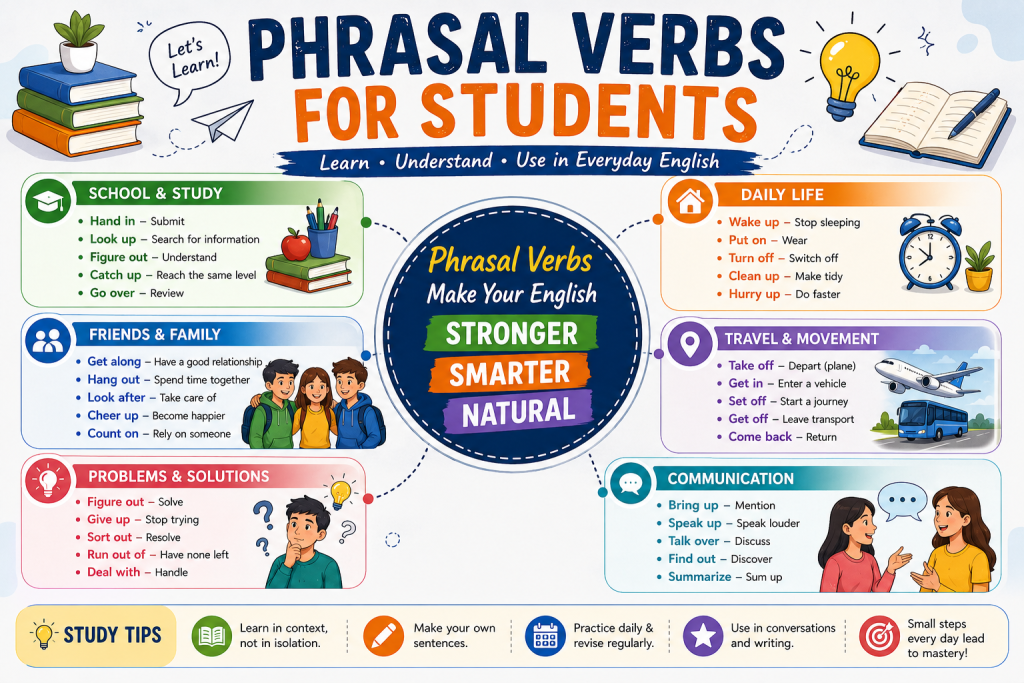
Common Phrasal Verbs with LOOK
The verb look produces many useful combinations.
| Phrasal Verb | Meaning |
|---|---|
| Look after | Take care of |
| Look around | Explore |
| Look back | Think about the past |
| Look for | Search |
| Look forward to | Anticipate with pleasure |
| Look into | Investigate |
| Look out | Be careful |
| Look over | Examine |
| Look up | Search for information |
| Look up to | Admire |
Example
I look up to my science teacher because she makes difficult concepts easy to understand.
Common Phrasal Verbs with GET
| Phrasal Verb | Meaning |
|---|---|
| Get along | Have a good relationship |
| Get away | Escape or leave |
| Get back | Return |
| Get in | Enter |
| Get off | Leave transport |
| Get on | Enter transport |
| Get out | Leave |
| Get over | Recover |
| Get through | Finish successfully |
| Get up | Leave bed |
Common Phrasal Verbs with TAKE
| Phrasal Verb | Meaning |
|---|---|
| Take after | Resemble |
| Take away | Remove |
| Take back | Return |
| Take down | Remove/write |
| Take off | Remove/depart |
| Take on | Accept responsibility |
| Take out | Remove |
| Take over | Assume control |
| Take up | Begin |
| Take apart | Separate into pieces |
Common Phrasal Verbs with PUT
| Phrasal Verb | Meaning |
|---|---|
| Put away | Store |
| Put back | Return |
| Put down | Place |
| Put off | Postpone |
| Put on | Wear |
| Put out | Extinguish |
| Put together | Assemble |
| Put up | Display |
| Put up with | Tolerate |
| Put forward | Suggest |
Common Phrasal Verbs with GIVE
| Phrasal Verb | Meaning |
|---|---|
| Give away | Donate |
| Give back | Return |
| Give in | Stop resisting |
| Give out | Distribute |
| Give up | Stop trying |
| Give off | Produce/release |
| Give in to | Yield to |
| Give up on | Stop believing in |
| Give over | Transfer control |
| Give away | Reveal unintentionally |
How to Learn Phrasal Verbs Easily
Trying to memorise 170 expressions in one sitting is not a good strategy.
Instead, use these methods.
Learn 5 Phrasal Verbs at a Time
Suppose today’s five expressions are:
give up
look after
find out
put off
carry on
Create one sentence for each.
Tomorrow, review those five before learning another five.
Learn Phrasal Verbs by Topic
Instead of memorising them alphabetically, group them by situations.
For example:
School
hand in
write down
look up
go over
catch up
Travel
set off
get on
get off
take off
come back
Friends
hang out
get along
make up
fall out
cheer up
This creates associations that can make them easier to remember.
Learn Phrasal Verbs Inside Sentences
Don’t memorise:
put off = postpone
Memorise:
Don’t put off your homework until tomorrow.
Now you know both the meaning and the natural usage.
Phrasal Verbs Practice Exercise
Phrasal Verbs Quiz
Frequently Asked Questions About Phrasal Verbs
What is a phrasal verbs for students?
A phrasal verb is a multi-word verb formed by combining a verb with one or more particles. The combination functions together as a verb and may have a meaning different from the base verb.
What are 10 common phrasal verbs for students?
Ten useful examples are:
- Wake up
- Get up
- Give up
- Look after
- Look for
- Look up
- Find out
- Hand in
- Write down
- Carry on
What are some phrasal verbs for students used at school?
Common school-related phrasal verbs include hand in, write down, look up, find out, go over, read over, catch up, fall behind, fill in, cross out, and work out.
How can students remember phrasal verbs?
Learn a small number at a time and use each one in a complete sentence. Grouping them by topic or base verb can also make revision easier.
Can a phrasal verb have more than one meaning?
Yes.
For example, take off can mean removing clothing or an aircraft leaving the ground.
The intended meaning depends on context.
Are all phrasal verbs informal?
No.
Many are common in neutral everyday English, while others are more informal. In very formal or academic contexts, writers may sometimes prefer a single-word alternative such as postpone instead of put off or investigate instead of look into.
What is the difference between a verb and a phrasal verb?
A verb can consist of one word, such as look, give, or take.
A phrasal verb contains a verb plus one or more particles and functions as a unit, such as look after, give up, or take off.
Quick Revision Chart
| Phrasal Verb | Meaning |
|---|---|
| Break down | Stop working |
| Bring up | Mention |
| Call off | Cancel |
| Carry on | Continue |
| Catch up | Reach the same level |
| Come across | Find unexpectedly |
| Figure out | Understand |
| Find out | Discover |
| Get along | Have a good relationship |
| Get up | Leave bed |
| Give up | Stop trying |
| Grow up | Become an adult |
| Hand in | Submit |
| Hang out | Spend time socially |
| Look after | Take care of |
| Look for | Search |
| Look up | Search for information |
| Pick up | Lift/collect |
| Put away | Store |
| Put off | Postpone |
| Put on | Wear |
| Run out of | Have none left |
| Set up | Arrange/establish |
| Take off | Remove/depart |
| Turn off | Deactivate |
| Turn on | Activate |
| Wake up | Stop sleeping |
| Work out | Solve |
| Write down | Record |
| Look forward to | Anticipate with pleasure |
Final Thoughts
Phrasal verbs are an important part of everyday English, and students do not need to learn hundreds of them overnight.
Start with the expressions you are most likely to use.
Learn five phrasal verbs at a time, understand their meanings, read them in context, and create your own sentences.
For example:
Wake up → I wake up at 6 a.m.
Look up → I looked up the word in a dictionary.
Hand in → I handed in my homework.
Find out → We found out the answer.
Give up → Never give up when learning something new.
Once these become familiar, move on to another group.
The goal is not simply to memorise a long list of phrasal verbs. The goal is to understand them and use them correctly in real sentences.
With regular practice, expressions such as find out, carry on, look after, figure out, come across, put off, catch up, and work out will gradually become a natural part of your English.