
🎯 Recommended Products for Students & Parents
Handpicked products specially selected for our visitors.

School Backpack Combo
✔ 29 L Spacious Backpack
✔ Includes Tiffin & Pouch
✔ Perfect for School & Coaching

Niacinamide Bright & Clear Skin Combo
✔ Brightens Skin
✔ Reduces Acne Marks
✔ Suitable for Daily Skincare
Disclosure: Some links on this page are affiliate links. We may earn a small commission if you purchase through them, at no additional cost to you.
Have you ever touched a metal spoon sitting in a hot cup of tea and noticed how quickly it warmed up? Or wondered why a giant bucket of warm water actually holds more thermal energy than a tiny cup of boiling water?
These everyday experiences are directly connected to two important concepts in physics: heat and temperature.
Many students think heat and temperature are the same thing, but in science, they have completely different meanings. Understanding the difference between heat and temperature is very important for school exams, competitive exams like NEET, and basic daily-life science.
In this article, we will explain:
What is Heat?
Heat is a form of energy that transfers from one object to another because of a temperature difference.
In simple words, heat is thermal energy in motion. It always flows from a hotter object to a colder object until both reach the same temperature.
Key Characteristics of Heat
- Heat is a type of energy.
- It depends on the amount of substance.
- Heat flows from hot objects to cold objects.
- It is represented by the symbol Q.
- SI unit of heat is Joule (J).
- Heat can also be measured in calories (cal).
Real-Life Example of Heat
Suppose you place an ice cube in warm water.
- Heat flows from the warm water to the ice.
- The water loses heat and becomes cooler.
- The ice gains heat and starts melting.
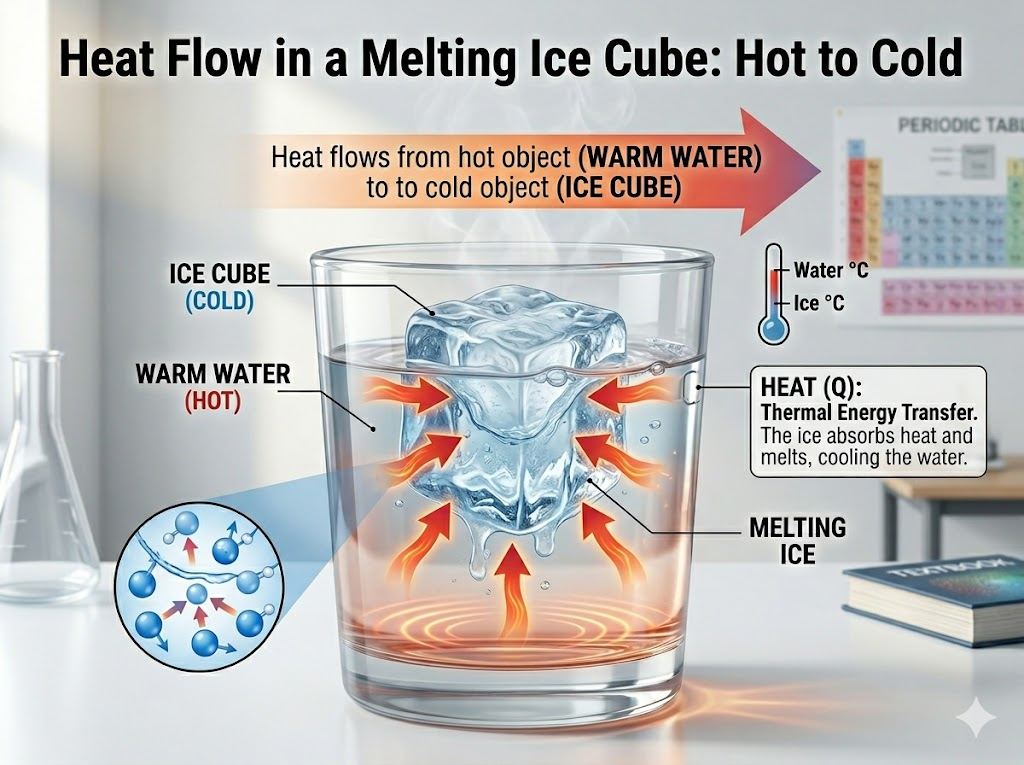
This is a perfect example of heat transfer.
What is Temperature?
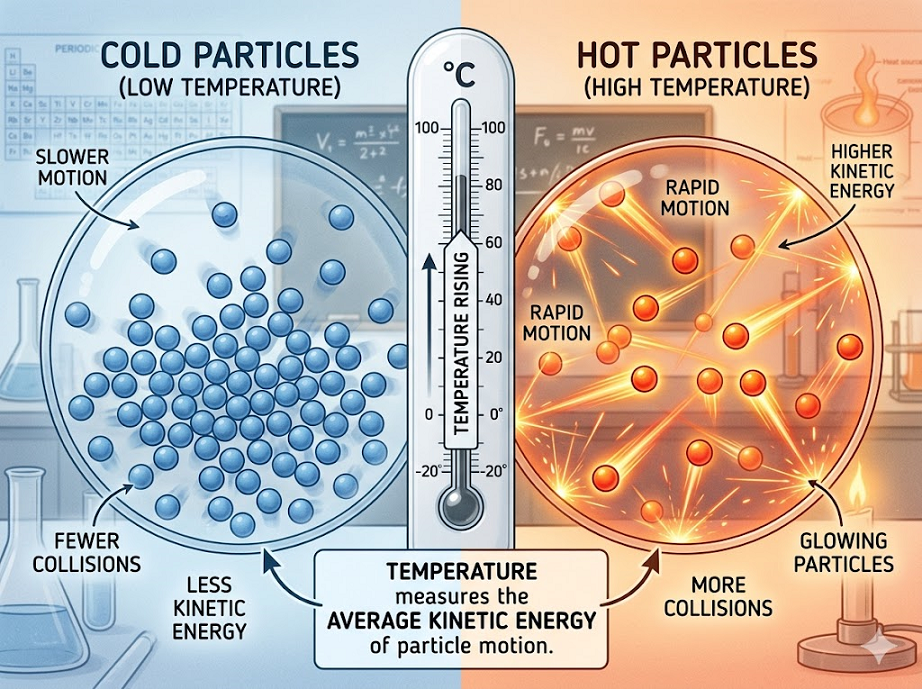
Temperature is the measure of how hot or cold an object is.
Scientifically, it measures the average kinetic energy of particles inside a substance. Faster-moving particles mean higher temperature, while slower-moving particles mean lower temperature.
Key Characteristics of Temperature
- Temperature measures hotness or coldness.
- It does not depend on the quantity of substance.
- It is represented by the symbol T.
- It is measured using a thermometer.
- Common units are:
- Celsius (°C)
- Fahrenheit (°F)
- Kelvin (K)
Real-Life Example of Temperature
A small cup of boiling water and a large pot of boiling water may both have the same temperature of 100°C.
However, the pot contains much more heat energy because it has more water.
This shows that heat and temperature are not the same.
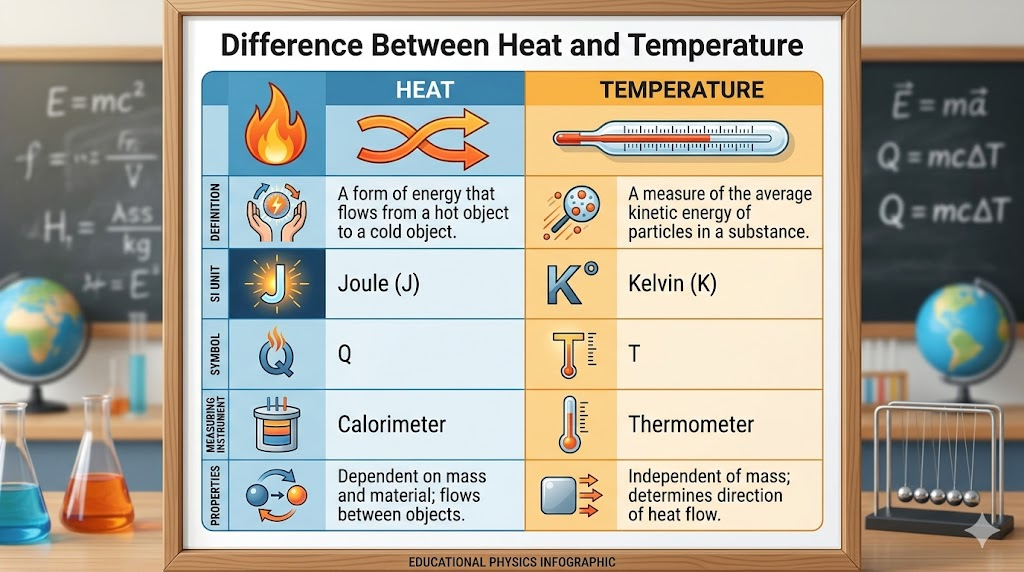
Difference Between Heat and Temperature
Here is the most important comparison students should remember:
| Feature | Heat | Temperature |
|---|---|---|
| Definition | Total thermal energy transferred | Measure of hotness or coldness |
| Symbol | Q | T |
| SI Unit | Joule (J) | Kelvin (K) |
| Depends on Mass? | Yes | No |
| Type of Property | Extensive property | Intensive property |
| Measured By | Calorimeter | Thermometer |
| Nature | Energy | Measurement |
| Direction | Flows from hot to cold | Determines direction of heat flow |
Relationship Between Heat and Temperature
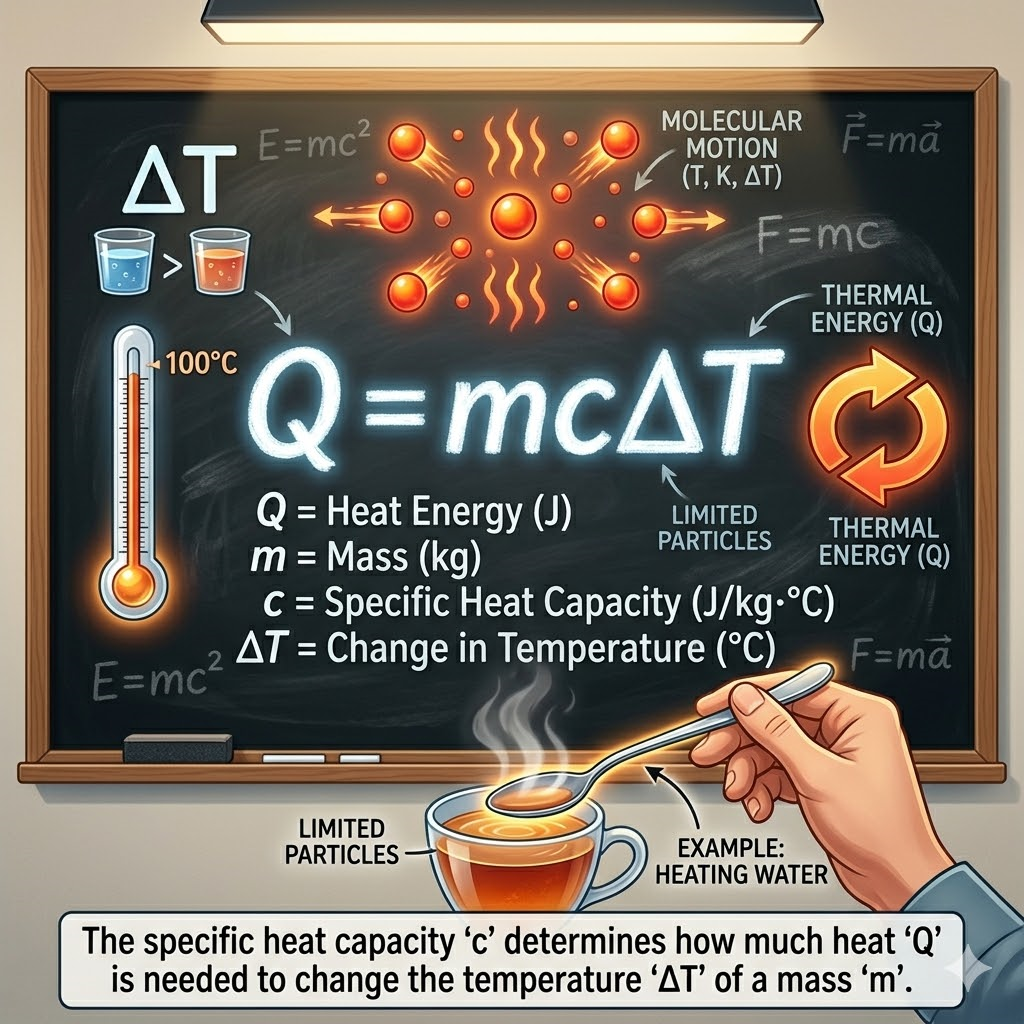
Heat and temperature are closely related. When heat energy is added to an object, its temperature usually increases.
The relationship is given by the formula:
Where:
- Q = Heat energy
- m = Mass of substance
- c = Specific heat capacity
- ΔT = Change in temperature (Traingle is readed as ‘delta’)
Interactive Heat Formula Game
Change the values below and see how Heat Energy changes visually.
Mass (m)
20 kg
Specific Heat Capacity (c)
5
Temperature Change (ΔT)
30 °C
Visual Simulation
This formula clearly shows that heat depends on both mass and temperature change.
Why Mass Matters: Bucket vs Cup Example
Imagine two containers:
- A cup of boiling water at 100°C
- A bucket of warm water at 40°C
Which has higher temperature?
The cup of water.
Which contains more heat energy?
The bucket of water.
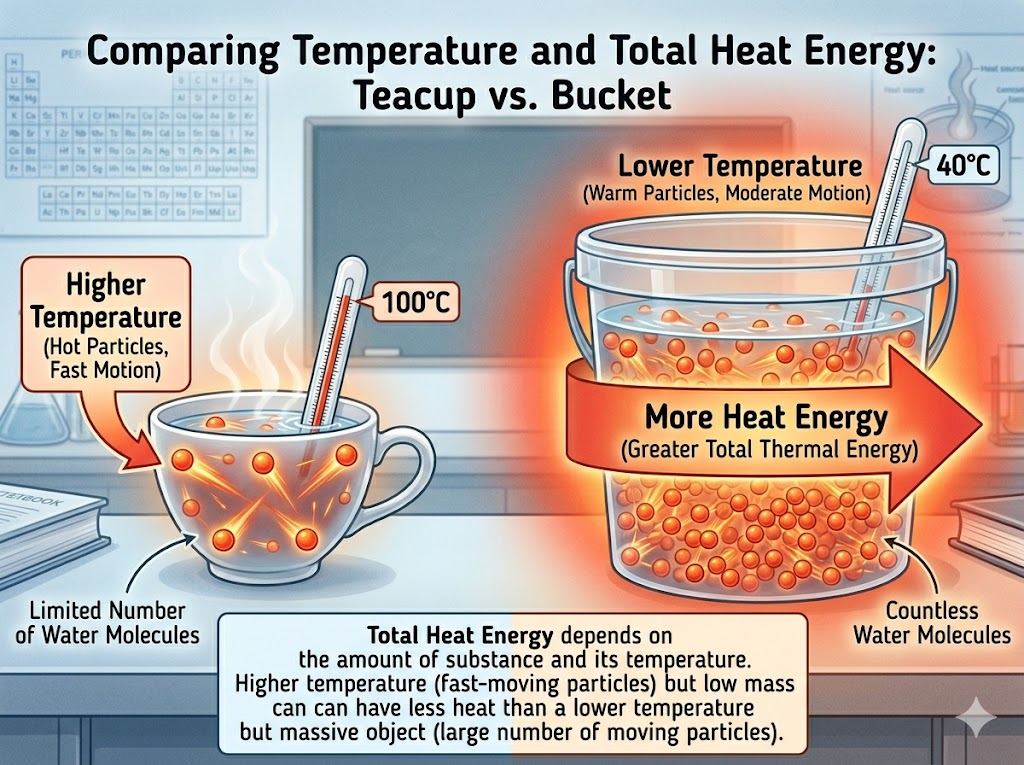
Why?
Because the bucket contains much more water. Even though its temperature is lower, the total thermal energy inside it is greater.
This example perfectly explains the difference between heat and temperature.
Daily Life Applications of Heat and Temperature
Cooking Food
Heat from the stove increases the temperature of food and cooks it.
Refrigerator
A refrigerator removes heat from inside the compartment to keep food cool.
Air Conditioner
An AC transfers heat from inside a room to the outside environment.
Weather and Climate
Temperature helps describe weather conditions, while heat energy from the Sun affects climate.
Common Mistakes Students Make
1. Heat and temperature are the same
Wrong. Heat is energy, while temperature is a measurement.
2. Bigger objects always have higher temperature
Not true. Bigger objects may contain more heat but can still have lower temperature.
3. Temperature measures total heat
Temperature only measures the average kinetic energy of particles.
Frequently Asked Questions (FAQs)
1. What is the main difference between heat and temperature?
Heat is thermal energy transfer, while temperature measures hotness or coldness.
2. Can two objects have the same temperature but different heat?
Yes. A swimming pool and a glass of water can both be at 25°C, but the pool contains much more heat energy.
3. Does heat always flow from hot to cold?
Yes. Heat naturally flows from higher temperature to lower temperature.
4. Which instrument measures temperature?
A thermometer measures temperature.
5. Which instrument measures heat?
A calorimeter is used to measure heat energy.
Quick Revision Summary
- Heat is a form of energy.
- Temperature measures hotness.
- Heat flows from hot objects to cold objects.
- Heat depends on mass.
- Temperature does not depend on mass.
- SI unit of heat is Joule.
- SI unit of temperature is Kelvin.
Conclusion
Understanding the difference between heat and temperature is essential in physics and everyday life. Although these terms are often used together, they represent completely different concepts.
- Heat is the transfer of thermal energy.
- Temperature is the measure of hotness or coldness.
By remembering simple examples like boiling water, melting ice, and the bucket-versus-cup comparison, students can easily understand these concepts and avoid confusion in exams.
Whether you are preparing for school studies, board exams, or NEET, mastering heat and temperature builds a strong foundation in thermodynamics and physics.
Do you want to read more about science. check this out: