
🎯 Recommended Products for Students & Parents
Handpicked products specially selected for our visitors.
🎒 Student Choice

School Backpack Combo
★★★★★
✔ 29 L Spacious Backpack
✔ Includes Tiffin & Pouch
✔ Perfect for School & Coaching
✨ Trending

Niacinamide Bright & Clear Skin Combo
★★★★★
✔ Brightens Skin
✔ Reduces Acne Marks
✔ Suitable for Daily Skincare
Disclosure: Some links on this page are affiliate links. We may earn a small commission if you purchase through them, at no additional cost to you.
Looking for Laws of Motion Class 9 notes? Get a clear breakdown of Newton’s Laws, momentum, and acceleration with practice problems and answers tailored for Class 9 Science.
Laws of Motion Class 9:
Table of Contents
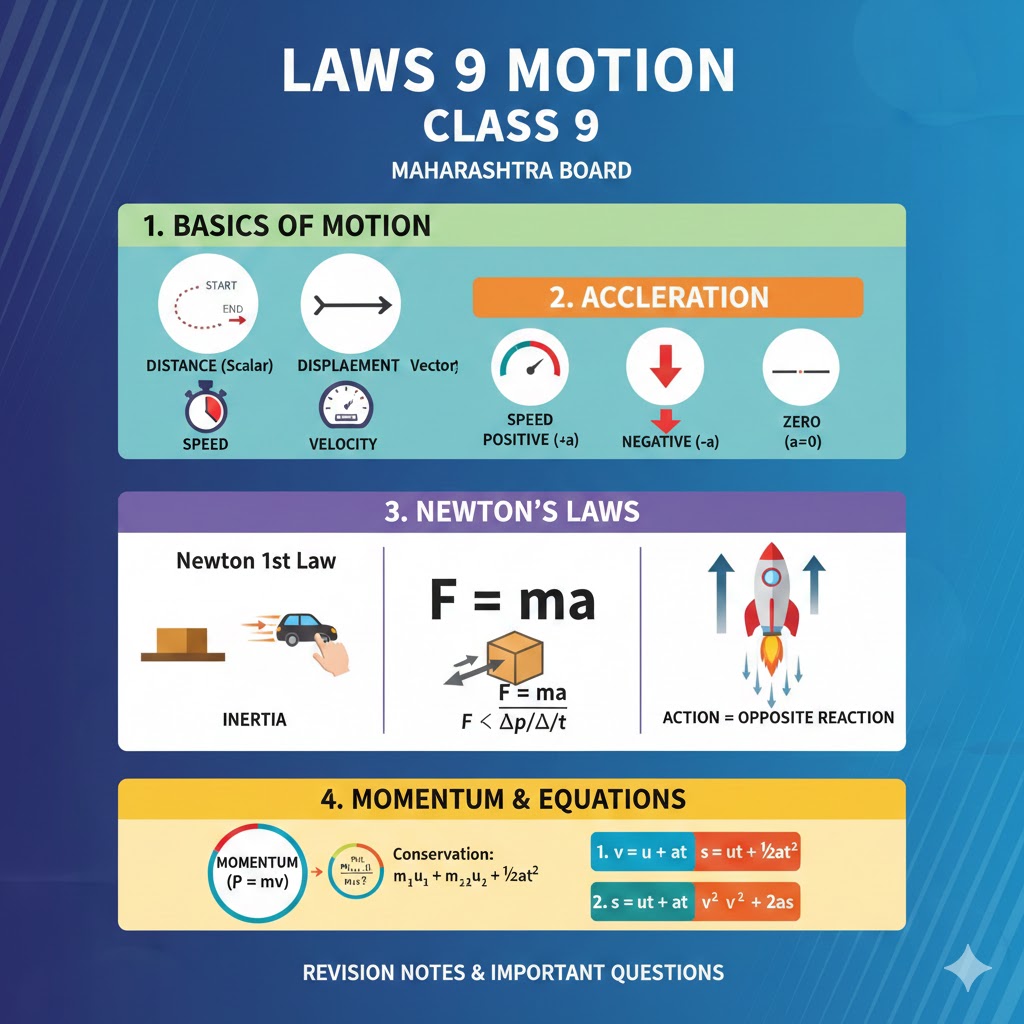
1. Fundamental Concepts
- Motion: A relative concept; change in position of an object with respect to its surroundings.
- Distance vs. Displacement: Distance is the total path length (Scalar). Displacement is the minimum distance between start and end points (Vector).
- Speed: Distance covered per unit time. Unit: $m/s$.
- Velocity: Displacement per unit time. Velocity changes if either speed or direction changes.
2. Acceleration ($a$)
The rate of change of velocity.
$$a = \frac{\text{Change in velocity}}{\text{Time}} = \frac{v – u}{t}$$
- Positive: Velocity increases with time.
- Negative (Retardation): Velocity decreases with time.
- Zero: Velocity is constant.
3. Newton’s Laws of Motion
- First Law (Law of Inertia): An object stays at rest or in uniform motion unless acted upon by an unbalanced force. Inertia is the inherent resistance to change in state.
- Second Law: The rate of change of momentum is proportional to the applied force.
- Formula: $F = ma$ (Force = mass $\times$ acceleration).
- Third Law: Every action force has an equal and opposite reaction force acting simultaneously.
4. Momentum ($P$) and Conservation
- Momentum: $P = m \times v$. It is a vector quantity. Unit: $kg.m/s$.
- Law of Conservation of Momentum: The total momentum of a system remains constant if no external unbalanced force acts on it ($m_1u_1 + m_2u_2 = m_1v_1 + m_2v_2$).
Question Bank: Laws of Motion Class 9th
Section A: Multiple Choice Questions (MCQs)
- If the displacement of an object is proportional to the square of time, then the object moves with:(a) Uniform velocity (b) Uniform acceleration (c) Increasing acceleration (d) Decreasing acceleration
- The product of mass and velocity is called:(a) Force (b) Acceleration (c) Momentum (d) Power
- $1\text{ Newton}$ is equal to:(a) $10^5\text{ dynes}$ (b) $10^3\text{ dynes}$ (c) $10^7\text{ dynes}$ (d) $10^4\text{ dynes}$
- Inertia of an object depends on its:(a) Velocity (b) Speed (c) Shape (d) Mass
- A passenger in a moving train tosses a coin which falls behind him. This means the motion of the train is:(a) Accelerated (b) Uniform (c) Retarded (d) Circular
Section B: Very Short Answer (1 Mark)
- Define ‘Uniform Circular Motion’.
- Give the S.I. unit of momentum.
- State the relation between force, mass, and acceleration.
- What is the displacement of a body moving in a semi-circle of radius $r$?
- If a body starts from rest, what is its initial velocity?
Section C: Short Notes & Definitions (2-3 Marks)
- Write a short note on Inertia of Rest with an example.
- Distinguish between Uniform and Non-uniform motion.
- Explain Negative Acceleration with a real-life example.
- Explain why a person falls backward when a bus starts suddenly.
- Derive the first equation of motion ($v = u + at$) using a velocity-time graph.
Section D: Scientific Reasons (2 Marks)
- Why is it difficult to stop a heavy truck than a light car moving at the same speed?
- Why does a gun recoil when a bullet is fired?
- Why is the motion of a stone tied to a string and whirled in a circle called accelerated motion?
Section E: Numerical Problems (3 Marks)
- A car increases its speed from $36\text{ km/h}$ to $72\text{ km/h}$ in $10\text{ seconds}$. Calculate its acceleration.
- A force of $50\text{ N}$ acts on a body of mass $5\text{ kg}$. What is the acceleration produced?
Laws of Motion Class 9 : Answers and Solutions
Section A: MCQs
- (b) Uniform acceleration.
- (c) Momentum.
- (a) $10^5\text{ dynes}$.
- (d) Mass (More mass = more inertia).
- (a) Accelerated.
Section B: Very Short Answer
- When an object moves with constant speed along a circular path, it is called Uniform Circular Motion.
- $kg.m/s$.
- $F = m \times a$.
- $2r$ (the diameter).
- $0\text{ m/s}$.
Section C: Short Notes
- Inertia of Rest: The tendency of an object to remain at rest. Example: When you shake a branch of a tree, the leaves fall because the branch moves but leaves try to stay at rest.
- Uniform Motion: Covering equal distances in equal intervals of time. Non-uniform: Unequal distances in equal intervals of time.
- Negative Acceleration: When velocity decreases. Example: Applying brakes to a moving car.
- Due to Inertia of Rest. The lower body moves with the bus, but the upper body tries to remain at rest.
- Hint: Acceleration $a = \text{Slope of v-t graph} = (v – u) / t$. Rearranging gives $v = u + at$.
Section D: Scientific Reasons
- Because the truck has more mass, it has more momentum ($P = mv$). Greater force or time is needed to stop it.
- Due to Newton’s 3rd Law. The gun exerts a forward force on the bullet (action), and the bullet exerts an equal backward force on the gun (reaction).
- Because its direction of motion changes at every point, and change in direction means a change in velocity, which is acceleration.
Section E: Numericals
- $u = 36\text{ km/h} = 10\text{ m/s}$; $v = 72\text{ km/h} = 20\text{ m/s}$; $t = 10\text{ s}$.$a = (20 – 10) / 10 = \mathbf{1\text{ m/s}^2}$.
- $F = 50\text{ N}$, $m = 5\text{ kg}$.$a = F / m = 50 / 5 = \mathbf{10\text{ m/s}^2}$.
#Laws of Motion Class 9