
🎯 Recommended Products for Students & Parents
Handpicked products specially selected for our visitors.
School Backpack Combo
✔ 29 L Spacious Backpack
✔ Includes Tiffin & Pouch
✔ Perfect for School & Coaching

Niacinamide Bright & Clear Skin Combo
✔ Brightens Skin
✔ Reduces Acne Marks
✔ Suitable for Daily Skincare
Disclosure: Some links on this page are affiliate links. We may earn a small commission if you purchase through them, at no additional cost to you.
Master Force and Pressure Class 8 Chapter 11: Force and Pressure. Get complete revision notes, solved Q&A, practice MCQs, and helpful infographics to ace your exams. Based on CBSE/NCERT syllabus.
Table of Contents
📝 Force and Pressure Class 8 Chapter 11 | SECTION 1: REVISION NOTES
Class 8 Science Chapter 11
A. FORCE: A Push or a Pull
- Definition: A force is a push or a pull exerted on an object. It is an interaction between two or more objects.
- Magnitude and Direction: Force has both magnitude (strength) and direction.
- The strength of a force is expressed by its magnitude.
- The SI unit of force is the Newton (N).
- Net Force:
- If two forces act in the same direction, they add up (Net Force = F1 + F2).
- If two forces act in opposite directions, the net force is the difference between them and acts in the direction of the larger force (Net Force = F1 – F2, where F1 > F2).
- If two equal forces act in opposite directions, the net force is zero.
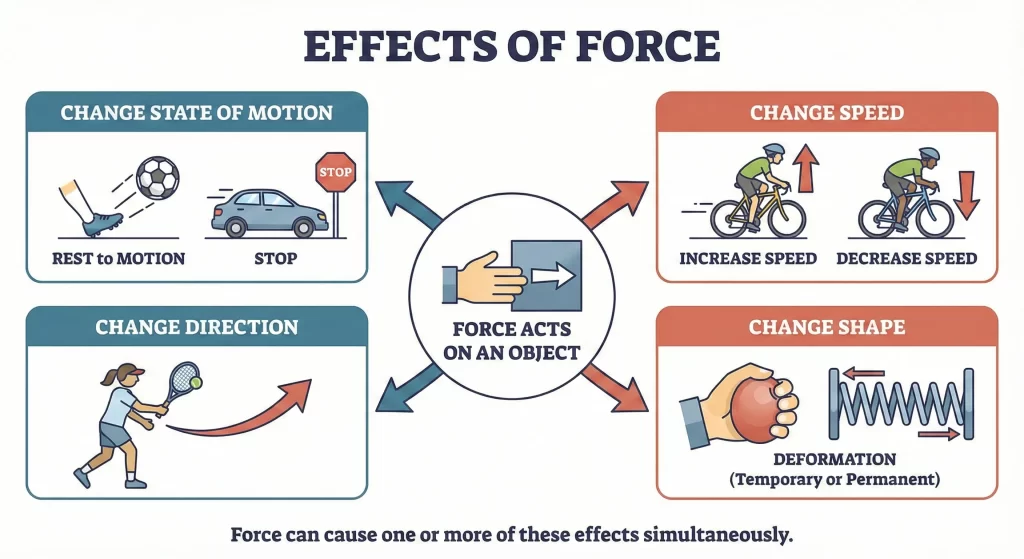
B. Effects of Force
A force can:
- Change the state of motion of an object:
- It can make a stationary object move.
- It can stop a moving object.
- It can change the speed of a moving object (increase or decrease).
- It can change the direction of motion of an object.
- Change the shape of an object (e.g., squeezing a rubber ball, stretching a spring).
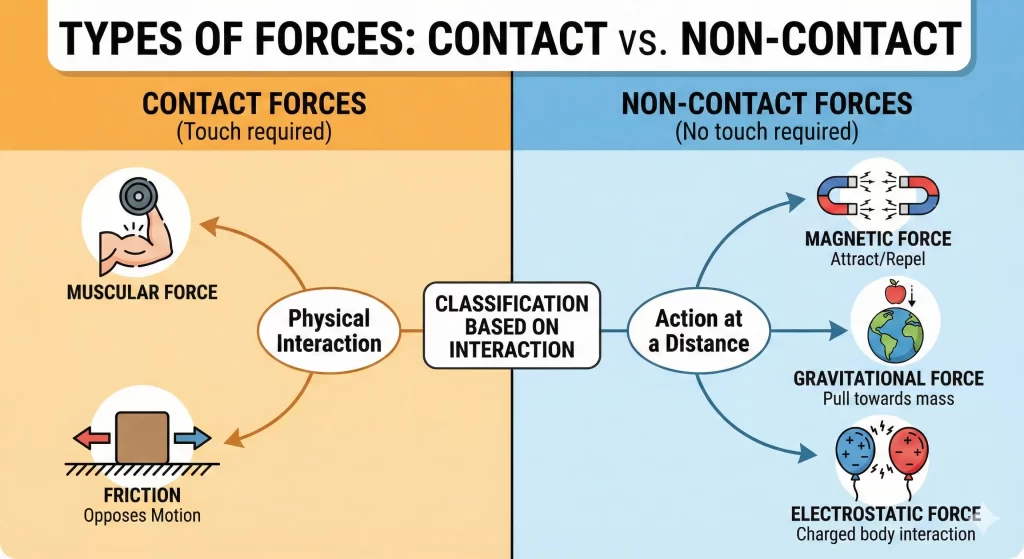
C. Types of Forces
Forces are broadly classified into two categories based on interaction:
1. Contact Forces: Forces that come into play only when two objects are in physical contact with each other.
- Muscular Force: The force resulting from the action of muscles. We use it for all our activities like lifting, walking, and running.
- Friction: A force that opposes the relative motion between two surfaces in contact. It always acts in the direction opposite to the direction of motion.
2. Non-Contact Forces: Forces that can come into play even when objects are not in physical contact.
- Magnetic Force: The force exerted by a magnet on another magnet or a magnetic material (like iron). Like poles repel, and unlike poles attract.
- Electrostatic Force: The force exerted by a charged body on another charged or uncharged body.
- Gravitational Force (Gravity): An attractive force that exists between every two objects in the universe. The earth pulls everything towards itself due to gravity.
D. PRESSURE
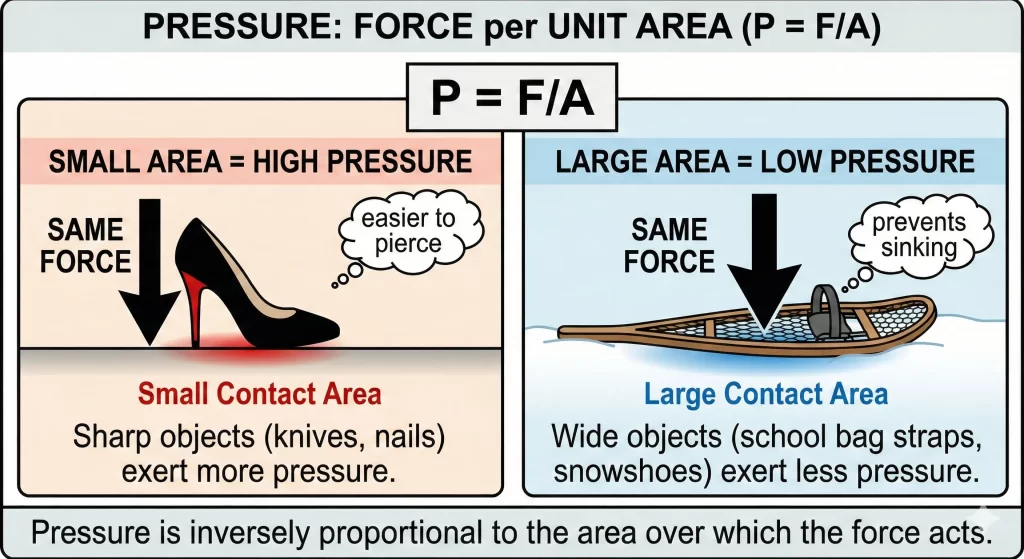
- Definition: Pressure is defined as the force acting perpendicularly on a unit area of a surface.
- Formula: Pressure = Force / Area (P = F/A)
- Unit: The SI unit of pressure is Pascal (Pa), where 1 Pa = 1 N/m².
- Relation with Area: Pressure is inversely proportional to the area.
- Smaller area -> Larger pressure for the same force (e.g., a sharp knife cuts better).
- Larger area -> Smaller pressure for the same force (e.g., school bags have wide straps).
E. Pressure Exerted by Fluids (Liquids and Gases)
- Liquids:
- Liquids exert pressure on the walls and base of their container.
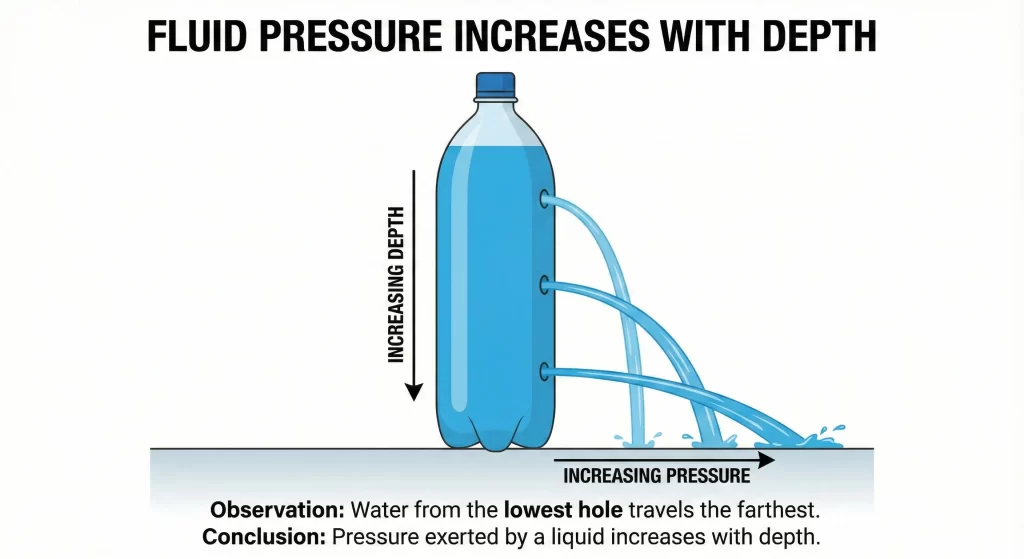
- Pressure in a liquid increases with depth.
- At the same depth, a liquid exerts equal pressure in all directions.
- Gases:
- Gases also exert pressure on the walls of their container.
- The envelope of air surrounding the earth is called the atmosphere.
- The pressure exerted by this air is called atmospheric pressure. It is very large, but we don’t feel it because the pressure inside our bodies balances it out.
🗣️ Force and Pressure Class 8 Chapter 11 | SECTION 2: SUBJECTIVE QUESTION AND ANSWERS
Q1: Give two examples of situations where you push or pull to change the state of motion of an object. Answer:
- Push: Kicking a football that is at rest. The push from the foot changes its state from rest to motion.
- Pull: Opening a drawer. We pull the handle, changing the drawer’s state from rest to motion.
Q2: Why do school bags have wide straps? Answer: Pressure is inversely proportional to area (Pressure = Force/Area). Wide straps have a larger surface area compared to thin straps. When the weight (force) of the bag falls on the shoulders, the force is distributed over a larger area, reducing the pressure on the shoulders. This makes it more comfortable to carry the heavy bag.
Q3: Distinguish between contact and non-contact forces with an example for each. Answer:
- Contact Force: A force that acts only when two objects are in physical touch with each other.
- Example: Muscular force (kicking a ball), Friction (a rolling ball stopping).
- Non-Contact Force: A force that can act even without physical contact between objects.
- Example: Gravitational force (an apple falling from a tree), Magnetic force (a magnet attracting iron nails).
Q4: Explain why a sharp knife cuts better than a blunt knife. Answer: Cutting involves applying pressure. Pressure is Force divided by Area (P=F/A). A sharp knife has a very thin edge, meaning its surface area in contact with the object is very small. A blunt knife has a thicker edge and a larger surface area. For the same amount of force applied, the sharp knife exerts much greater pressure due to its smaller area, making it easier to cut.
Q5: Describe an activity to show that liquid pressure increases with depth. Answer:
- Take a tall plastic bottle or can.
- Make three small holes at different heights along the side of the bottle.
- Fill the bottle with water.
- Observe the water jets coming out of the holes.
- Observation: The water from the lowest hole travels the farthest distance, the middle hole a medium distance, and the top hole the shortest distance.
- Conclusion: This indicates that the water pressure is highest at the bottom and decreases as we move up. Thus, liquid pressure increases with depth.
✅ Force and Pressure Class 8 Chapter 11 | SECTION 3: MULTIPLE CHOICE QUESTIONS (MCQs)
1. A force can do which of the following? a) Change the speed of an object b) Change the direction of motion c) Change the shape of an object d) All of the above
Correct Answer: d) All of the above
2. Which of the following is a non-contact force? a) Muscular force b) Electrostatic force c) Frictional force d) None of these
Correct Answer: b) Electrostatic force
3. The SI unit of pressure is: a) Newton b) Meter square c) Pascal d) Kilogram
Correct Answer: c) Pascal
4. If we apply a force of 100 N on an area of 2 m², what is the pressure exerted? a) 200 Pa b) 50 Pa c) 102 Pa d) 98 Pa
Correct Answer: b) 50 Pa (Pressure = F/A = 100/2 = 50 Pa)
5. Why does a deep-sea diver need a special suit? a) To protect from cold b) To protect from sea animals c) To withstand the high pressure of water at great depths d) To see clearly underwater
Correct Answer: c) To withstand the high pressure of water at great depths
6. When two forces act in opposite directions, the net force is the: a) Sum of the two forces b) Difference between the two forces c) Product of the two forces d) Zero
Correct Answer: b) Difference between the two forces
Class 8 Science Chapter 15
Class 8 Science Chapter 13
#Force and Pressure Class 8 Chapter 11