
Complete study guide for CBSE Friction Class 8 Science Chapter 12. Includes detailed notes on types of friction, methods to increase or reduce it, important subjective questions, and MCQs.
Table of Contents
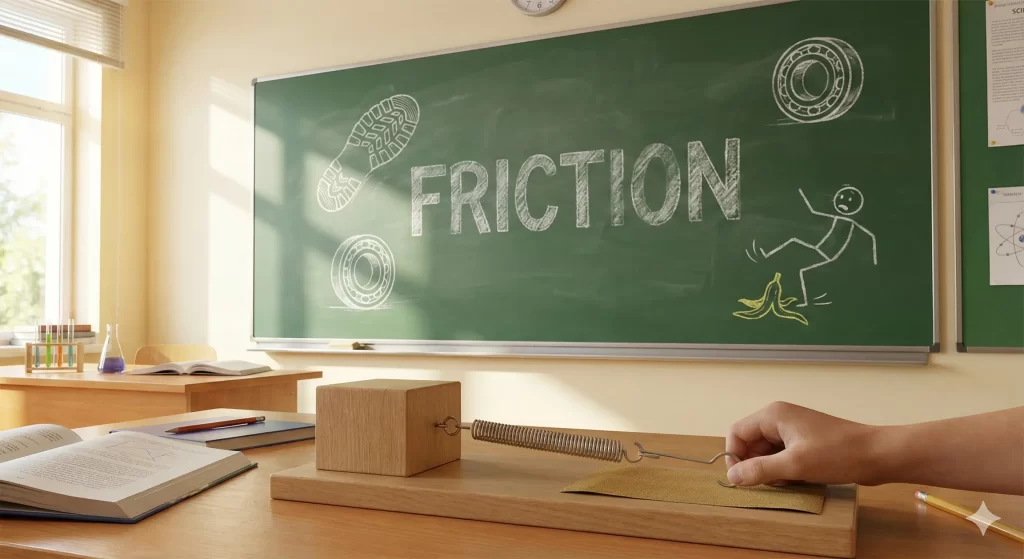
📘 Friction Class 8 Science Chapter 12 | SECTION 1: STUDY MATERIAL – FRICTION
📝 A. Revision Notes
1. What is Friction?
- Definition: Friction is a force that opposes the relative motion between two surfaces in contact. It always acts in the direction opposite to the direction of motion.
- Cause of Friction: Friction is caused by the irregularities (roughness) on the two surfaces in contact. Even surfaces that look smooth have tiny irregularities. When two surfaces move over each other, these irregularities interlock, causing resistance to motion.
2. Factors Affecting Friction
- Nature of the surfaces: Rough surfaces produce more friction than smooth surfaces.
- The force pressing the surfaces together: Friction increases if the two surfaces are pressed harder together (e.g., it’s harder to drag a heavy box than a light one because the heavy box presses harder against the floor).
3. Types of Friction
- Static Friction: The force required to overcome friction at the instant an object starts moving from rest. It is the highest value of friction.
- Sliding Friction: The force required to keep an object moving with the same speed. Sliding friction is slightly less than static friction (because once moving, the irregularities don’t have enough time to lock completely).
- Rolling Friction: When one body rolls over the surface of another, the resistance to its motion is called rolling friction. Rolling friction is much smaller than sliding friction. This is why wheels are so useful.
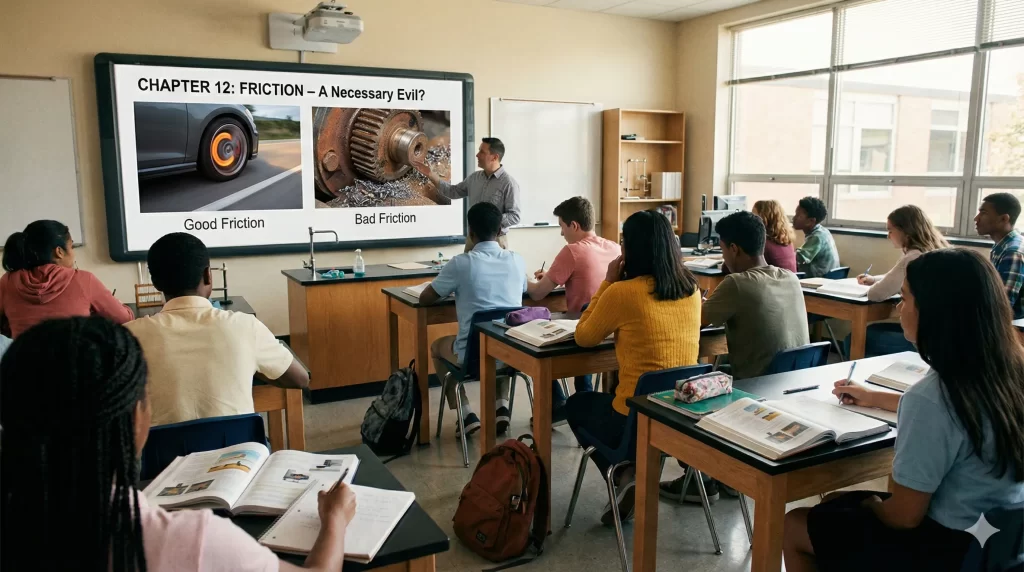
4. Friction: A Necessary Evil Friction is called a “necessary evil” because it is both harmful and very helpful.
- Advantages (Why it’s necessary):
- It enables us to walk without slipping.
- It allows us to write with a pen on paper.
- It allows brakes to stop a vehicle.
- It enables a matchstick to light when struck.
- Disadvantages (Why it’s an evil):
- It causes wear and tear of machine parts, shoes, and tires.
- It produces heat, wasting energy (e.g., engines get hot).
- It reduces the efficiency of machines.
5. Methods to Increase and Decrease Friction
- Increasing Friction (When needed):
- Treads on tires and soles of shoes to improve grip.
- Gymnasts apply coarse powder on hands for better grip.
- Brake pads in vehicles are designed to increase friction to stop wheels.
- Decreasing Friction (When it’s harmful):
- Lubricants: Applying oil, grease, or graphite powder between moving parts fills the irregularities, forming a thin layer so surfaces don’t rub directly.
- Wheels/Ball Bearings: Converting sliding friction into rolling friction significantly reduces resistance (used in fans, bicycles, axles).
- Polishing: Making surfaces smoother.
6. Fluid Friction (Drag)
- Definition: Fluids (liquids and gases) also exert a frictional force on objects moving through them. This is called drag.
- Factors affecting Drag: Speed of the object, shape of the object, and the nature of the fluid.
- Streamlining: To reduce fluid friction, objects like airplanes, ships, and even the bodies of birds and fish have special shapes called streamlined shapes (narrow in front and back, wider in the middle).
🗣️ Friction Class 8 Science Chapter 12 | B. Subjective Question and Answers
Q1: Explain why sliding friction is less than static friction. Answer: Friction is caused by the interlocking of irregularities on two surfaces. When an object is at rest, the irregularities have enough time to interlock completely, so static friction is high. When the object starts sliding, the contact points on its surface do not get enough time to lock into the contact points of the floor. Therefore, sliding friction is slightly less than static friction.
Q2: Why is friction considered a “necessary evil”? Give examples. Answer: It is called a “necessary evil” because it is helpful in some situations but harmful in others.
- Necessary: We cannot walk, write, or stop vehicles without friction.
- Evil: It causes wear and tear of machinery parts and wastes energy in the form of heat.
Q3: Explain how lubricants help in reducing friction. Answer: When lubricants like oil, grease, or graphite are applied between moving parts of a machine, a thin layer is formed there. The moving surfaces do not directly rub against each other; instead, they slide over the layer of lubricant. This prevents the interlocking of irregularities, thereby reducing friction greatly.
Q4: Why are the soles of shoes and the tires of cars treaded? Answer: Treading converts the smooth surface into a rough surface. This increases the friction between the shoes/tires and the ground, providing a better grip and preventing slipping or skidding.
Q5: Why do airplanes have a streamlined shape? Answer: Airplanes move at high speeds through air (a fluid). Air exerts frictional force (drag) that opposes their motion. A streamlined shape (narrow front, wider middle) helps in reducing this air resistance, allowing the plane to fly faster and consume less fuel.
✅ Friction Class 8 Science Chapter 12 | C. Multiple Choice Questions (MCQs)
1. Friction always acts in a direction _________ to the applied force. a) Same b) Opposite c) Perpendicular d) Downward
Correct Answer: b) Opposite
2. Which of the following produces the least friction? a) Sliding friction b) Static friction c) Rolling friction d) Fluid friction
Correct Answer: c) Rolling friction
3. Friction can be increased by: a) Using lubricants b) Using ball bearings c) Polishing surfaces d) Making surfaces rough
Correct Answer: d) Making surfaces rough
4. The frictional force exerted by fluids is also called: a) Drag b) Rolling friction c) Sliding friction d) Static friction
Correct Answer: a) Drag
5. Which of the following is NOT an effect of friction? a) It produces heat. b) It causes wear and tear. c) It increases the speed of a moving object. d) It opposes motion.
Correct Answer: c) It increases the speed of a moving object.