
🎯 Recommended Products for Students & Parents
Handpicked products specially selected for our visitors.

School Backpack Combo
✔ 29 L Spacious Backpack
✔ Includes Tiffin & Pouch
✔ Perfect for School & Coaching

Niacinamide Bright & Clear Skin Combo
✔ Brightens Skin
✔ Reduces Acne Marks
✔ Suitable for Daily Skincare
Disclosure: Some links on this page are affiliate links. We may earn a small commission if you purchase through them, at no additional cost to you.
Master NCERT Sound Class 8 Science Chapter 13: Sound. This post includes comprehensive revision notes, important subjective questions with answers, and practice MCQs for exam preparation.
Sound Class 8 Science Chapter 13
Table of Contents
Sound Class 8 Science Chapter 13 : 📝 SECTION 1: REVISION NOTES
Sound Class 8 Science Chapter 13
1. How Sound is Produced
- Vibration: Sound is a form of energy produced by vibrating objects. A vibration is a rapid back-and-forth or to-and-fro motion of an object.
- Examples of vibrating bodies producing sound:
- Stretched strings (Guitar, Sitar).
- Stretched membranes (Tabla, Drum).
- Air columns (Flute, Trumpet).
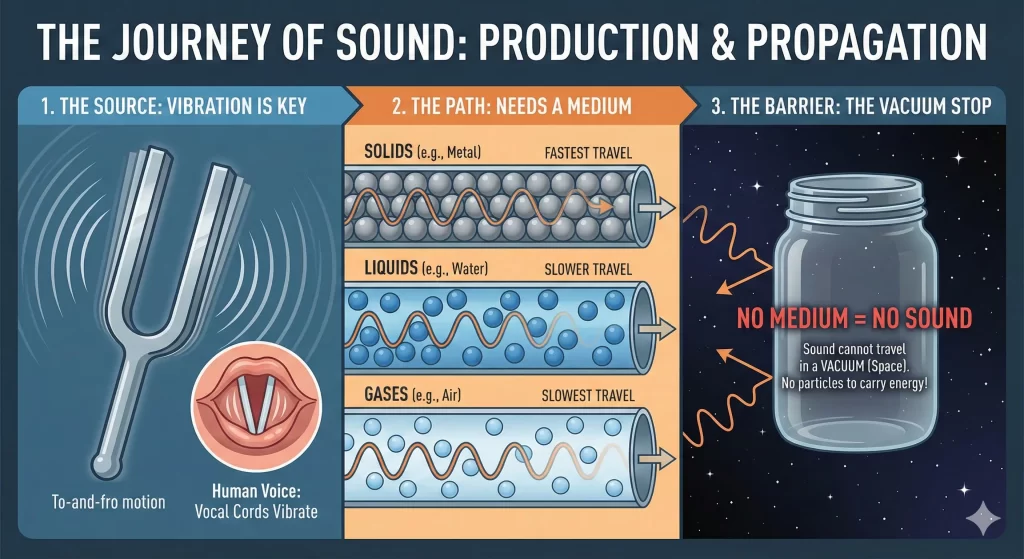
2. Sound Produced by Humans
- In humans, sound is produced by the voice box or the larynx, located at the upper end of the windpipe.
- Two vocal cords are stretched across the larynx in such a way that it leaves a narrow slit between them for the passage of air.
- When the lungs force air through the slit, the vocal cords vibrate, producing sound. Tighter and thinner cords produce a higher pitch.
3. Sound Needs a Medium for Propagation
- Sound travels from the source to the listener.
- Sound requires a material medium (solid, liquid, or gas) to travel. It travels by forming compressions and rarefactions in the medium.
- Speed of Sound: Sound travels fastest in solids, slower in liquids, and slowest in gases (air).
- Vacuum: Sound cannot travel through a vacuum because there are no particles to vibrate and transfer the energy. (This is why astronauts on the moon cannot talk directly to each other).
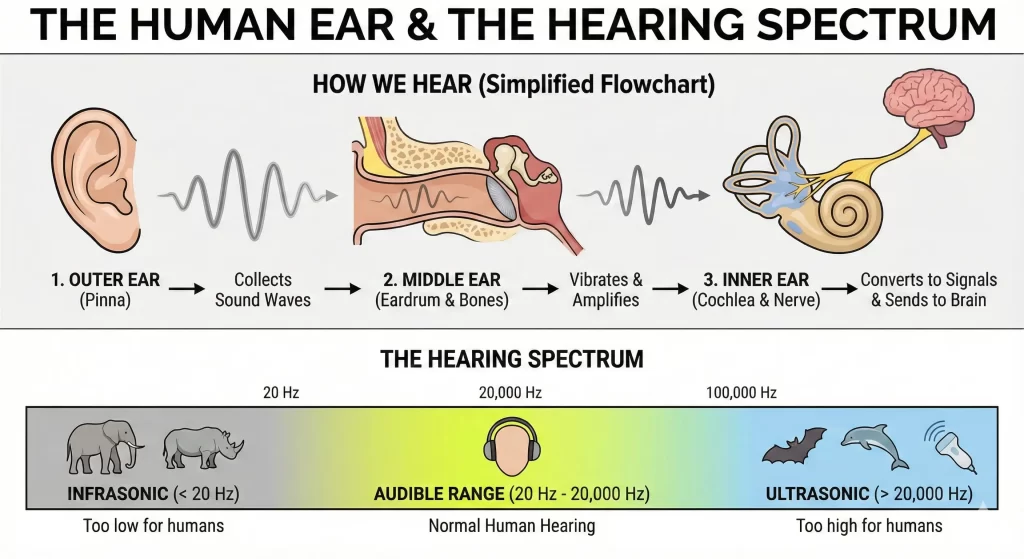
4. How We Hear Sound (Human Ear)
- Outer Ear (Pinna): Collects sound waves and directs them into the ear canal.
- Eardrum (Tympanic Membrane): A stretched membrane at the end of the ear canal. When sound waves hit it, it vibrates.
- Middle Ear: Contains three tiny bones (hammer, anvil, stirrup) that amplify the vibrations from the eardrum and send them to the inner ear.
- Inner Ear (Cochlea): Converts vibrations into electrical signals which are sent to the brain via the auditory nerve.
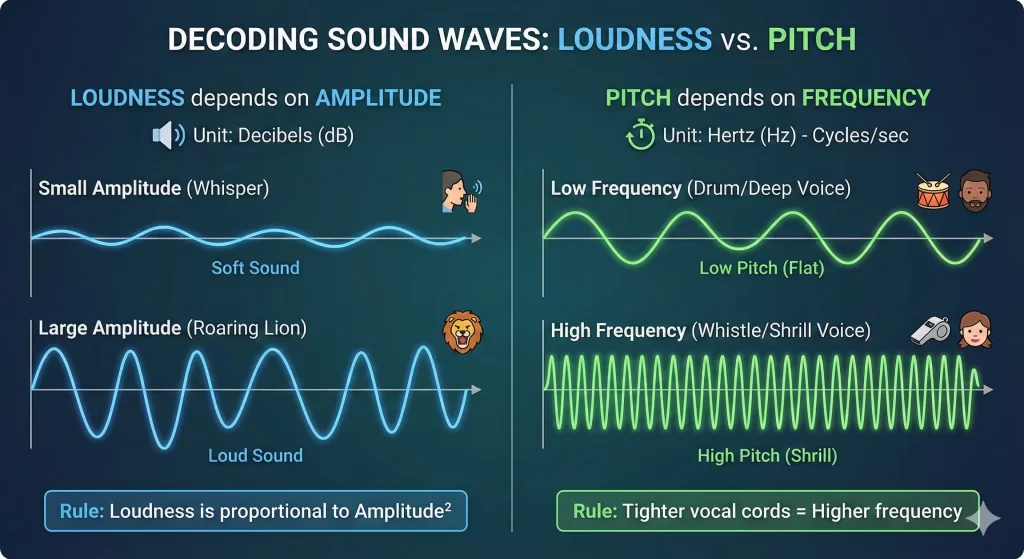
5. Characteristics of Vibration and Sound The to-and-fro motion of an object is called oscillation motion.
- Frequency:
- The number of oscillations per second.
- Measured in Hertz (Hz).
- Frequency determines the PITCH (shrillness) of a sound.
- Higher Frequency = Higher Pitch (Shriller sound, e.g., a whistle, female voice).
- Lower Frequency = Lower Pitch (Deeper sound, e.g., a drum, male voice).
- Amplitude:
- The maximum displacement of a vibrating body from its mean position.
- Amplitude determines the LOUDNESS of a sound.
- Loudness is expressed in decibels (dB).
- Larger Amplitude = Louder Sound (e.g., roaring lion).
- Smaller Amplitude = Feeble Sound (e.g., whispering).
- Note: Loudness is proportional to the square of the amplitude. If amplitude becomes twice, loudness becomes four times.
- Time Period: The time taken to complete one oscillation. (Time Period = 1/Frequency).
6. Audible and Inaudible Sounds
- Audible Range: The range of frequencies that humans can hear is roughly 20 Hz to 20,000 Hz (or 20 kHz).
- Infrasonic Sound: Sounds with frequencies below 20 Hz (e.g., produced by elephants, rhinos, earthquakes).
- Ultrasonic Sound: Sounds with frequencies above 20,000 Hz (e.g., produced by bats, dolphins; used in medical ultrasound).
7. Noise and Music
- Music: Pleasant, rhythmic, and organized sounds produced by regular vibrations.
- Noise: Unpleasant, irregular, and disorganized sounds produced by irregular vibrations.
8. Noise Pollution
- Definition: Presence of excessive or unwanted sounds in the environment.
- Causes: Vehicle traffic, industrial machines, construction work, loud music, firecrackers.
- Effects: Lack of sleep (insomnia), hypertension (high blood pressure), anxiety, temporary or permanent hearing impairment.
- Control Measures: Using silencers in vehicles, locating industries away from residential areas, minimizing horn usage, planting trees along roads to absorb sound.
🗣️ Sound Class 8 Science Chapter 13 – SECTION 2: QUESTION AND ANSWERS (Subjective)
Q1: Define vibration and explain how it relates to sound. Answer: Vibration is the rapid back-and-forth or to-and-fro motion of an object about its mean position. Sound is a form of energy that is produced only when an object vibrates. These vibrations create waves in the surrounding medium (like air), which travel to our ears and are interpreted as sound.
Q2: How is sound produced in humans? Answer: In humans, sound is produced by the larynx (voice box). Inside the larynx, two vocal cords are stretched with a narrow slit between them. When lungs force air through this slit, the vocal cords vibrate. These vibrations produce sound. Muscles attached to the vocal cords can make them tight or loose, changing the type of sound produced.
Q3: Differentiate between Loudness and Pitch. Answer:
- Loudness: It refers to how loud or soft a sound is. It depends on the amplitude of vibration. Higher amplitude results in a louder sound. It is measured in decibels (dB).
- Pitch: It refers to the shrillness or flatness of a sound. It depends on the frequency of vibration. Higher frequency results in a higher pitch (shriller sound). It is measured in Hertz (Hz).
Q4: Why can’t astronauts talk to each other directly on the surface of the moon? Answer: Sound requires a material medium (solid, liquid, or gas) to travel. The moon has no atmosphere; there is a vacuum on its surface. Since there are no air particles to vibrate and carry sound waves, sound cannot travel on the moon. Therefore, astronauts cannot talk directly and must use radio transmitters.
Q5: Explain the function of the eardrum. Answer: The eardrum is a thin, stretched membrane located at the end of the ear canal. When sound waves enter the ear, they strike the eardrum, causing it to vibrate. The eardrum transfers these vibrations to the tiny bones in the middle ear, starting the process of hearing.
Q6: What is noise pollution? List two harmful effects and two measures to control it. Answer:
- Noise Pollution: The presence of excessive or unwanted sound in the environment that causes disturbance.
- Harmful Effects:
- It can cause hypertension (high blood pressure).
- It can lead to temporary or permanent hearing loss.
- Control Measures:
- Silencers should be installed in vehicles and industrial machinery.
- Planting trees along roadsides helps absorb sound and reduce noise pollution.
✅ Sound Class 8 Science Chapter 13 SECTION 3: MULTIPLE CHOICE QUESTIONS (MCQs)
1. Sound cannot travel through: a) Air b) Water c) Iron d) Vacuum
Correct Answer: d) Vacuum
2. The voice box in humans is also known as the: a) Pharynx b) Trachea c) Larynx d) Oesophagus
Correct Answer: c) Larynx
3. The number of oscillations per second of a vibrating object is called its: a) Amplitude b) Frequency c) Time period d) Wavelength
Correct Answer: b) Frequency
4. Loudness of sound is determined by its: a) Frequency b) Amplitude c) Speed d) Pitch
Correct Answer: b) Amplitude
5. Which of the following voices is likely to have the highest pitch (shrillest sound)? a) A man b) A small boy c) A small girl d) A woman
Correct Answer: c) A small girl (Generally has the shortest/thinnest vocal cords, leading to highest frequency).
6. The audible range of sound for normal human beings is: a) 10 Hz to 10,000 Hz b) 20 Hz to 20,000 Hz c) Below 20 Hz d) Above 20,000 Hz
Correct Answer: b) 20 Hz to 20,000 Hz
7. The unit used to measure the loudness of sound is: a) Hertz (Hz) b) Meter (m) c) Second (s) d) Decibel (dB)
Correct Answer: d) Decibel (dB)
8. Sound travels fastest in: a) Gases b) Liquids c) Solids d) Vacuum
Correct Answer: c) Solids
9. Sounds with frequencies below 20 Hz are called: a) Ultrasonic sound b) Infrasonic sound c) Audible sound d) Noise
Correct Answer: b) Infrasonic sound
10. An object is vibrating at 50 Hertz. What is its time period? a) 0.02 seconds b) 0.2 seconds c) 2 seconds d) 50 seconds
Correct Answer: a) 0.02 seconds (Hint: Time Period = 1 / Frequency = 1 / 50 = 0.02s)
Class 8 Science Chapter 15
#Class 8 Science Chapter 13