
🎯 Recommended Products for Students & Parents
Handpicked products specially selected for our visitors.

School Backpack Combo
✔ 29 L Spacious Backpack
✔ Includes Tiffin & Pouch
✔ Perfect for School & Coaching

Niacinamide Bright & Clear Skin Combo
✔ Brightens Skin
✔ Reduces Acne Marks
✔ Suitable for Daily Skincare
Disclosure: Some links on this page are affiliate links. We may earn a small commission if you purchase through them, at no additional cost to you.
Easy and complete notes for NCERT Class 6 Science Chapter 14 – Water. Learn about sources of water, water cycle, groundwater, infiltration, aquifers, water scarcity, and conservation. Includes solved important questions and answers for Class 6 exam preparation.
Table of Contents
💧 Class 6 Science Chapter 14 NOTES
Water
⭐ 1. Importance of Water
Water is essential for:
- Drinking
- Cooking
- Cleaning
- Agriculture
- Industries
- Life processes
All living organisms need water to survive.
⭐ 2. Sources of Water
Main sources:
- Rain
- Rivers
- Lakes
- Ponds
- Wells
- Groundwater
The Sun plays an important role in the water cycle.
⭐ 3. Uses of Water
- Domestic use
- Irrigation (farming)
- Industrial use
- Transportation (ships, boats)
- Hydroelectric power
⭐ 4. States of Water
Water exists in three forms:
- Solid → ice
- Liquid → water
- Gas → water vapor
Water changes its state on heating or cooling.
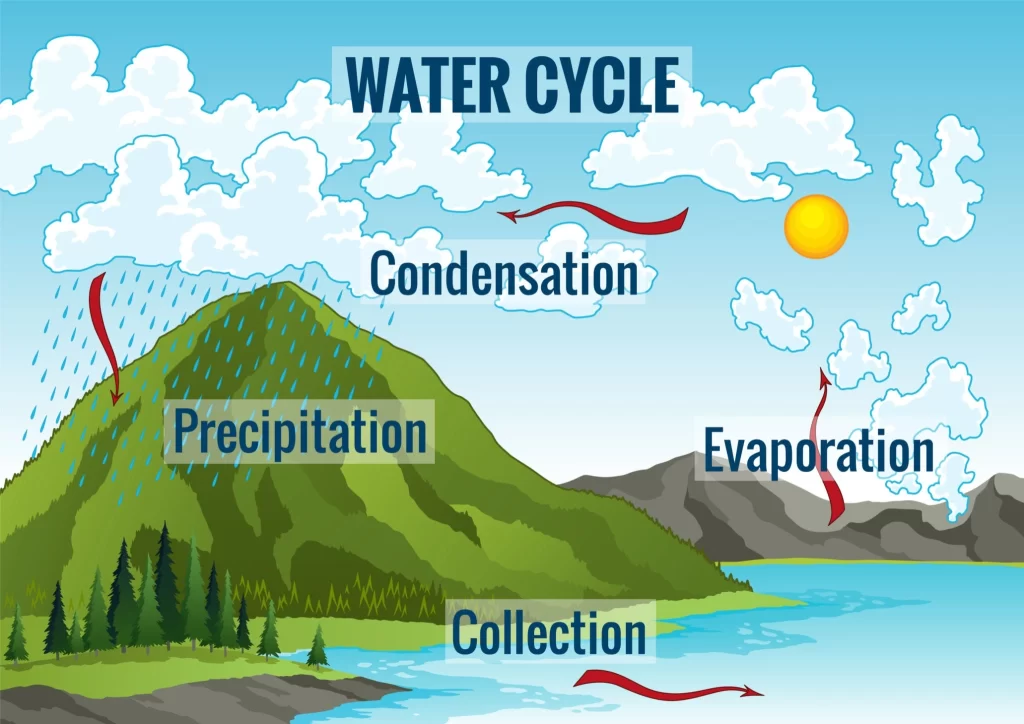
⭐ 5. Water Cycle
Water cycle is the continuous movement of water between land, oceans, and atmosphere.
Steps:
- Evaporation
Water turns into water vapor by heat. - Condensation
Water vapor cools → forms tiny droplets → clouds. - Precipitation
Clouds become heavy → rain, snow, hail fall. - Collection
Water goes back to rivers, lakes, oceans.
This cycle maintains the balance of water on Earth.
⭐ 6. Groundwater
Water moves into the soil and collects between layers of rocks. This is groundwater.
Sources:
- Hand pumps
- Wells
- Tube wells
⭐ 7. Infiltration & Aquifer
- Infiltration: Water seeping into the soil.
- Aquifer: Underground layer that stores groundwater.
⭐ 8. Conservation of Water
Ways to save water:
- Close taps properly
- Use bucket instead of shower
- Fix leakage
- Rainwater harvesting
⭐ 9. Water Scarcity
Occurs due to:
- Less rainfall
- Overuse of groundwater
- Pollution of water bodies
📘 IMPORTANT QUESTIONS & ANSWERS – Class 6 Science Chapter 14
✅ 1 Mark Questions
1. What is evaporation?
The process of converting water into water vapor using heat.
2. What is condensation?
The process of turning water vapor into tiny water droplets.
3. Name the three states of water.
Solid, liquid, gas.
4. What is precipitation?
Rain, snow, or hail falling from clouds.
5. What is groundwater?
Water stored under the earth’s surface.
✅ 2 Mark Questions
6. What are the main sources of water?
Rain, rivers, lakes, oceans, ponds, wells, groundwater.
7. Define infiltration and aquifer.
- Infiltration: Water soaking into the ground.
- Aquifer: Underground layer storing water.
8. Why is water essential?
It is needed for drinking, farming, cleaning, and all life processes.
✅ 3 Mark Questions
9. Explain the water cycle.
The water cycle includes:
- Evaporation → water turns into vapor
- Condensation → vapor forms clouds
- Precipitation → rain falls
This repeats continuously.
10. Write three ways to conserve water.
- Fix leaking taps
- Use bucket instead of shower
- Harvest rainwater
- Reuse water for plants
11. Why does water scarcity occur? Give two reasons.
- Excessive use of groundwater
- Low rainfall
- Pollution of water bodies
✅ 5 Mark Questions
12. Describe the processes of evaporation, condensation, and precipitation with examples.
- Evaporation: Water changes into vapor due to heat (drying clothes).
- Condensation: Vapor cools to form droplets (water on cold bottle).
- Precipitation: Clouds release water as rain or snow.
These processes together form the water cycle.
13. Explain groundwater, its importance, and how it can be conserved.
- Groundwater is the water stored under soil and rocks.
- Important for wells, hand pumps, drinking water, irrigation.
- Conserved through rainwater harvesting and reducing overuse.
⭐ HOTS Questions
14. Why do coastal areas receive heavy rainfall?
Because warm ocean water evaporates and forms moisture-rich clouds.
15. Why does water stored in earthen pots stay cool?
Because water evaporates through tiny pores, removing heat.
16. Why should we not waste water even if it seems abundant?
Because only 1% of Earth’s water is freshwater used for drinking.
# Class 6 Science Chapter 14