
🎯 Recommended Products for Students & Parents
Handpicked products specially selected for our visitors.
School Backpack Combo
✔ 29 L Spacious Backpack
✔ Includes Tiffin & Pouch
✔ Perfect for School & Coaching

Niacinamide Bright & Clear Skin Combo
✔ Brightens Skin
✔ Reduces Acne Marks
✔ Suitable for Daily Skincare
Disclosure: Some links on this page are affiliate links. We may earn a small commission if you purchase through them, at no additional cost to you.
Easy and complete notes for NCERT Class 6 Science Chapter 13 – Fun With Magnets. Learn about magnetic and non-magnetic materials, poles of magnets, compass, making magnets, and daily life uses. Includes solved important questions and answers for Class 6 exam preparation
Table of Contents
🧲 Class 6 Science Chapter 13 – NOTES
Fun With Magnets
⭐ 1. Discovery of Magnets
- Magnets were first discovered in Magnesia (ancient Greece).
- A naturally occurring magnet is called lodestone.
⭐ 2. What is a Magnet?
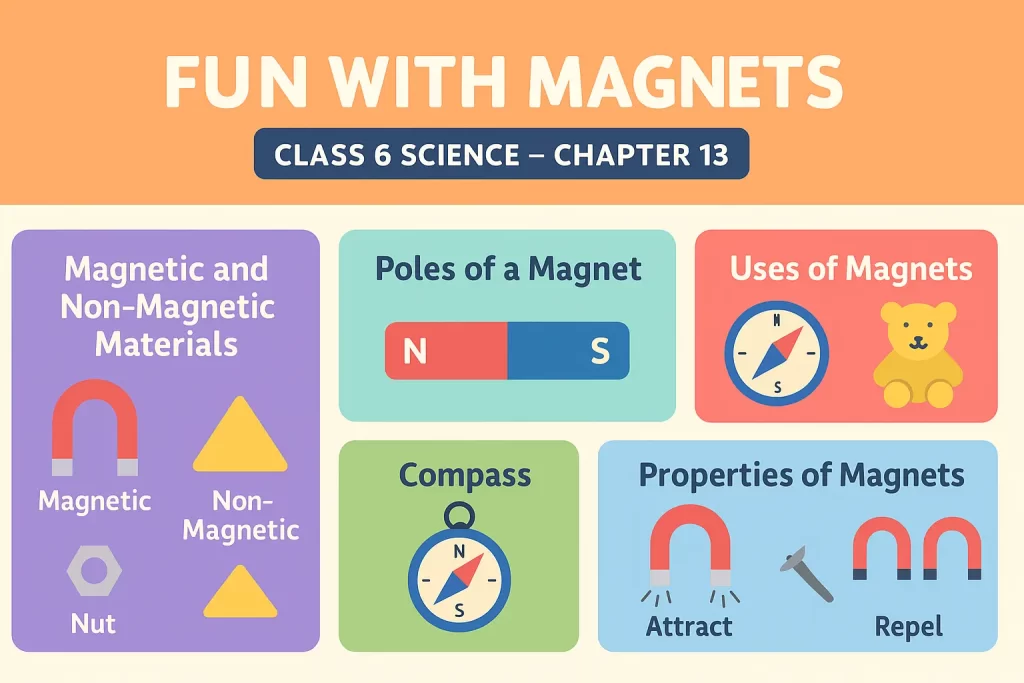
A magnet is a material that attracts iron, nickel, cobalt.
⭐ 3. Magnetic and Non-Magnetic Materials
Magnetic Materials
Attract magnets.
Examples: iron, steel, nickel, cobalt.
Non-Magnetic Materials
Do NOT attract magnets.
Examples: wood, glass, plastic, rubber, aluminium.
⭐ 4. Poles of a Magnet
Every magnet has two poles:
- North Pole (N)
- South Pole (S)
Key facts:
- Poles are strongest points.
- Like poles repel (N–N, S–S).
- Unlike poles attract (N–S).
⭐ 5. Making Magnets
Magnets can be made by:
- Stroking method (rubbing with magnet)
- Electricity (electromagnet)
⭐ 6. Magnetic Compass
- A device used to find direction.
- Has a magnetic needle that always points North–South.
⭐ 7. Earth as a Magnet
The Earth behaves like a big magnet with:
- North Pole
- South Pole
Thus, a compass always shows directions.
⭐ 8. Uses of Magnets
- Compass
- Refrigerator door
- Toys
- Speakers
- Magnetic strips (ATM cards)
⭐ 9. Safety with Magnets
- Do not drop magnets (they can lose strength).
- Do not heat magnets.
- Keep magnets away from electronic devices & credit cards.
⭐ 10. Properties of Magnets
- Attract magnetic materials
- Have poles
- Poles always exist in pairs
- Like poles repel
- Unlike poles attract
📘 IMPORTANT QUESTIONS & ANSWERS – CHAPTER 13
✅ 1 Mark Questions
1. What is lodestone?
A natural magnet.
2. Name two magnetic materials.
Iron, nickel.
3. Which pole of a magnet points towards the North?
North pole.
4. Do magnets attract plastic?
No.
5. What happens when like poles are brought close?
They repel.
✅ 2 Mark Questions
6. Write two uses of magnets.
- Used in a compass
- Used on refrigerator doors
7. What is a magnetic compass?
A device used to find directions using a magnetic needle.
8. What are magnetic materials? Name two.
Materials attracted by a magnet.
Examples: iron, steel.
✅ 3 Mark Questions
9. Explain the stroking method to make a magnet.
- Take an iron bar.
- Rub it with one pole of a magnet in one direction several times.
- The bar becomes a magnet.
10. Write three properties of a magnet.
- They have two poles.
- Like poles repel; unlike poles attract.
- They attract iron, cobalt, nickel.
11. Why does a compass needle always point North–South?
Because Earth behaves like a big magnet with its own North and South poles.
✅ 5 Mark Questions
12. Describe the uses of magnets in daily life.
- To find direction using a compass
- Refrigerator doors use magnets
- In speakers/headphones
- In toys
- ATM and credit cards have magnetic strips
Explain how magnets make devices work.
13. Explain magnetic and non-magnetic materials with examples.
Magnetic: Iron, nickel, cobalt → attracted by magnets
Non-Magnetic: Wood, plastic, rubber → not attracted
Include how magnets only attract certain metals.
⭐ HOTS Questions
14. Why should magnets be kept away from mobiles or ATM cards?
Because strong magnets can erase magnetic data.
15. Why do bar magnets always have both poles even when broken?
Because each piece becomes a smaller magnet with its own N & S poles.
# Class 6 Science Chapter 13