
🎯 Recommended Products for Students & Parents
Handpicked products specially selected for our visitors.

School Backpack Combo
✔ 29 L Spacious Backpack
✔ Includes Tiffin & Pouch
✔ Perfect for School & Coaching

Niacinamide Bright & Clear Skin Combo
✔ Brightens Skin
✔ Reduces Acne Marks
✔ Suitable for Daily Skincare
Disclosure: Some links on this page are affiliate links. We may earn a small commission if you purchase through them, at no additional cost to you.
Easy and complete notes for NCERT Class 6 Science Chapter 11 – Light, Shadows and Reflections. Learn about light, luminous and non-luminous objects, transparent–translucent–opaque materials, shadows, pinhole camera, and reflection. Includes solved important questions and answers for exam preparation.
Table of Contents
🌟 Class 6 Science Chapter 11
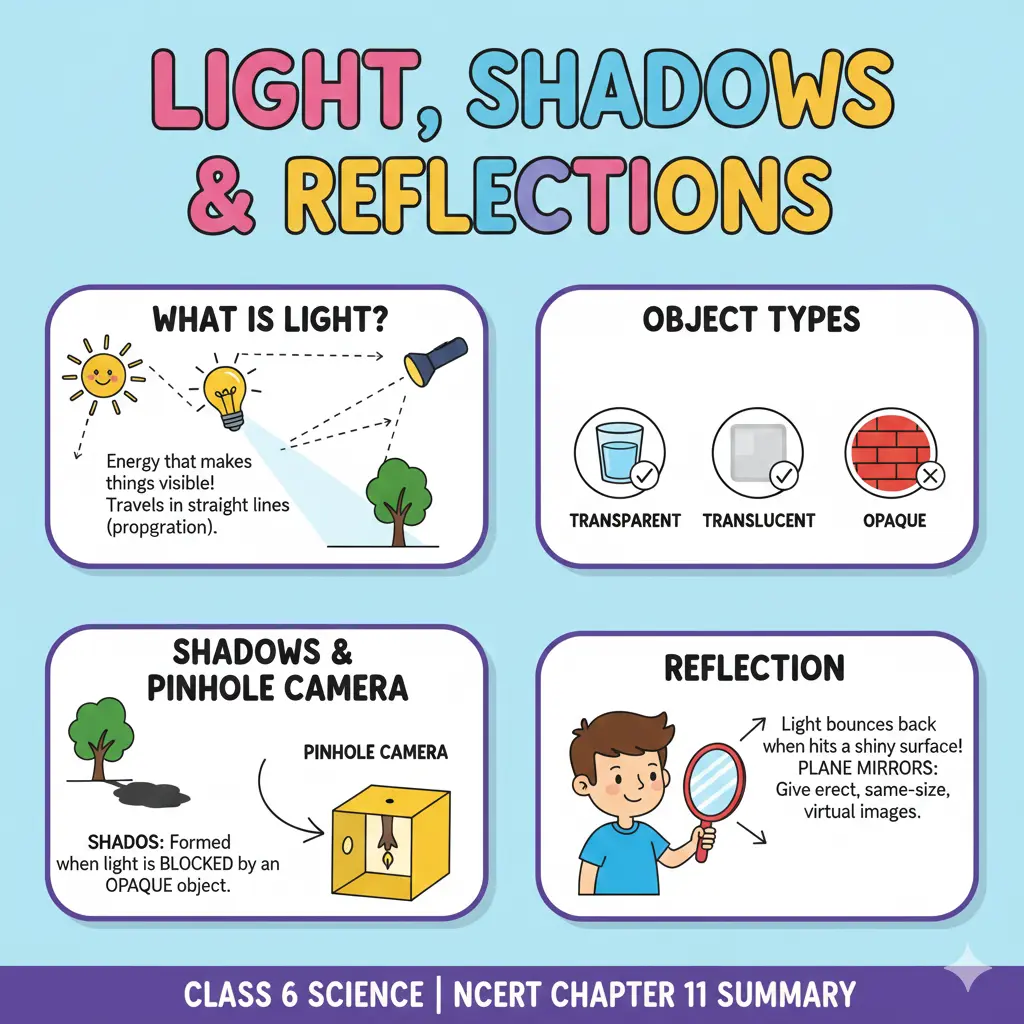
Class 6 Science Chapter 11 : Light, Shadows and Reflections
⭐ 1. What is Light?
- Light is a form of energy that helps us see objects.
- Light travels in a straight line (rectilinear propagation of light).
- We see objects when light from an object enters our eyes.
⭐ 2. Luminous & Non-Luminous Objects
A. Luminous Objects
Objects that produce their own light.
Examples: Sun, candle, torch, firefly.
B. Non-Luminous Objects
Objects that do not produce light.
They are visible only when light falls on them.
Examples: Moon, chair, book.
⭐ 3. Transparent, Translucent & Opaque Materials
| Type | Meaning | Example |
|---|---|---|
| Transparent | Allow light to pass fully | Glass, clean water |
| Translucent | Allow partial light | Oiled paper, frosted glass |
| Opaque | Do NOT allow light | Wood, metal |
⭐ 4. What is a Shadow?
A dark region formed when an opaque object blocks light.
Conditions required:
- Light source
- Opaque object
- Surface (screen)
Properties of Shadow:
- Always black
- Size changes based on distance
- Only formed by opaque objects
⭐ 5. Pinhole Camera
A simple device to show that light travels in a straight line.
Features:
- Image formed is inverted
- Image is real
- Works best on a sunny day
⭐ 6. Reflection
When light bounces back from a surface.
Types:
- Regular reflection (smooth mirror)
- Diffused reflection (rough surface)
Mirror image properties:
- Lateral inversion (left ↔ right reversed)
- Same size
- Same distance from mirror
⭐ 7. Difference: Shadow vs Image
| Shadow | Image |
|---|---|
| Always black | Same colour |
| No details | Shows details |
| Formed on surface | Appears in mirror |
| Needs opaque object | Needs reflecting surface |
⭐ 8. Sources of Light
- Natural: Sun, fire
- Artificial: Bulb, lamp, torch
📘 IMPORTANT QUESTIONS & ANSWERS – CHAPTER 11
✅ 1 Mark Questions
1. What is light?
Light is a form of energy that enables us to see things.
2. Name two luminous objects.
Sun, candle.
3. What type of materials form shadows?
Opaque materials.
4. What is lateral inversion?
Left–right reversal in a mirror image.
5. Does a translucent object form a shadow?
Yes, but faint.
✅ 2 Mark Questions
6. Define transparent and opaque materials with examples.
- Transparent: allow light → glass
- Opaque: block light → wood
7. Why are shadows always black?
Because no light reaches the shadow region.
8. Mention two characteristics of a shadow.
- Always black
- Size changes with distance
✅ 3 Mark Questions
9. What are the conditions needed for a shadow to form?
- Light source
- Opaque object
- Screen
10. Explain reflection with an example.
Reflection is bouncing off of light from a surface.
Example: Image in a mirror.
11. What is the difference between an image and a shadow?
Image shows colour + details; shadow is black with no details.
✅ 5 Mark Questions
12. Describe the working of a pinhole camera.
- Light enters through a small hole.
- Image formed is inverted and real.
- Works because light travels in straight line.
- Used to observe the Sun safely (indirectly).
13. Explain transparent, translucent, and opaque objects with 2 examples each.
- Transparent: glass, water
- Translucent: tracing paper, frosted glass
- Opaque: wood, metal
Explain how each type affects light passing through them.
⭐ HOTS Questions
14. Why is the shadow of a tree bigger in the evening than at noon?
Because the Sun is low in the sky → longer shadow.
15. Why do we not see our reflection on a wall?
Because walls have rough surfaces → diffused reflection.
# Class 6 Science Chapter 11