
🎯 Recommended Products for Students & Parents
Handpicked products specially selected for our visitors.
School Backpack Combo
✔ 29 L Spacious Backpack
✔ Includes Tiffin & Pouch
✔ Perfect for School & Coaching

Niacinamide Bright & Clear Skin Combo
✔ Brightens Skin
✔ Reduces Acne Marks
✔ Suitable for Daily Skincare
Disclosure: Some links on this page are affiliate links. We may earn a small commission if you purchase through them, at no additional cost to you.
Class 6 Science Chapter 3 : Get the complete set of important questions and answers for NCERT Class 6 Science Chapter 3 – Fibre to Fabric. Includes short answers, long answers, HOTS questions, key concepts, and exam-focused notes. Perfect for students, teachers, and CBSE exam preparation.
Table of Contents
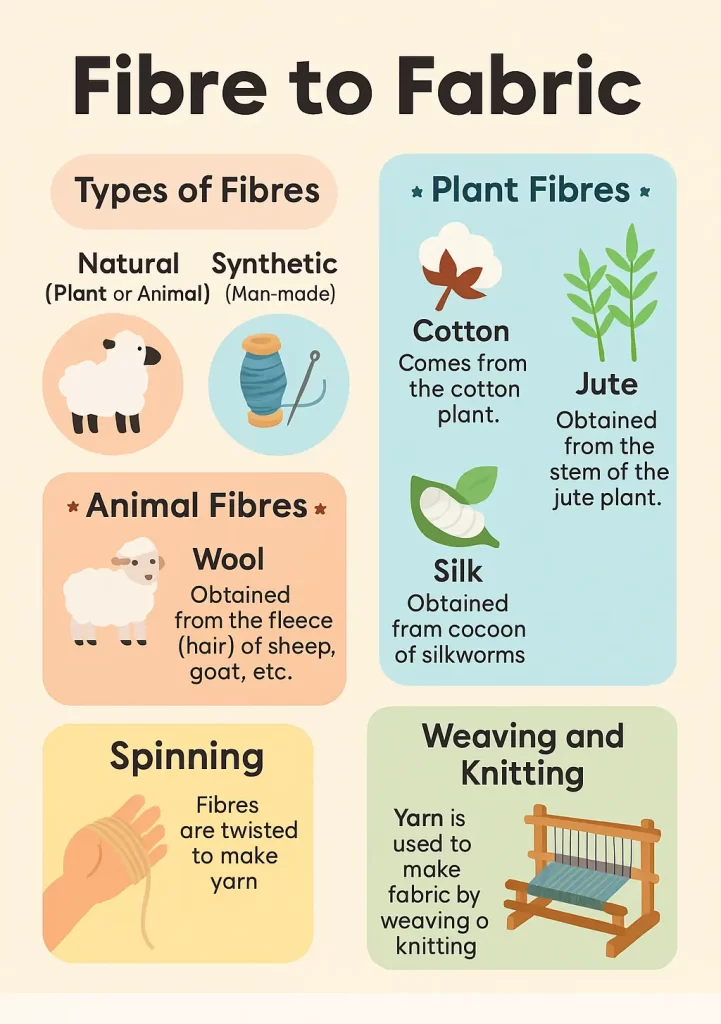
Class 6 Science Chapter 3
⭐ 1. What are Fibres?
- Fibres are thin, thread-like strands used to make fabrics.
- Fabrics → made from yarn, and yarn → made from fibres.
Types of Fibres:
- Natural Fibres (from plants & animals)
- Plant fibres: Cotton, Jute
- Animal fibres: Wool, Silk
- Synthetic Fibres (man-made)
- Examples: Nylon, Polyester, Acrylic, Rayon
⭐ 2. Plant Fibres
A. Cotton
- Comes from the cotton plant growing in black soil & warm climate.
- Cotton fruits are called bolls.
- After bursting, white cotton fibres come out.
- Ginning: Process of removing seeds from cotton fibres.
B. Jute
- Obtained from the stem of the jute plant.
- Plant is cut and soaked in water (retting).
- Fibres are separated by hand.
⭐ 3. Animal Fibres
A. Wool
- Obtained from fleece (hairy skin) of sheep, goats, camels, yak etc.
Processing of Wool:
- Shearing – Removing fleece
- Scouring – Washing fleece
- Sorting – Separating types of wool
- Carding – Combing into a sheet
- Spinning – Making wool yarn
- Knitting/Weaving – Making fabrics
B. Silk
- Obtained from silkworms.
- Silkworms spin a cocoon made of silk fibres.
- Silk fibre is unwound from cocoon → reeling.
⭐ 4. From Fibre to Fabric
Important Processes:
1. Spinning
- Fibres → twisted to form yarn.
2. Weaving
- Two sets of yarn arranged at right angles.
- Done using looms.
3. Knitting
- Fabric is made by interlocking a single yarn.
- Sweaters, caps, socks are made by knitting.
⭐ 5. Difference Between Weaving & Knitting
| Weaving | Knitting |
|---|---|
| Two yarns needed | Single yarn needed |
| Done on looms | Done using needles/machines |
| Fabrics are less stretchable | Fabrics are stretchable |
⭐ 6. Properties of Different Fibres
Cotton
- Soft, absorbs water, good for summer.
Wool
- Warm, traps air, good for winter.
Silk
- Shiny, smooth, expensive.
Synthetic Fibres
- Strong, durable, wrinkle-free but not environmentally friendly.
⭐ 7. Why Natural Fibres Are Skin-Friendly?
- Allow air to pass (breathable).
- Absorb sweat.
- Cause less skin irritation.
⭐ 8. Uses of Different Fibres
- Cotton → shirts, bed sheets, towels
- Wool → sweaters, blankets
- Silk → sarees, ties
- Jute → bags, ropes
- Synthetic fibres → raincoats, sportswear, ropes
📚 Quick Summary (for last-minute revision)
- Fibres → Yarn → Fabric
- Two main types of fibres: Natural & Synthetic
- Cotton from bolls; jute from stem
- Wool & silk are animal fibres
- Important processes: Spinning, Weaving, Knitting
- Wool processing involves shearing → scouring → sorting → carding → spinning
- Synthetic fibres are strong but non-biodegradable
✅ A. Very Short Answer Questions (1 Mark)
Class 6 Science Chapter 3
1. What are fibres?
Fibres are thin, thread-like strands used to make fabrics.
2. Name two natural fibres.
Cotton and wool.
3. Name two synthetic fibres.
Nylon and polyester.
4. What is ginning?
Ginning is the process of separating cotton fibres from seeds.
5. Which part of the sheep’s body gives wool?
The hairy skin (fleece).
✅ B. Short Answer Questions (2 Marks)
Class 6 Science Chapter 3
6. What are natural fibres? Give examples.
Natural fibres come from plants and animals.
Examples: cotton, jute, silk, wool.
7. What is shearing?
Shearing is the process of removing the wool coat (fleece) from a sheep’s body.
8. Name two fibres obtained from plants.
Cotton and jute.
9. How is jute obtained?
Jute fibres are obtained from the stem of the jute plant. The plant is soaked in water to loosen fibres, which are then separated.
10. What is spinning?
Spinning is the process of twisting fibres to make yarn.
✅ C. Short Answer Questions (3 Marks)
Class 6 Science Chapter 3
11. Describe the process of making fabric from fibres.
The main steps are:
- Spinning: Fibres → Yarn
- Weaving/Knitting: Yarn → Fabric
Weaving uses looms, and knitting uses needles or machines.
12. What is the difference between weaving and knitting?
| Weaving | Knitting |
|---|---|
| Two sets of yarn are interlaced | Single yarn looped continuously |
| Done on looms | Done by needles |
13. How is wool processed into fabric?
Steps:
- Shearing
- Scouring (washing the fleece)
- Sorting
- Carding
- Spinning to make wool yarn
- Knitting/weaving into woolen fabric
14. Why do shepherds rear sheep?
Shepherds rear sheep for:
- Wool
- Milk
- Meat
Wool is the main purpose.
✅ D. Long Answer Questions (5 Marks)
15. Write the steps involved in processing cotton fibre.
- Picking: Cotton bolls are picked from the plants.
- Ginning: Seeds are removed from cotton fibres.
- Spinning: Cotton fibres are spun into yarn.
- Weaving/Knitting: Yarn is made into fabric.
16. Explain how synthetic fibres differ from natural fibres.
Synthetic fibres:
- Made by humans using chemicals
- Strong, durable, wrinkle-free
- Examples: nylon, rayon, polyester
Natural fibres:
- Come from plants or animals
- Comfortable but may wrinkle
- Examples: cotton, jute, wool
✅ E. HOTS (Higher Order Thinking Skills)
17. Why do we wear cotton clothes in summer?
Cotton absorbs sweat and allows air to pass through, keeping the body cool.
18. Why is wool warm?
Wool traps air in its fibres. Air is a poor conductor of heat, so wool keeps us warm.
19. Why is silk considered a costly fibre?
Because obtaining silk involves rearing silkworms and carefully unwinding long fibres from the cocoon, which is time-consuming and expensive.
20. How can we reduce the usage of synthetic fibres?
- Use eco-friendly natural fibres
- Recycle existing synthetic materials
- Promote awareness about pollution caused by plastics